





 English
  Francês
  Alemão
  Italiano
  Japonês
  Norueguês
  Portuguese
  Spanish
  5 min of reading
  5 comments


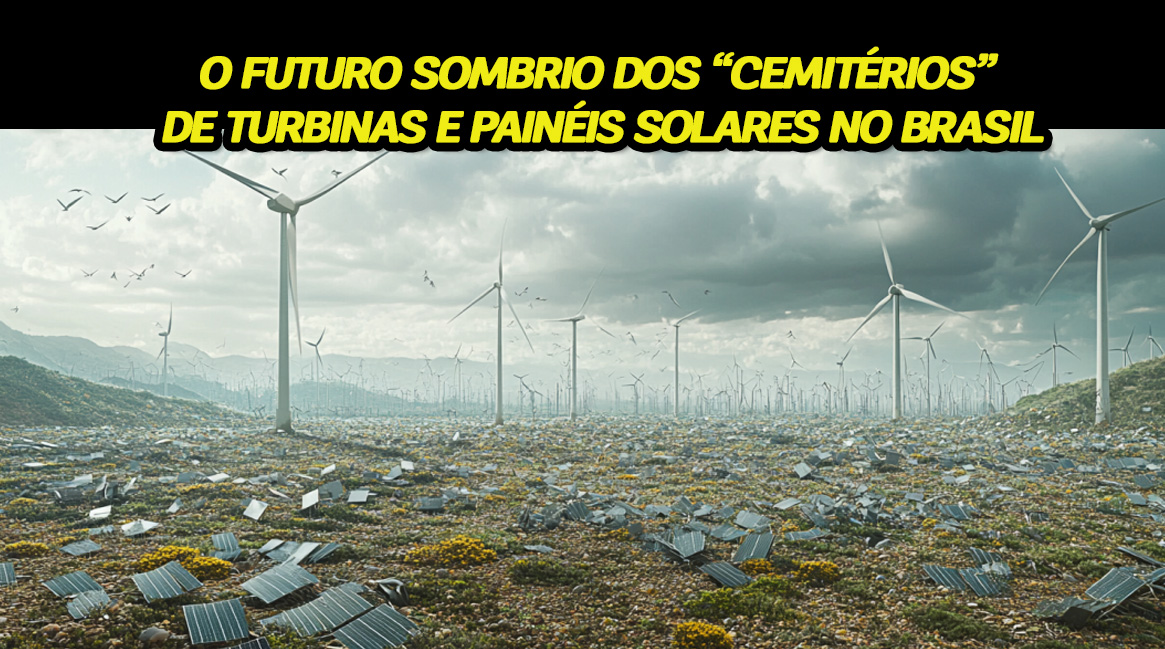

Amidst The Growing Popularity Of Renewable Energy In Brazil, A New And Concerning Environmental Threat Is Quietly Emerging.
The promise of a more sustainable future, powered by wind and solar parks, may be hiding a much bigger problem: the massive accumulation of waste from these technologies, which is already showing signs of an impending ecological disaster.
As reported this Sunday by the newspaper O Globo, the rapid expansion of wind and solar plants in Brazil is accompanied by a gigantic challenge: the final disposal of equipment when it reaches the end of its useful life.
Experts warn that, without an adequate legislation, the country may face a concerning scenario of accumulated waste, with the potential to generate serious environmental impacts.
-
Unemployment rises again to 5.8% at the beginning of 2026, raising alarms about the end of temporary positions and its impact on the Brazilian job market.
-
Document organization can cut invisible costs in small businesses, a simple step that prevents waste, rework, and losses in daily operations.

-
Renewable energy advances over protected areas in Brazil, and a survey by the Energy Transition Observatory reveals silent impacts that challenge environmental conservation and pressure sensitive traditional territories.

-
Rio Grande do Sul accelerates energy transition: State invests in renewable technologies and consolidates decarbonization strategies and pathways to attract billions in new industrial investments.


The Lack Of Adequate Regulation
Brazil is at risk of becoming a dump for technological waste if measures are not taken immediately. In the municipality of Aquiraz, Ceará, it is already possible to observe the result of the lack of effective policies for the disposal of equipment.
According to O Globo, wind turbine blades have been irregularly abandoned along the Washington Soares Highway, highlighting the unpreparedness and absence of specific regulation for the sector.
The wind turbines, which began to be installed in Brazil in the 1990s, have a lifespan of approximately 20 years. This means that, in a few years, a large part of the installed structures will need to be replaced or decommissioned.
With over 1,800 blades in operation since 2010, the country is approaching a significant environmental challenge. And the problem is not limited to wind turbines.
The Challenge Of Solar Panels
Solar panels, with an average lifespan of 25 years, also pose a significant environmental risk. According to the International Renewable Energy Agency (Irena), by 2030, Brazil may generate between 2,500 and 8,500 tons of waste from discarded equipment. Without an effective recycling policy, this number could grow exponentially, reaching 750,000 tons by 2050.
Despite a 2020 decree including solar panels in the National Solid Waste Policy, current legislation still leaves much to be desired.
Experts consulted by O Globo emphasize that the country lacks detailed norms that address the circularity of materials, something that is already a reality in European countries. Without these guidelines, Brazil may face an unprecedented problem in terms of technological waste.
The Responsibility For Disposal
One of the major questions raised by experts is who should be responsible for the proper disposal of solar panels and wind turbines.
Rodrigo Sauaia, president of the Brazilian Association of Photovoltaic Solar Energy (Absolar), emphasizes that the responsibility cannot fall on the end consumer, as the installation and dismantling of these equipment require technical expertise.
He suggests that reverse logistics should be conducted by qualified companies, in partnership with the government, to ensure an appropriate destination for this waste.
However, the national solar panel industry is almost nonexistent, with over 90% of the equipment installed in Brazil being imported from China. This raises doubts about the feasibility of efficient recycling, as the responsibility for recycling is unlikely to be assumed by foreign suppliers.
The Future Of Wind Waste
In the case of wind turbines, the scenario is equally concerning. Francisco Silva, regulatory technical director of the Brazilian Wind Energy Association (Abeeólica), advocates for the creation of specific regulations for the recycling of this equipment.
According to him, while the wind sector in Brazil is still relatively new, it is essential that measures be adopted now to avoid future problems.
Wind blades, in particular, represent a significant challenge. They are made of complex materials, such as fiberglass and epoxy resin, which make the recycling process difficult.
Currently, companies tend to store these decommissioned equipment, but this practice will not be sustainable as the number of plants increases.
The Cost And Negligence In Disposal
The lack of regulation not only jeopardizes the environment but also generates high costs for companies operating in the sector.
In Xanxerê, Santa Catarina, Edson Zatta, owner of DVolta Reverse Logistics, reports that many companies neglect the recycling of solar panels. The disposal cost is approximately R$ 1.40 per kilogram, and each panel weighs between 24 and 27 kilos.
This leads some companies to opt for cheaper and less appropriate solutions, such as selling damaged panels to garbage collectors.
For experts like Thais Moreno, from the Machado Meyer law firm, a solution would be to condition the licensing of plants to well-defined recycling plans. However, most Brazilian states still do not require these strategies, contributing to the formation of “graveyards” of equipment.
The European Experience And The Challenges In Brazil
Europe, which began investing in renewable energy long before Brazil, is already facing the challenge of dealing with the waste from these technologies.
As pointed out by O Globo, the European Union has set ambitious targets for 2030, including the requirement that 25% of strategic raw materials, such as solar panels and wind turbines, be recycled.
However, Brazil is still far behind in this race. With one of the first solar plants installed in 1998 at the Federal University of Santa Catarina (UFSC), the country should be further along in regulating the disposal and recycling of this equipment.
Ricardo Rüther, coordinator of the Photovoltaic Solar Energy Laboratory at UFSC, emphasizes that recycling photovoltaic cells, which convert solar energy into electricity, is an expensive and complex process but essential to ensure the sustainability of the sector.
If nothing is done, Brazil risks becoming a large cemetery of technological waste. The lack of a national policy to deal with the decommissioning of this equipment could turn the promise of clean energy into an environmental nightmare.
The Question That Remains Is: Is Brazil Prepared To Deal With The Consequences Of This Uncontrolled Growth?








Acredito que isso seja material 100% reciclável e pode ser aplicado a lei de política reversa nestes contratos. Só meio minuto de boa vontade dos gestores municipais resolveria isso. Problema é eles terem esse meio minuto pra coisas sérias.
Não entendo as pessoas no começo da crise energética, todos preocupados com impacto ambiental vamos investir em novas fontes de energia renovável e q não afete o meio ambiente aí veio as fontes de energia eólica e placas solares agora começa a discussão do lixo que isso vai gerar daqui a uns anos , então é melhor ficar em energia nenhuma e ficar no escuro , também não funciona hospital , não tem mais empresas para fazer eletrodomésticos q tanto esse povo gosta de facilidades no dia a dia a vamos processar tudo na base do pilão manual o ruim véi se para cozinhar porq teremos que preservar as matas teremos que comer carne crua e só folhas legal voltaremos a idade da pedra. Ppm mais modernos já com casas não morreremos em cavernas , mas se for assim vou comprar umas terras próximo a uma nascente porq produzirei meus alimentos agora eße que fez essa pesquisa e matéria vai te coragem de trabalhar na lavoura?
fintech confiny, é uma evolução, isso facil responder, brasil e cheio de idéia, para evoluir, quando se trata, de impacto ambiental, ai começa os problemas, morte súbita, justamente isso estamos estudando desde 2016, de como dar origem, sucatas, que normalmente, fará brasil sujo de lixos nao reciclável, ai vem pior mais já estamos quase lá, bem vindo novo semitério do mundo. Startup fintech confiny está há passo, dar salto para sua evolução,