





 Portuguese
  English
  Spanish
  3 min of reading
  0 comments


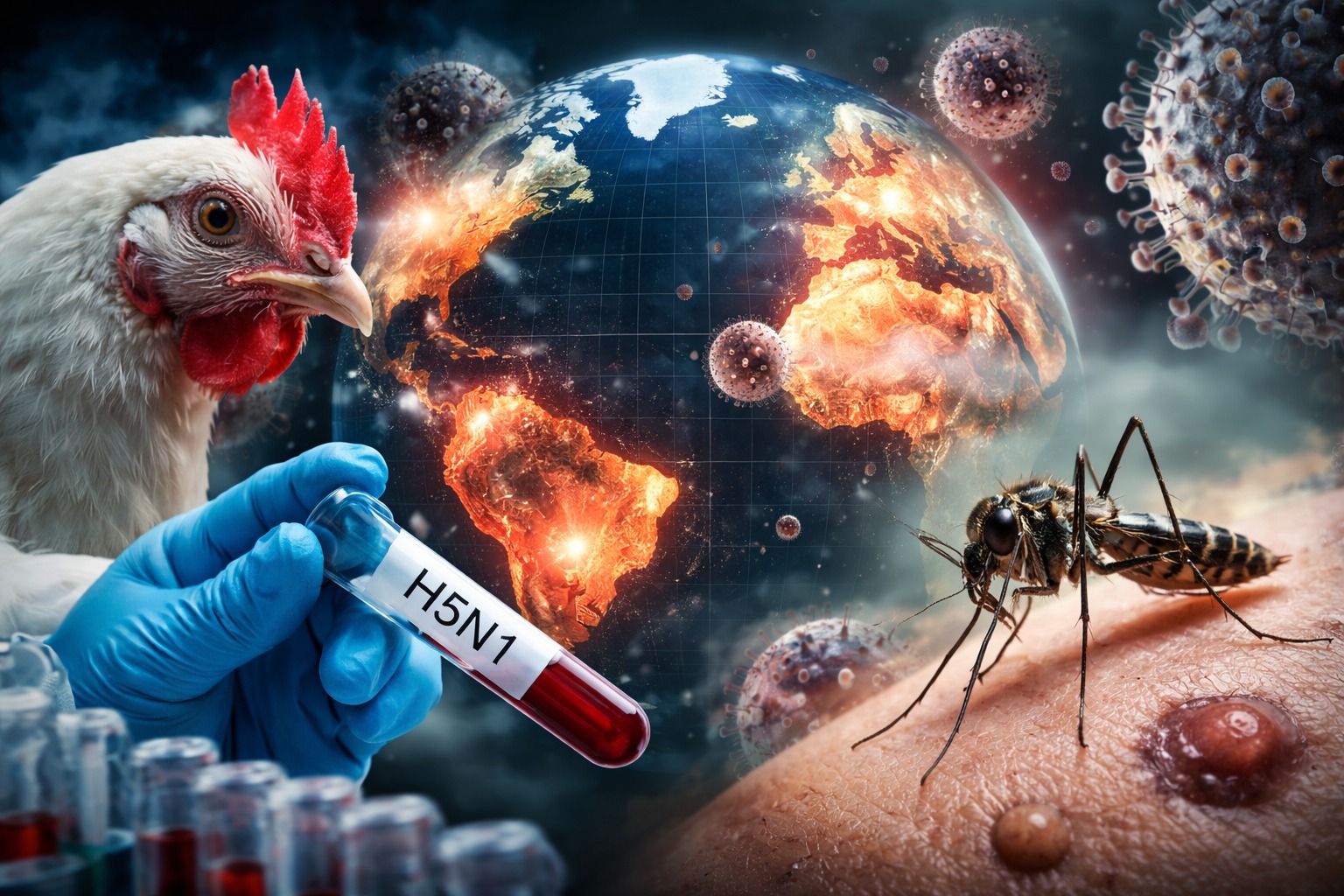
Global Sanitary Scenario in 2026 Maintains Surveillance Over Avian Flu H5N1, Mpox and Oropouche Virus After Geographical Expansion, 71 Human Cases in the USA, 90% of Records in the Americas Concentrated in Brazil and More Than 445 Thousand Cases of Chikungunya
The global sanitary scenario in 2026 keeps experts on alert regarding the global health context, marked by the expansion of avian flu H5N1, mpox and the Oropouche virus, with 71 human cases in the United States, 90% of records in the Americas concentrated in Brazil, and more than 445 thousand cases of chikungunya in 2025.
Factors such as global warming, population growth, deforestation, and increased international mobility create favorable conditions for viral mutations and accelerated dissemination.
In an article published in the scientific journal The Conversation, infectious disease specialist Patrick Jackson from the University of Virginia highlighted three agents under priority monitoring in 2026.
-
Motorola launched the Signature with a gold seal from DxOMark, tying with the iPhone 17 Pro in camera performance, Snapdragon 8 Gen 5 that surpassed 3 million in benchmarks, and a zoom that impresses even at night.

-
Satellites reveal beneath the Sahara a giant river buried for thousands of kilometers: study shows that the largest hot desert on the planet was once traversed by a river system comparable to the largest on Earth.

-
Scientists have captured something never seen in space: newly born stars are creating gigantic rings of light a thousand times larger than the distance between the Earth and the Sun, and this changes everything we knew about stellar birth.

-
Geologists find traces of a continent that disappeared 155 million years ago after separating from Australia and reveal that it did not sink, but broke into fragments scattered across Southeast Asia.

Although distinct, avian flu H5N1, mpox, and Oropouche virus have recently expanded their geographical circulation. The global health scenario demands continuous surveillance in light of this expansion.
Oropouche Virus Concentrates 90% of Cases in the Americas in Brazil
The Oropouche virus is transmitted by small mosquitoes and causes symptoms similar to those of the flu, such as fever, headache, and muscle pain.
Identified in the 1950s in Trinidad and Tobago, it remained mainly restricted to the Amazon region for decades.
In recent years, it has expanded to other areas of South America, Central America, and the Caribbean. In 2024, Brazil recorded the first deaths associated with the virus.
As of August 2025, the country concentrated 90% of cases in the Americas, distributed across 20 states.
Cases have also been identified in Europe among infected travelers. There are reports of vertical transmission and investigations into a possible relationship with microcephaly and fetal deaths.
There is no vaccine or specific treatment. In January 2026, the World Health Organization presented a proposal to accelerate prevention tools.
Avian Flu H5N1 Sums 71 Human Cases and Two Deaths Since 2024
Influenza A H5N1 has returned to the center of discussions after detection in dairy cows in the United States in 2024.
Traditionally associated with birds, it has started circulating in bovine herds, raising concerns in the global sanitary scenario.
According to the Centers for Disease Control and Prevention, 71 human cases and two deaths have been recorded since 2024, with no confirmation of sustained transmission among people.
The main worry is the acquisition of efficient contagion among humans, an essential condition for a pandemic.
In Brazil, there was a report in a commercial farm in 2025. Specific vaccines are under development, with pre-clinical studies conducted by the Butantan Institute.
Mpox Maintains Circulation in More Than 100 Countries
Mpox, previously known as monkeypox, has ceased to be restricted to regions of Africa following the global outbreak that began in 2022. The clade IIb variant has spread to more than 100 countries.
A new case has been confirmed in Brazil, in Porto Alegre, the capital of Rio Grande do Sul. Since 2024, there has been growing concern regarding clade I, considered more severe, especially in Central Africa.
Recent cases in the United States without travel history indicate possible local transmission. A vaccine is available, but experts warn that the virus continues to evolve, requiring ongoing surveillance and campaigns targeted at at-risk groups.
Other Diseases Increase Pressure on Health Authorities
In addition to the three monitored agents, chikungunya recorded more than 445 thousand cases in the Americas in 2025, with over 150 deaths. In Brazil, there were more than 129 thousand cases and 121 deaths, according to the Ministry of Health.
The Nipah virus has been back under monitoring after an outbreak in India, although without immediate pandemic risk. Measles has reappeared in several countries due to a drop in vaccination coverage.
Experts emphasize that it is not alarmism but strategic vigilance in the global health scenario.
Investment in vaccination, genetic monitoring, and international cooperation remain the main tools to avoid new health crises.
With information from Francesnews.







-

Uma pessoa reagiu a isso.