





 Portuguese
  English
  Spanish
  6 min of reading
  2 comments


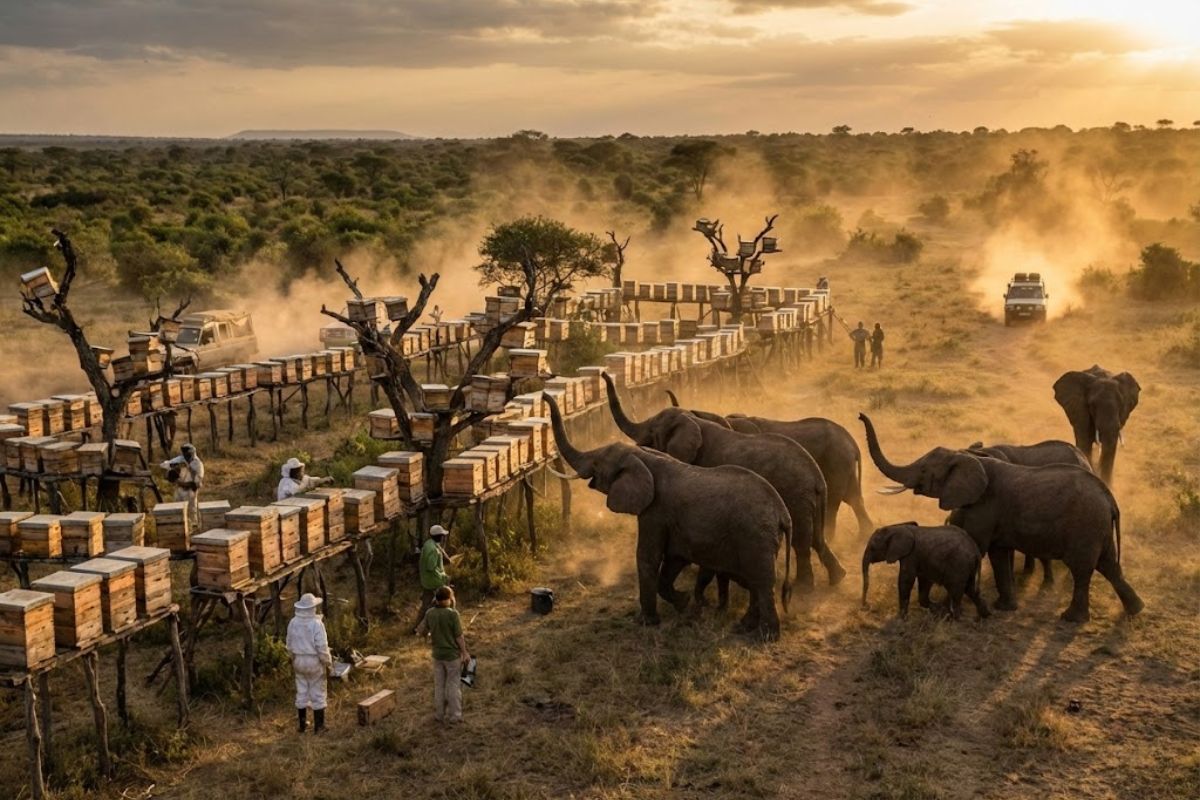


Hundreds Of Hives Installed In Upper Kitete Village In The Ngorongoro Crater Elephant Corridor Form A Fence Connected By Wire That Vibrates, Releasing Aggressive Bees And Guiding Up To One Hundred Animals Away From The Fields, Protecting Farmers, Honey Income And Now Extends 2 Km With Community Support.
Hundreds Of Hives Have Become A Living Fence In Tanzania After Elephants Began To Cross Farmlands As If They Were A Buffet, Pushing Rural Communities To The Brink Of Productive Collapse. The Bet Is Simple And Controversial: Use The Fear Of Bees To Curb Destruction.
In Practice, The Method Has Already Been Associated With A Sharp Decrease In Conflicts, From 63 To Just 5 Incidents Per Month, In An Area Where Geography Makes The Encounter Between People And Elephants Practically Inevitable, Around The Ngorongoro Crater, Within The Serengeti Ecosystem.
Ngorongoro, A Fence-Free Corridor Where The Density Of Life Is Extreme
The Story Takes Place In The Ngorongoro Crater, In Tanzania, Described As One Of The Most Beautiful And Biodiverse Places On Earth.
-
Researchers from Embrapa have discovered how to transform the saline water found in 140,000 wells in the Brazilian Semi-Arid region into a tool for producing food in an area where agriculture has always relied solely on rainfall.

-
China inaugurates a ghost factory that operates in the dark 24 hours a day without any human workers and produces 10 million smartphones a year using 97% of equipment developed by the company itself.

-
Scientists create a semiconductor that mimics the human brain using hydrogen and boost a new generation of smart chips with learning capabilities and the potential to revolutionize artificial intelligence applications.

-
Scientists discover that humanity has exchanged one environmental disaster for another: the same chemicals that saved the ozone layer are now contaminating rivers, aquifers, and human blood with an eternal pollutant that is impossible to remove.


What Was Once A Gigantic Volcano Now Hosts The Densest Mammal Population In Africa And Is Part Of The Serengeti Ecosystem, Recognized As UNESCO World Heritage.
It Is Also One Of The Few Remaining Scenarios Where Elephants Can Still Move Freely, Without Continuous Barriers Of Borders Or Fences.
This Matters Because, In The Serengeti, They Are Considered A Keystone Species, Capable Of Shaping The Landscape In Ways That Allow Other Animals To Thrive.
Why Elephants “Fix” The Savanna And Why That Increases The Impact Of Conflict
The Ecological Role Assigned To These Animals Is Broad And Direct. With Their Enormous Appetite For Bushes And Thickets, Elephants Keep The Savanna Open, Something Described As Vital For Zebras And The Balance Of Plants And Animals.
Furthermore, By Digesting This Food, Their Dung Spreads Thousands Of Seeds Over Vast Areas. During The Dry Season, They Also Use Their Tusks To Dig Water Holes, Opening Access For Many Animals To Drink.
There Is Also A Fascinating Detail Mentioned By Those Who Have Observed The Operation: Their Treading Can Be So Devastating That It Generates Subterranean Sound Waves Capable Of Traveling For Dozens Of Kilometers.
The Idea Is That They Use These Seismic Signals To Communicate, Like “Little Earthquakes” Detected By Sensitive Feet, Suggesting They Are More Delicate Than They Appear.
The Threat Is Not Just Hunting: The Land Has Become The Battleground
Despite All Their Ecological Importance, The African Savanna Elephant Is Described As Endangered, With Numbers In Tanzania Having Dropped By Nearly 90% In 40 Years.
The Historical Picture Presented Is Harsh: By The End Of The 1970s, More Than 300,000 Elephants Lived In The Country; By 2014, The Total Had Plummeted To 40,000.
Since Then, There Has Been Mention Of Partial Recovery, Attributed To Anti-Poaching Policies, But With The Caveat That The Threat Remains “Considerable.”
The Current Focus Of Pressure, However, Appears With A Name And Surname: Human-Elephant Conflict Linked To Land Use.
With The Population Growing And Climate Change Rendering Whole Areas Unusable, Farms Have Encroached Upon Habitat And Migration Routes.
In Ngorongoro, The Very Configuration Of The Territory Makes Everything Worse: The Agricultural Lands Of Upper Kitete Border A Narrow Corridor Where, “At Any Moment,” Up To One Hundred Elephants Could Be Passing, Coming Out Of The Forest At The Crater’s Edge Toward A Salt Lake On The Other Side.
When Farming Becomes A Buffet, The Loss Can Be Existential
The Scale Of The Problem Lies In The Size Of The Animal And The Eating Rate. A Male Can Reach Four Meters In Height, About 13 Feet, Seven Meters In Length, About 23 Feet, And Weigh Up To 10 Tons, Compared To “A Truck.”
And, Because They Are So Large, They Spend Almost The Entire Day Eating.
This Turns Any Crop Into A Target. A Field With Pigeon Peas, For Example, Is Described As Something That Can Be Consumed “In An Instant,” Because To Them It Works Like Candy.
Along The Way, They Can Also Trample Human Structures. For Farmers Like Zacharias, Neighboring The Elephants’ Forest, This Can Lead To Huge Losses, Even Existential.
Why Flashlights And Noise Don’t Work And Might Make It Worse
The Traditional Response Is Usually Improvised: Flashlights And Loud Noises To Scare Them Away. The Problem Is That This Is Described As Dangerous, Because Elephants That Have Been Through Traumatic Experiences With Humans, Including Incidents Related To Ivory Hunting, Can React Aggressively.
And This Escalation Has Already Led To Casualties On Both Sides In The Past.
It Is At This Point That The Strategy Of The Hundreds Of Hives Enters As An Attempt To Reduce Tension Without Direct Confrontation.
The Game-Changing Fact: Elephants Are Afraid Of Bees
The Basis Of The Plan Is A Simple And Surprising Fact: Elephants Are Afraid Of Bees. The Explanation Given Refers Not To Urban Legend, But To Anatomy: Despite Their Thick Skin, There Are Regions That Are Extremely Sensitive, Such As The Mouth, Ears, And The Inside Of The Trunk. A Sting There Hurts A Lot.
Add To That A Second Element: The Honey Bees Of East Africa Are Described As Having Many Predators And, Therefore, Can Become Very Aggressive When Necessary.
The Result Is A Huge Animal Getting Nervous In Front Of A Small But “Powerful” Insect.
How The Hive Fence Made Of Wire, Vibration, And Buzzing Works
The Implementation Is Concrete And Repeatable. At The Edge Of The Agricultural Area, Exactly Where The Elephant Corridor Begins, More Than One Hundred Hives Were Installed, All Connected By Wire.
If An Elephant Tries To Cross, It Brushes Against The Wire, Which Shakes The Boxes And Alerts The Bees. Then They Buzz Around, And The Animal Has Only One Option: Give Up And Back Off.
The Central Point Is That The Hundreds Of Hives Form A Barrier That Does Not Block Everything.
The Solution Is Described As Minimally Intrusive Because It Still Allows Other Species To Pass, While Guiding Elephants Away From Fields And Human Settlements.
The Number That Became An Argument: From 63 To 5 Incidents Per Month
Throughout The Area Where The Idea Has Been Implemented, The Cited Reduction Is Objective: Conflicts Between Humans And Elephants Would Have Dropped From 63 To Just 5 Incidents Per Month.
In A Scenario Where The Proximity Between Farming And The Corridor Is Permanent, This Leap Becomes The Main Practical Evidence That The Fear Of Bees Can, Indeed, Reorganize The Risk Map.
Empty For Now: Why The Hives Don’t “Release” Human-Reared Bees
There Is An Operational Detail That Often Goes Unnoticed. At First, The Hives Remain Empty. The Logic Is Not To Release Colonies Raised By Humans Into The Wild, But To Let The Boxes Be Occupied By Wild Bees.
It Is A Design That Aims To Avoid A Type Of Artificial Intervention While Utilizing An Existing Behavioral Mechanism.
Who Pays For The Expansion And What Is Included In The Package Besides Protection
The Initiative Is Connected To A Mobilization Called Planet Wild, Presented As A Community That Funds Monthly Missions.
Within This Arrangement, The Sponsorship Of Two Kilometers Of New Hive Fence Was Cited To Expand The Protection Line.
There Is Also An Explicit Social Component: The Fence Not Only Keeps Elephants Away And Reduces Agricultural Losses, But Also Helps Create Stable Income From Honey.
The Project Mentions A Local Collective Of Women Who Started To Set Up An Operation For Honey Processing And Distribution, Focusing On Training And Women’s Entrepreneurship. To “Close The Loop” Of This Design, Two Trainings In Beekeeping And Entrepreneurship For The Group Were Also Mentioned.
The Declared Reach: More Than 1,000 Elephants And Dozens Of Farmers
The Funded Expansion And Additional Hives Are Presented As Part Of A Larger Goal: Rapidly Expand Nature-Based Protection For More Than 1,000 Elephants That Regularly Cross The Upper Kitete Wildlife Corridor, While Protecting Farms Of Dozens Of Farmers And, Consequently, Their Livelihoods.
And There Is A Final Invitation That Tries To Transform Audience Into Infrastructure: The Promise To Add “100 Bees” To The Fence Through Comments By The End Of January, Linking Public Engagement To The Increase In The Number Of Hives Beyond What Has Already Been Installed.
Would You Trust Hundreds Of Hives As A Standard Solution To Protect Farms And Elephants In The Savanna, Or Do You Think It Is Risky To Rely On The Fear Of Bees?









Excelente trabalho, conciliação de proteção, natureza, empreendedorismo levando alimentos ao próprio povo e ao mundo.
Maravilhoso! É a ciência a serviço da natureza!