





 Portuguese
  English
  Spanish
  4 min of reading
  0 comments


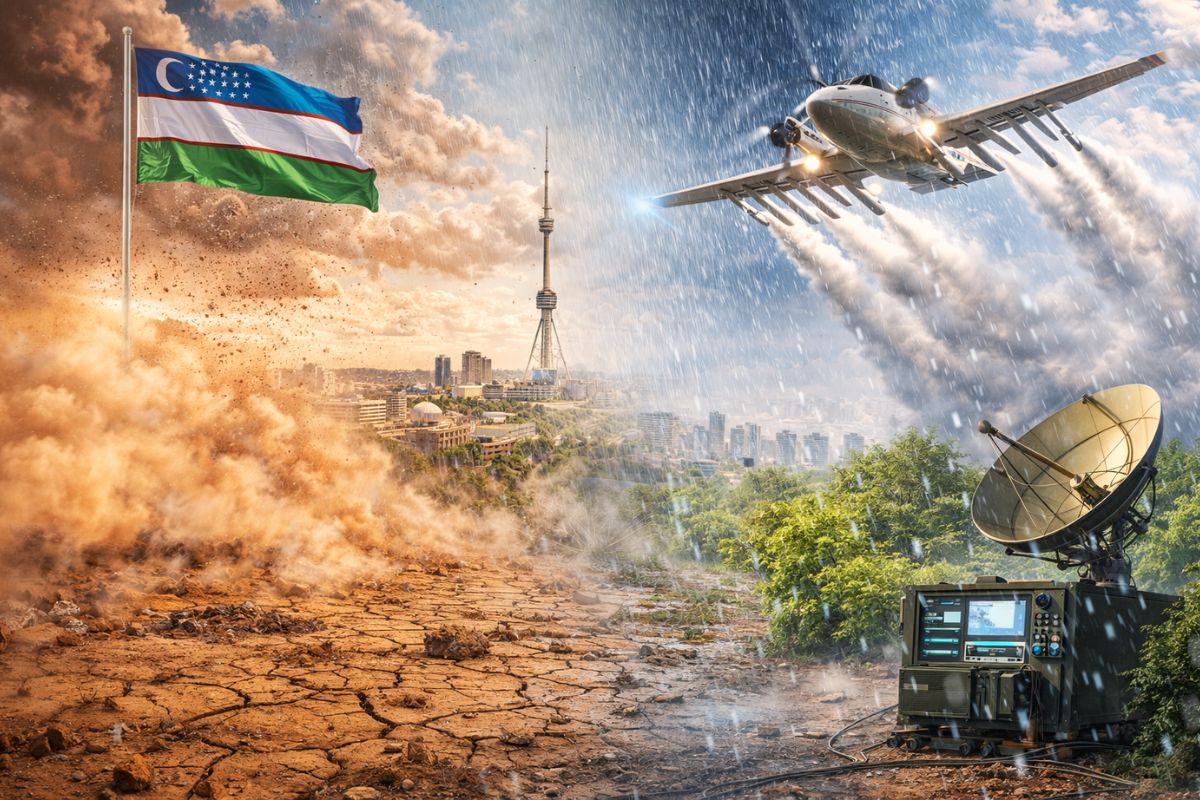
Uzbekistan will implement artificial rain technology in Tashkent with the goal of increasing precipitation by 10 to 20% above natural levels, reducing dust particles and pollutants in the air, and combating drought in regions affected by extreme heat with funding from a state environmental fund.
Uzbekistan has just taken a step that few countries have dared: installing artificial rain devices on a large scale to simultaneously combat drought, extreme heat, and air pollution. According to information from the portal TV Brics, a presidential decree determined that cloud seeding technology will be implemented in Tashkent and the surrounding region, with a deadline of October 1, 2027, for the complete installation of the equipment. The goal is to increase the amount of rain by 10 to 20% above natural levels enough to change the environmental reality of one of the driest regions in Central Asia.
The project is not improvised. Funding will come from the State Fund for Special Objectives, created specifically to address environmental issues in the country. The implementation of artificial rain will be done in stages and will follow the best international practices of cloud seeding, a technology that is already used on different scales by countries such as China, the United Arab Emirates, and the United States. What makes Uzbekistan’s case relevant is the ambition: it is not a one-off experiment, but a structured public policy with deadlines, funding, and defined goals.
What is cloud seeding and how does it generate artificial rain
Cloud seeding is a technique that involves dispersing substances, usually silver iodide, salt, or dry ice, into existing clouds to stimulate the formation of water droplets or ice crystals.
-
Rare phenomenon of silent electric flashes in trees on the east coast of the United States intrigues researchers, confirms century-old suspicion, and raises alarm about invisible environmental impacts.
-
A leak shows that Sony is preparing a more ambitious PlayStation in the PS6, with a handheld running current games natively.

-
China’s space solar power station could function as a military weapon by transmitting microwaves with high precision, supporting electronic warfare and protecting communications, says a study.
-
Without rain, with reservoirs under pressure, countries are accelerating desalination and placing the sea at the center of water supply, but the advancement of this infrastructure requires a lot of energy and increases the disposal of brine.
These particles act as condensation nuclei: the moisture present in the cloud aggregates around them, forming droplets large enough to fall as artificial rain. The process does not create water from nothing; it optimizes the precipitation that the clouds already have the potential to produce.
In practice, artificial rain devices can be installed on the ground, shooting particles into the clouds, or attached to aircraft that fly directly into the formations.
Uzbekistan plans to install these devices in areas with low humidity in the Tashkent region, focusing on periods and locations where atmospheric conditions favor cloud formation but natural precipitation does not occur. The idea is to give a technological push so that the rain that almost happens actually happens.
Why Uzbekistan needs artificial rain now
Central Asia faces a combination of climatic challenges that worsen each year. Uzbekistan suffers from prolonged droughts, extreme heat waves, and rising levels of pollution from dust particles, a problem linked to the degradation of the Aral Sea, which has drastically dried up in recent decades and left vast areas of exposed bed that feed dust storms.
Artificial rain is seen as a tool to tackle these problems simultaneously: more precipitation means more moisture in the soil, less dust in the air, and milder surface temperatures.
The capital Tashkent and its region are home to millions of inhabitants who directly feel the effects of drought and low air quality.
The government’s expectation is that artificial rain will contribute to the reduction of dust particles and atmospheric pollutants, providing temporary improvement in environmental quality especially in the hottest months, when the combination of heat and dust makes life in cities particularly difficult.
What the artificial rain project aims to achieve by 2027
The goals are specific. By October 2027, artificial rain devices must be installed and operational in Tashkent and the region.
The expected increase in precipitation is 10 to 20% above natural levels a seemingly modest increment in percentage but can be transformative in a region where every millimeter of rain makes a difference for agriculture, water supply, and air quality.
The project will be implemented in stages, with continuous evaluation of results. Uzbekistan is using the best international practices of artificial rain as a reference, which suggests that the country is studying the cloud seeding programs of China, which operates the largest system in the world, and the United Arab Emirates, which invest heavily in technology to combat water scarcity in the desert.
The difference is that Uzbekistan does not have the budget of these countries, and the success of the program will depend on the efficiency in applying the resources of the State Fund.
The limits of artificial rain and what science says about the technology
Cloud seeding is not unanimous in the scientific community. Studies show that the technology can increase precipitation under favorable conditions, but its effectiveness varies greatly depending on climate, topography, and the type of cloud available.
Artificial rain only works when there are clouds with sufficient moisture; under completely clear sky conditions, no device can make it rain. This limitation is relevant for Central Asia, where the most severe dry periods coincide precisely with the absence of cloud formations.
There are also questions about side effects. Increasing precipitation in one region may, in theory, reduce rain in neighboring areas, although this effect is difficult to quantify and still debated among scientists.
Uzbekistan is betting that the benefits of artificial rain for air quality and combating drought outweigh the scientific uncertainties a bet that will be tested in practice over the next two years. If it works as the government hopes, the model could expand to other regions of the country and serve as a reference for neighboring nations facing similar climate challenges.
What do you think about the idea of using artificial rain to combat drought and pollution? Should this technology be tested in Brazil? Leave your opinion in the comments.







Seja o primeiro a reagir!