





 Portuguese
  English
  Spanish
  4 min of reading
  0 comments


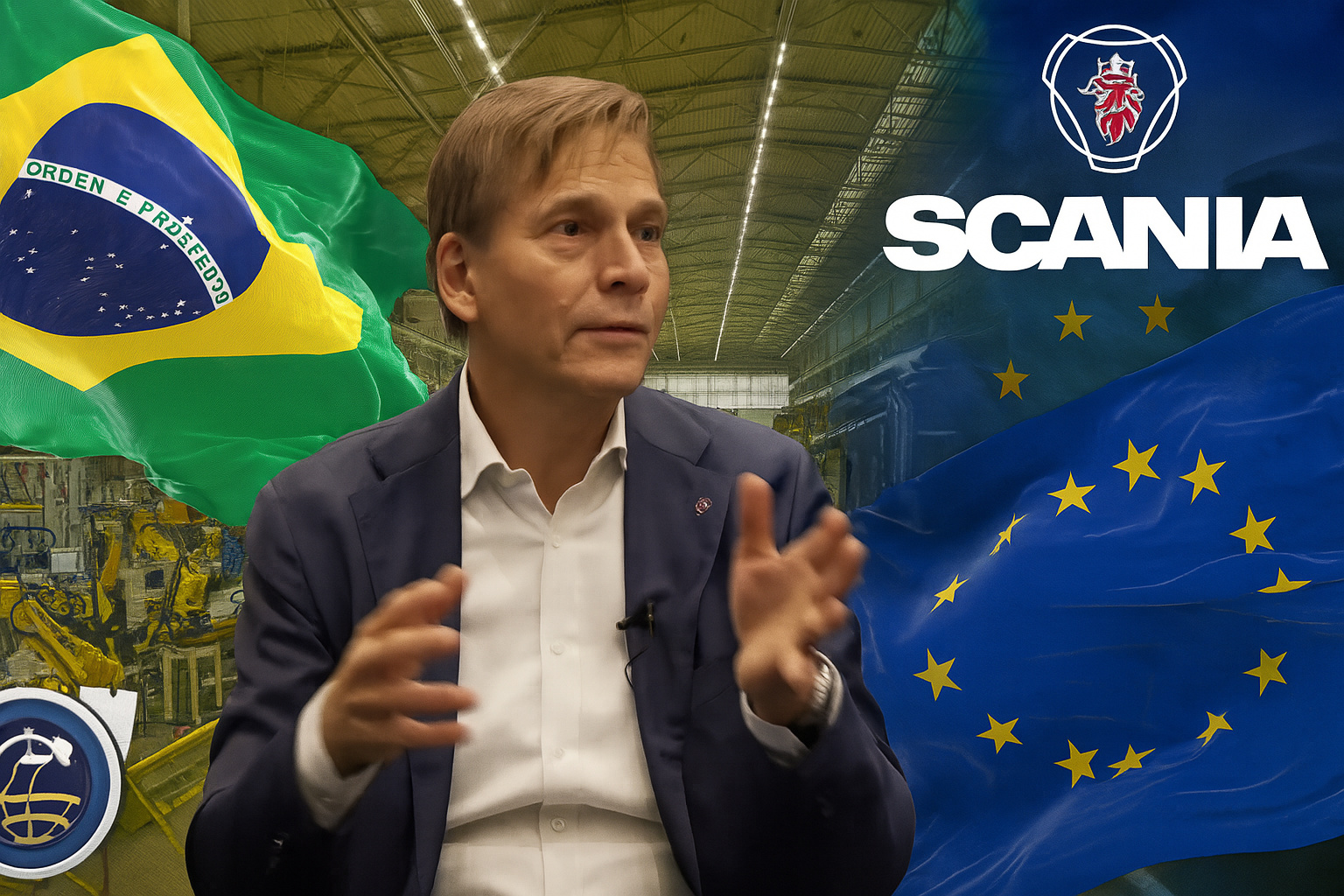
Scania CEO Praises Brazil as a Manufacturing Hub, Champions EU–Mercosur Agreement, and Highlights the Role of the Brazilian Industry in the Energy Transition.
The Global CEO of Scania, Christian Levin, emphasized in a recent interview that the company is “very fortunate to have Brazil as a manufacturing hub.” He also stated that the EU–Mercosur agreement is interesting. The statement summarizes the weight of the Brazilian industry in the global landscape of the Swedish manufacturer of heavy trucks and buses. According to Levin, the national operation is now not only a production base but also a technological innovation center that has contributed to energy transition and the decarbonization of transport.
Brazil hosts one of Scania’s largest industrial plants in the world. The factory located in São Bernardo do Campo, in the ABC region of São Paulo, has grown to the point of surpassing its own European headquarters in scale. Currently, national production is about ten times larger than the Swedish operation, serving not only the domestic market but also exporting across all of Latin America. This performance makes the country a key player in the company’s global growth strategy.
Scania CEO Advocates for Urgent Approval of the EU–Mercosur Agreement
One of the central points in Levin’s remarks was the urgent defense of the approval of the EU–Mercosur agreement. The executive explained that the integration between the two blocs would not only reduce tariffs and bureaucracies, but also create a more competitive environment for companies investing in the energy transition.
-
Historic bankruptcy of Centauro shocks the market, and the century-old company puts more than 500,000 products, machines, and complete infrastructure up for online auction.

-
New shoe factory in Ceará is expected to create 400 jobs and strengthen the local economy.
-
No one imagined it, but a mixture of sawdust with a mineral that fights fires surprises scientists with a result that changes the course of fire-resistant construction.

-
From empty land to a high-end house, wooden construction uses a lightweight system, metal structure for the foundation, ventilated ceramic cladding, and special windows to create an efficient and comfortable living space throughout the year.
For Scania, the treaty is viewed as a catalyst that will allow for more efficient market service, connecting production lines in Brazil with European demand.
According to Levin, the expectation is that the agreement will finally be ratified to unlock investments and expand Brazilian exports.
The executive made it clear that Scania seeks a commercial structure that facilitates the movement of vehicles, parts, and technologies between continents, increasing productivity and positioning the Brazilian industry as a strategic partner for Europe in the automotive sector.
Brazilian Industry as a Driver of the Energy Transition
Another highlight of the statements was the role of the Brazilian industry in Scania’s sustainability agenda. The country, due to its characteristics and cleaner energy matrix, has served as a laboratory for solutions that unite efficiency and emission reduction.
Scania is already developing biodiesel-powered trucks in Brazil, in addition to investing in electrification programs aimed at urban transport.
Christian Levin was emphatic in stating that sustainability and profitability should not be viewed as opposing forces. For him, the future of mobility depends on companies capable of proving that investing in clean technologies can also generate economic returns.
The Brazilian operation, according to the CEO, is an example of this convergence, as it demonstrates that it is possible to reduce emissions without losing competitiveness.
Scania and Investment in Innovation in Brazil
In recent years, Scania announced a new investment cycle of approximately R$ 2 billion in Brazil, aimed at producing heavy vehicles powered by electric and hybrid energy.
These resources reinforce the commitment to modernizing the São Bernardo do Campo plant and developing new product lines aligned with the global climate agenda.
With the growing demand for sustainable solutions, Scania believes that Brazil can become a reference not only in production volume but also in technological innovation.
The combination of industrial tradition, availability of biofuels, and skilled labor puts the country at an advantage compared to other emerging markets.
EU–Mercosur Agreement as a Competitive Differentiator
The EU–Mercosur agreement, according to Levin, should be seen as a strategic step that benefits both Europe and South America.
The possibility of enhancing commercial integration will allow vehicles produced in Brazil to reach international markets faster and at reduced costs. At the same time, it will open the door for importing cutting-edge technologies that can accelerate the electrification process.
In the context of global competition, Scania’s CEO argued that Brazil cannot afford to miss this opportunity.
In his view, the treaty strengthens the country’s position as a manufacturing hub and ensures predictability for new investments in the automotive sector.
Brazilian Industry in the Global Scene
While praising Brazil as a manufacturing hub, Levin also highlighted the resilience of the Brazilian industry in the face of economic, political, and logistical crises.
For the CEO, the experience accumulated by the country in overcoming adversities and maintaining active production shows the solidity of an industrial ecosystem capable of supporting long-term projects.
Scania’s presence in Brazil for almost seven decades is proof of this confidence. The country has not only grown in relevance within the company’s strategy but is now seen as a hub from which solutions capable of serving both the domestic market and international demands are produced.









Seja o primeiro a reagir!