





 Portuguese
  English
  Spanish
  4 min of reading
  1 comment


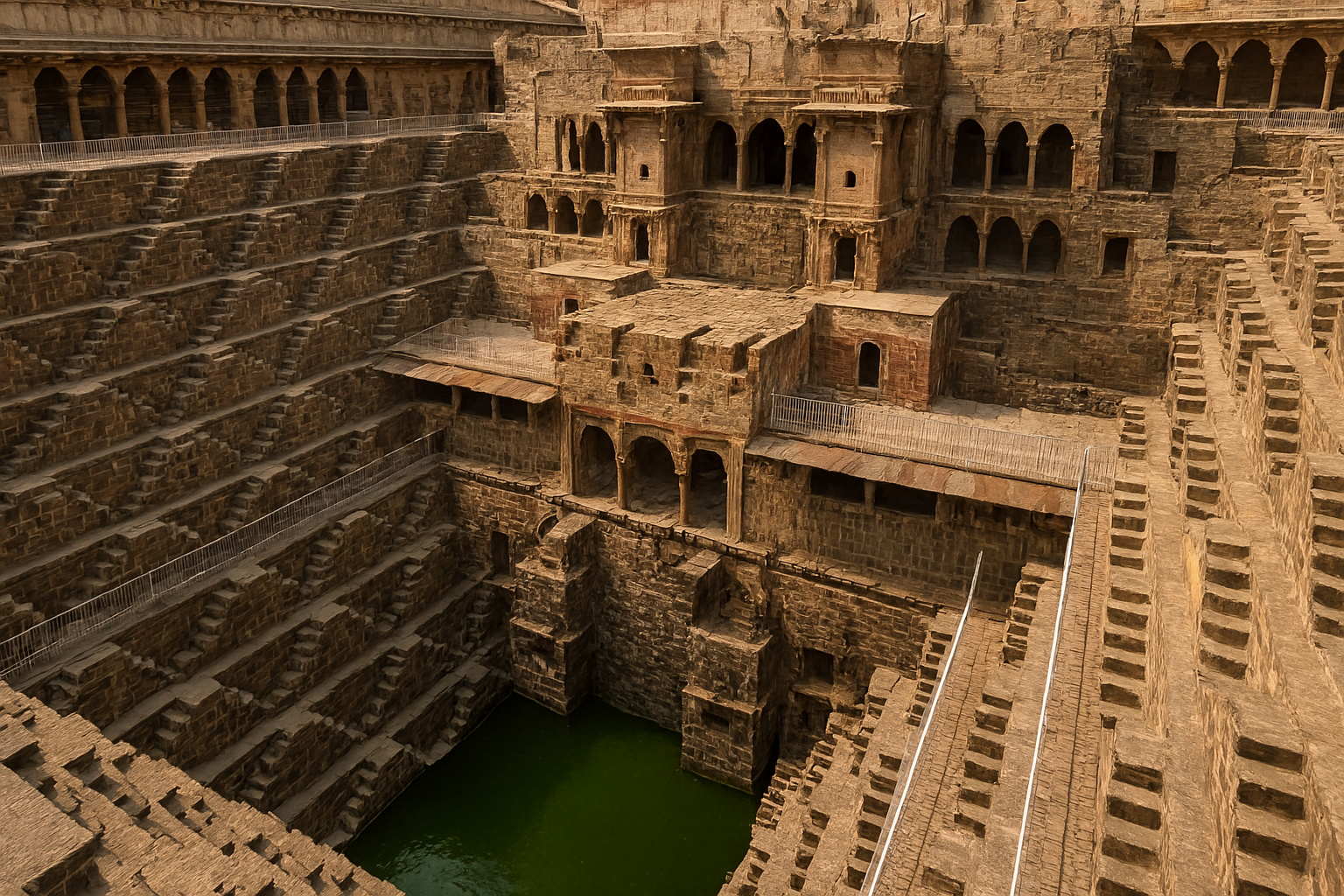


Chand Baori, In India, Has Over 3,500 Steps in Perfect Symmetry and Intrigues Engineers as One of the Most Impressive Works of Antiquity.
In the village of Abhaneri, in the state of Rajasthan, India, there is a construction so mesmerizing that many people believe they are looking at a computer-generated scene. It is the Chand Baori, a stepwell with more than 3,500 perfectly symmetrical stairs, forming a gigantic geometric funnel that descends dozens of meters into the ground.
At first glance, the brain struggles to accept that this was built over a thousand years ago, with extremely limited tools, without machines, cranes, or any type of modern technology. However, there it is, intact, still functioning today as one of the greatest practical mysteries of ancient engineering.
A Well That Looks More Like An Inverted Temple
Unlike ordinary wells, which descend in a straight line, Chand Baori was designed like an upside-down pyramid. Its 3,500 steps multiply in geometric patterns that create a sense of almost infinite depth. From above, the visitor sees a hypnotic mosaic of lines, shadows, and angles that change throughout the day according to the sun’s position.
-
The Argentine government celebrates the lowest poverty rate in 7 years, but experts warn that the methodology has changed, real wages have fallen, unemployment has risen, and the number of people on the streets of Buenos Aires has increased by 57% since Milei took office.

-
7.8 magnitude earthquake in Indonesia frightens the population, triggers tsunami alert, and hits an island with over 200,000 inhabitants this Thursday.

-
Google will finally let you change that embarrassing Gmail address you created in your teenage years without losing any accounts, logins, or old emails: the feature is already available in the United States.

-
Heading to Brazil in a Bonanza F33 single-engine aircraft: a couple departs from Florida on a visual flight, makes technical stops in the Caribbean to refuel and organize paperwork, and begins the staged crossing until they reach the country.

The lower you go, the cooler the temperature becomes. This was not an accidental consequence but rather part of the design. The well functioned as:
- water reservoir in a desert region,
- natural cooling system,
- community space,
- religious structure linked to nearby temples.
On extremely hot days, the temperature difference between the top and the bottom could reach several degrees, turning Chand Baori into a true natural refrigerator of antiquity.


Why This Structure Was Built in the Middle of the Desert
Rajasthan has faced severe droughts for centuries. Water has always been a scarce and extremely valuable resource. Chand Baori was not just an architectural curiosity but a vital survival structure.
Its step design had a very clear purpose: to allow access to water regardless of the reservoir level. In times of flooding, only a few steps were needed. In times of severe drought, it was possible to descend dozens of meters to reach the water level.
This solution ensured continuous supply for entire generations in one of the driest regions of the Indian subcontinent.
The Geometric Precision That Defies Ancient Construction Logic
What intrigues engineers the most is not only the size of the structure but the absurd precision of the symmetry. The stairs follow strict mathematical patterns, repeating angles and alignments almost millimeter by millimeter throughout the entire structure.
There are no records of formal calculations, technical plans, or mathematical models as used today. Nevertheless, the structure presents:
- balanced weight distribution,
- impressive structural stability,
- resistance to collapse after over a thousand years,
- and perfect drainage without causing erosion.
All of this was done with hand-carved stone, fitted without modern mortar.
Temple, Reservoir, and Social Center at the Same Time
Besides its function as a water storage, Chand Baori also had a religious character. A temple dedicated to the goddess Harshat Mata was built right next to the well, linking water, faith, and survival in the same architectural complex.

People did not come to the well just to fetch water. It also served as a community gathering point, place of prayer, and space for social interaction on the hottest days.
Each step served not only as access but also as an area for rest, contemplation, and social interaction.
Why the Steps Get Darker as You Descend
One of the most curious visual phenomena of Chand Baori is the change in light as the depth increases. At the top, everything is bright and open. Further down, light slowly disappears, giving way to a play of geometric shadows that makes the descent even more impressive.
This effect was not merely a consequence of the shape but also a functional choice: less light means less water evaporation. Another detail that shows the level of climate intelligence applied in the construction.
The Modern Rediscovery and Its Impact on the World
For a long time, Chand Baori remained practically forgotten outside of India. Only in recent decades, with the popularization of images on the internet and its appearance in international productions, did the well gain global recognition. Today, it is considered:
- one of the largest ancient hydraulic works in the world,
- one of the most photographed constructions in Rajasthan,
- and one of the most impressive underground structures in the history of engineering.
Even so, it is still little known outside architectural, historical, and specialized tourism circles.
A Reminder of the Genius of Ancient Engineering
Chand Baori proves that great civilizations deeply understood:
- geometry,
- climatology,
- structural engineering,
- and water resource management.
All of this long before electricity, reinforced concrete, or structural steel. Each hand-carved step represents a combination of empirical knowledge, tradition, and extreme necessity for survival.
Over a thousand years later, the well remains standing, functional, intricate, and absolutely mesmerizing — a monument that not only intrigues modern engineers but also makes it clear that human intelligence has always been much greater than often imagined.









it is better Chand Baori to remain unknown, in the shadows, yet alive.
for all it takes to be ruined is to open it to the public.
in Italy, the masterpieces, are “hidden” or saved locked in the Comuna’s undergroud.
But in this case, a pity, for the last storm still in the 1990 made the paintings wet, mudy, and filty durty for most of them are exposed, and unkept by ill, egocentric creatures thinking they know what they’re doing.
there is no need to go to far and abroad.
for instance, me here, in the country side of são paulo state, in brazil, do not have a public library to go cause our major, one after another sent the books away in boxes, only god knows where.
guess good thing is to know they did not catch on fire yet, to say the least.
I firmely think, eron musk has something to do with it, or is just a trend?
this particular CREATION was unfamiliar to me, yet as magnificent and great as the mind of those engeneered it.
kind of a place, makes one feeling as to spend a good while around before to go.
really awesome, move over
thaj mahal.
thank’s for sharing
good by