





 Portuguese
  English
  Spanish
  4 min of reading
  0 comments


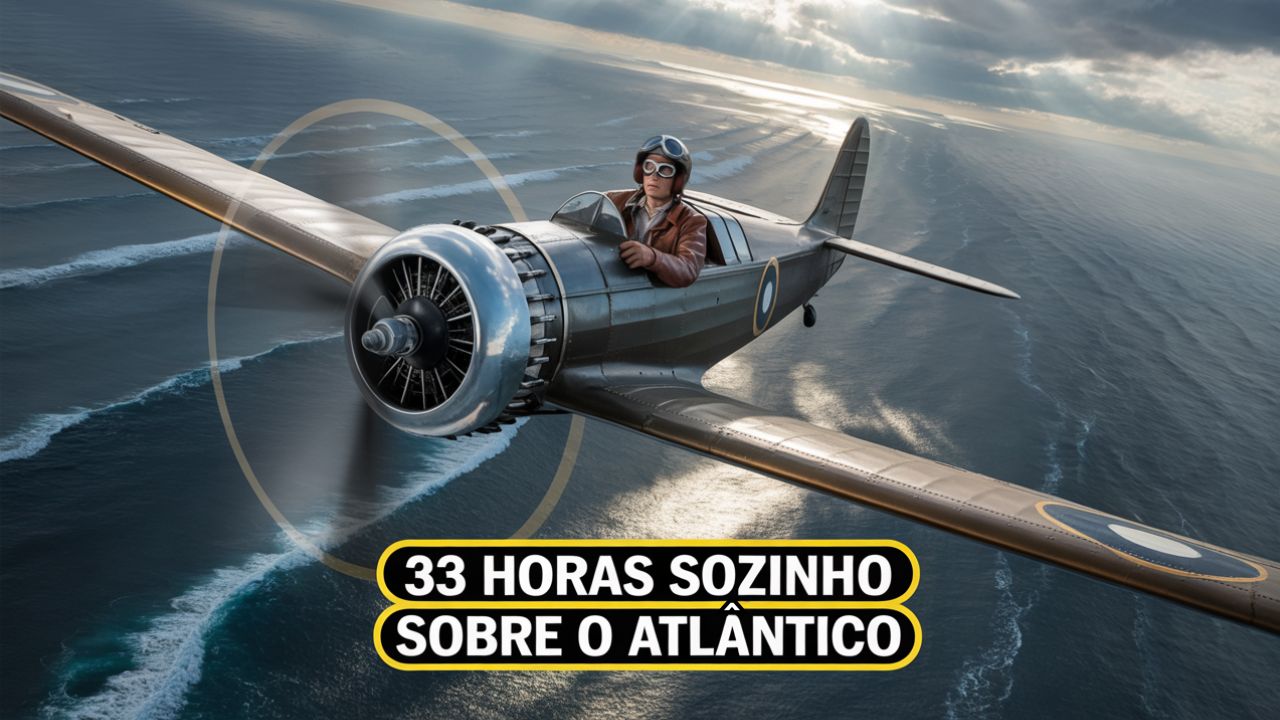
Alone and Without Modern Instruments, Charles Lindbergh Crossed the Atlantic in 33 Hours, Covered More Than 5,800 km, and Changed the History of World Aviation.
When Charles Lindbergh took off from New York in the small single-engine Spirit of St. Louis, no one imagined that this solitary journey would become one of the greatest individual feats in human history. He had no co-pilot, flight engineer, modern instruments, radio to call for help, or comfort on board. The cockpit had no front windshield — just fuel tanks — and he had to navigate by instinct, compass, and starlight, relying solely on his own skill and folded maps on his lap.
For 33 hours and 30 minutes without interruption, Lindbergh maintained control of the aircraft as he flew over open ocean without any visual reference. The flight covered more than 5,800 kilometers between the American continent and Europe, at a time when commercial aviation was still in its infancy and long flights were considered nearly impossible. His crossing redefined the limits of what a single human being could accomplish in a cockpit.
The Audacity of a Solo Pilot
Before becoming world-renowned, Lindbergh was an air mail pilot and flew dangerous routes transporting mail in unpredictable weather conditions. This background fueled the confidence he displayed in the air and conditioned him to handle long flights, mechanical failures, and emergency landings.
-
Hidden marks on the walls of the site associated with the Last Supper of Jesus for centuries have been deciphered in Jerusalem, revealing medieval inscriptions left by pilgrims, European nobles, and travelers from the Middle East.

-
One of the most important lakes in the United States for birds, the balance of nature, and the climate has dried to historic levels, leaving boats stranded, revealing salt flats, and showing how the lack of water can transform an entire landscape.

-
It’s not Cristiano Ronaldo or Messi: the richest football player in the world is only 27 years old, has a fortune of 100 billion reais, and is the nephew of a sultan from an Asian country that few people know about.

-
At 77, the king of one of the most famous and powerful crowns on the planet is said to be under pressure to leave the throne, while behind the scenes there are already talks of a new coronation that could cost R$ 260 million.



The Atlantic crossing was not only a technical challenge — it was also an extreme test of physical endurance. Without sleep, he had to fight the deep fatigue caused by the constant noise of the engine, the intense cold, and the continuous vibration of the fuselage. At several points, he noted that he experienced hallucinations and lapses of consciousness, forcing himself to keep his eyes open by rubbing ice on his face or banking the aircraft to create sudden pressure variations that would wake him up.
The fuel, calculated to the limit, occupied much of the airplane. To fit in more tanks, Lindbergh sacrificed the front windshield and relied on a small side periscope to see the runway during takeoff and the sea during the flight. The aircraft, specially designed for the flight, had a lightweight structure, minimal finishing, and an absolute focus on range.
The Crossing That Changed the World
Arriving in Paris was a global event. As soon as the Spirit of St. Louis touched down, a crowd of thousands of people stormed the airfield. Lindbergh was carried on the shoulders of those who managed to reach him, transformed into an instant worldwide hero. The European and American press described him as “the man who conquered the Atlantic,” and his journey paved the way for modern aviation.
From a technological standpoint, his success boosted investments in safer, faster, and more efficient aircraft. Airlines began studying transatlantic routes, and the dream of connecting continents by air ceased to be science fiction. Airports were expanded, companies emerged, and long-distance transportation began to enter the era of real progress.
Governments and engineers recognized that aviation was not just entertainment or a daredevil venture. It was a sector capable of integrating entire economies, bringing countries closer together, and transforming the world into a smaller and more interconnected place. Lindbergh became a consultant for aerospace companies and played an active role in the technological advancement of commercial aviation for decades.
The Journey of a Man Who Became a Symbol of Human Courage
Beyond the technical impact, Lindbergh’s flight gained cultural significance. He represented the spirit of overcoming, the confidence in progress, and the idea that a determined individual could break through limits previously considered absolute. The crossing showed the planet that courage and discipline could literally cross oceans.

As the years went by, Lindbergh remained involved in aviation, environmental conservation, and technology issues. His legacy lives on in museums, documentaries, and studies on aerospace development. The Spirit of St. Louis is now preserved at the Smithsonian Institution, serving as a testament to a time when flying was an act of heroism.
An Achievement That Remains Unmatched
Nearly a century later, Charles Lindbergh’s solo flight remains one of the greatest individual feats in history. He had no satellites, GPS, autopilot, radar, or digital panels. He only had a small airplane, folded maps, and immense courage. The crossing was not just an aviation accomplishment — it was a demonstration of what humanity can achieve when it decides to face the impossible.
The world has changed, airplanes have changed, and technologies have evolved, but the symbol of a man alone crossing the ocean in the silence of the early morning remains one of the most powerful images ever recorded in the history of air transportation.









Seja o primeiro a reagir!