





 Portuguese
  English
  Spanish
  5 min of reading
  0 comments


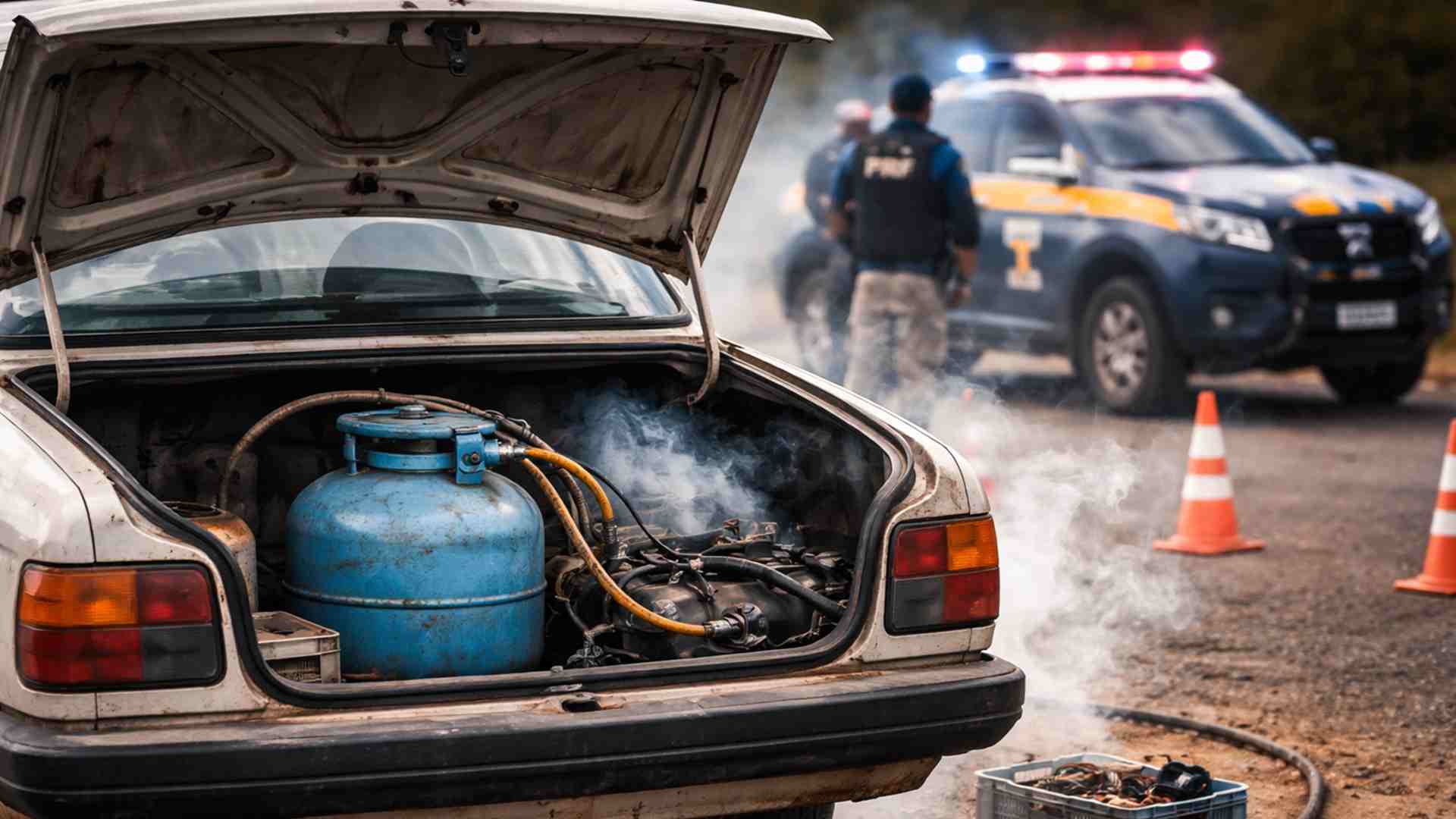
The clandestine use of gas cylinders in cars continues to be adopted by drivers seeking savings, but the improvised adaptation exposes the vehicle to leaks, explosion risks, accelerated engine wear, fines, towing, and other consequences provided for in the legislation
The use of gas cylinders as fuel in automobiles has returned to the center of attention after the Federal Highway Police seized, on the night of Sunday (29), in Pau dos Ferros, in the Upper West of Rio Grande do Norte, a car that was operating with a kitchen gas cylinder directly connected to the engine.
The case exposed a clandestine practice that remains prohibited in the country and is still adopted by drivers seeking to reduce costs.
The inspection occurred around 7 PM on BR-405 when the police stopped a Chevette that was traveling from Pau dos Ferros to Taboleiro Grande, also in the interior of Rio Grande do Norte. In the vehicle were the 54-year-old driver and a passenger, while the improvised equipment was found in the trunk of the car.
-
Fiat launches the new 2027 Toro hybrid with 48V, 176 hp, an electric motor of 15.5 hp, a 0.85 kWh battery, up to 7% fuel savings, 8% fewer emissions, and possible exemption from IPVA.

-
Used automatic cars from Hyundai that are reliable, offer comfort, good performance, and cost between R$ 45,000 and R$ 75,000.

-
Electric car surprises on the Transamazon Highway as it tackles a mud pit; Saveiro and Hilux get stuck and need to be pulled out, while a milk truck crosses alongside with ease and draws attention.

-
The war in Iran could be the push needed for the electric vehicle market to truly explode because when the price of oil exceeds 100 dollars a barrel, combustion cars become a luxury, and China already dominates 60% of the global electric market.


In addition to the irregular installation of the system, the occurrence involved other infractions. The PRF reported that the driver was unlicensed, admitted to having consumed alcohol, and refused to take a breathalyzer test.
The refusal to take the breathalyzer test is a serious infraction, with a fine of R$ 2,934.70, suspension of the right to drive for 12 months, and vehicle retention. Driving without a valid driver’s license is also a serious infraction and carries a fine of R$ 880.41, while the stopped car had been overdue for licensing since 2010, which led to its removal for storage until regularization.
Gas cylinders in cars remain prohibited
The installation and use of LPG as fuel in motor vehicles remain prohibited in Brazil. This prohibition is currently outlined in Contran Resolution No. 916, dated March 28, 2022, which maintains this ban for motor vehicles and only makes exceptions for machines used in the loading and unloading of goods, such as forklifts.
The same regulation stipulates that when there is installation and use of LPG as fuel in a motor vehicle, the penalties provided in Article 230, item XII, of the Brazilian Traffic Code shall be applied. Thus, the restriction remains in effect even after the replacement of previous Contran rules with a new resolution.
In the original text of the article, the reference was made to Contran Resolution 673. However, this legal basis has become outdated, as the current regulation is Resolution 916/2022, published on April 1, 2022.
The clandestine use of this type of adaptation persists due to the lower price of LPG compared to gasoline and ethanol. Nevertheless, the practice remains illegal and subject to penalties, in addition to exposing drivers and passengers to constant risks.
Improvised adaptation increases the risk of leaks and explosions
LPG, or liquefied petroleum gas, is composed of butane and propane and should not be confused with natural gas for vehicles. While CNG was designed for automotive use and operates within its own requirements, LPG was not intended to fuel passenger cars.
The common gas cylinder was also not developed to withstand vibrations, impacts, and permanent displacements of a moving vehicle. Its use in vehicles creates a condition incompatible with the original purpose of the container, increasing exposure to serious failures.
In clandestine installations, this scenario is often exacerbated by makeshift setups with inappropriate parts. Improvised hoses and adapted connections from forklifts are part of fragile systems, vulnerable to leaks and explosions.
The absence of specific safety standards for this type of adaptation reinforces the problem. Without technical standardization and regular control, the improvised system leaves the driver and passenger subject to permanent dangers.
In the case recorded in the interior of Rio Grande do Norte, the connection of the gas cylinder directly to the engine highlighted precisely this type of improvisation. The seizure made by the PRF brought back to light an old, prohibited practice still present in some regions.
Gas cylinders also accelerate engine wear
In addition to the immediate safety risk, the adaptation for LPG use compromises the mechanical functioning of the vehicle. Engines designed for gasoline, ethanol, or CNG do not have the necessary compression ratio to work properly with this fuel.
This incompatibility reduces power and accelerates wear on parts. What seems like an initial savings can result in more frequent maintenance and higher losses over time.
Spark plugs and ignition cables are among the affected components. The lifespan, estimated at around 30,000 kilometers under regular conditions, can drop to approximately 15,000 kilometers with the use of LPG.
The engine head also appears among the most vulnerable points, as the irregular pressure caused by the gas can lead to cracks. The valves are also subject to seizing and accelerated wear because LPG does not provide the lubrication present in liquid fuels.
The improvised alterations even impact the resale value of the car. Drilling to secure containers, unauthorized changes to the structure, and loss of space in the trunk or cargo bed reduce the vehicle’s attractiveness in the market.
Old practice continues to be debated in Congress
The use of LPG in vehicles is not recent and was already observed in the 1980s, especially in peripheral communities, even with a ban in place. In 1991, this use began to appear in the penal field related to the economic order, a topic that is still under legislative discussion.
In 2019, Bill 4217 was introduced in the Chamber of Deputies, proposing to revoke item II of Article 1 of Law No. 8,176, dated February 8, 1991. The proposal is currently ready for discussion in the Plenary.
Even with this process, the legal situation has not changed so far. The use of LPG in automobiles remains prohibited by the current traffic regulations, and the irregular adaptation continues to be subject to fines and the removal of the vehicle from circulation.
Apparent savings can turn into greater losses
The search for reduced fuel expenses helps explain why there is still demand for conversion kits sold on online platforms for prices between R$ 500 and R$ 1,000. The lower entry cost, however, hides high risks of safety, mechanical wear, and property loss.
The material also notes that LPG has cleaner emissions than gasoline or diesel, although its production and transportation still generate significant impacts. Nevertheless, in the case of automobiles, the decisive point remains the illegality of use and the lack of adequate safety for this type of adaptation.
The seizure in Pau dos Ferros summarizes this scenario by bringing together, in a single approach, the improvised gas cylinder in the car, the driver’s lack of a license, the refusal of the breathalyzer, and the years of overdue licensing. The episode shows that the savings sought at any cost can quickly turn into fines, vehicle removal, mechanical damage, and real safety risks.







Seja o primeiro a reagir!