





 English
  Francês
  Alemão
  Italiano
  Japonês
  Norueguês
  Portuguese
  Spanish
  6 min of reading
  0 comments


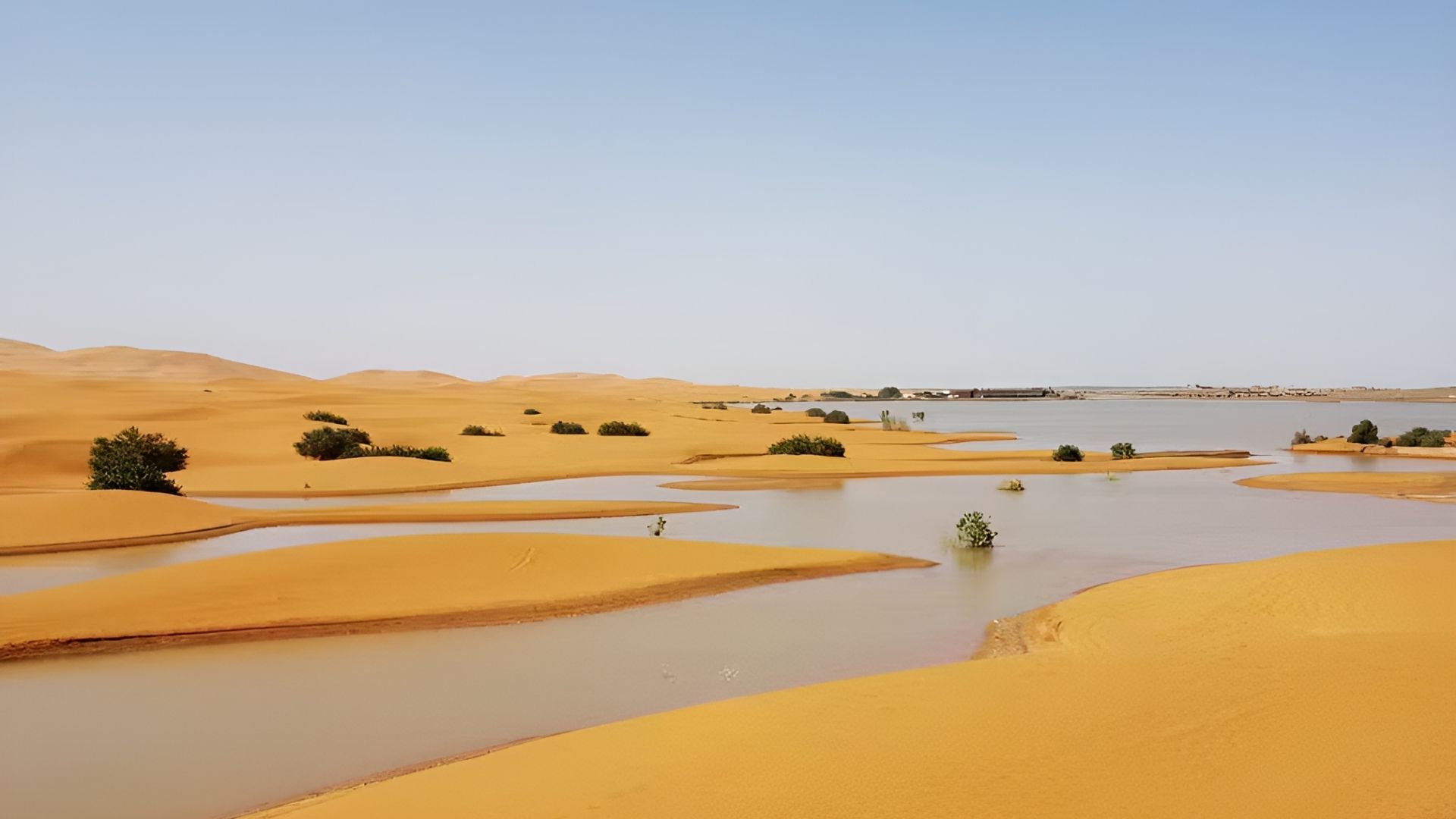
Desert Band in Northern China Turned Climate Laboratory with Continuous Use of Artificial Rain, Targeted Planting, and Advanced Technologies, Reducing Sandstorms and Integrating a National Program That Predicts Atmospheric Interventions on a Continental Scale.
An extensive desert band in northern China has undergone a rare transformation in arid regions, resulting from a set of planned interventions over several years.
About 200 kilometers once dominated by shifting dunes now showcase enough vegetation cover to reduce sandstorms and contain the desert’s advance.
This process combines cloud seeding, targeted planting, land use control, and the use of technologies such as rockets, drones, and advanced weather monitoring systems.
-
350-year mystery may have been solved: remains of a soldier who inspired the hero of The Three Musketeers found beneath a church in the Netherlands.

-
NASA photographed a nearly perfect square with 3 km sides on Mars, 13 times larger than the Great Pyramid of Giza, but the official explanation is natural erosion; still, no one has explained why the four sides have almost identical lengths.

-
Starlink breaks the barrier of 10,000 satellites in orbit and takes its expansion to an unprecedented level, with a direct impact on global internet, technological competition, and the race for space.

-
Japan finds an alternative to oil amid rising prices by transforming ocean balance into electricity with a new technology that maintains efficiency even when the sea changes.


The experience takes place in the region of Alxa, Inner Mongolia, and is part of a broader state effort aimed at climate intervention and addressing the effects of desertification.
Desertification in Northern China and Urban Impact
Located on the edge of the Badain Jaran Desert, one of the driest areas in the country, the region has faced decades of constant sand displacement.
This movement directly affected local communities, reduced pastures, and pressured already vulnerable agricultural areas.
Besides local impacts, the sandstorms were not confined to the desert’s surroundings.

Frequently, dust was carried by the wind to large cities in northern China, contributing to episodes of overcast skies, low visibility, and worsening air quality, especially during spring.
These effects are recurrently reported by Chinese media and international agencies.
Green Corridor to Contain Dunes and Wind
In light of this scenario, local authorities, forest engineers, and meteorologists began seeking solutions beyond traditional tree planting.
In extreme environments like this, isolated initiatives proved insufficient to stop the sand’s advance.
The adopted strategy was to create a containment corridor along the desert’s edge, narrow yet continuous.
The function of this corridor is to serve as a physical barrier against wind and sand, reducing its force before it advances into populated areas.
To sustain this “living wall,” the project started systematically using artificial rain.
How Artificial Rain Works in Practice
The technique, known as cloud seeding, does not create precipitation from clear skies.
Its goal is to increase the efficiency of clouds that already have moisture, taking advantage of favorable atmospheric conditions.
During the summer, when convective clouds cross Inner Mongolia, teams monitor weather radars for the right moment.
Upon identifying a cloud with rain potential, rockets and flares are launched into its interior.
These devices release particles such as silver iodide or other salts, which act as condensation nuclei.
Water vapor aggregates onto these particles, forming larger droplets that, upon gaining weight, fall as rain over the target area.
Reports from the South China Morning Post and Reuters indicate that this atmospheric “nudge,” though limited, can be decisive.
In arid regions, each additional millimeter of rain increases the chances of seedling survival, especially in the early stages of planting.

Planting, Straw, and Drones in Sand Dune Control
While the atmosphere is monitored, ground work continues in parallel.
Machines and human teams plant grasses and drought-resistant shrubs directly in the dunes, chosen for their adaptability to the dry climate.
In certain stretches, straw grids in a checkerboard pattern are installed, a technique widely used in northern China.
These structures reduce wind speed near the ground and prevent sand from covering young plants.
To reach hard-to-access areas, trucks and, more recently, drones are used for seed dispersal.
Gradual and Visible Results of Greening
The effects of these actions did not appear immediately.
In the initial years, green patches emerged only in isolated spots, barely perceptible when viewed from above.
Over time, aerial records began to show patches connecting.
These areas ultimately formed a continuous band of vegetation along the northeastern edge of the desert.
It is not a dense forest or a closed ecosystem.
It is a functional corridor, sufficient to stabilize the soil and reduce sand mobility.
The roots help stabilize the dunes, while the canopies break the wind’s force.
In winter, snow and moisture are retained among the plants, nourishing the soil.
In spring, when sandstorms used to advance freely, they now encounter a green obstacle.
For communities downwind, this translates to less dust on homes, crops, and roads, along with reduced health and infrastructure impacts.
National Climate Modification Program
The experience in Alxa represents only a part of a much larger national program.
Since the mid-20th century, China has maintained weather modification initiatives, initially aimed at protecting agriculture.
Over the years, these actions have gained structure and begun to integrate into long-term public policies.


In 2020, the Chinese State Council released an official plan outlining the expansion of artificial rain and snow operations.
The announced goal is to cover more than 5.5 million square kilometers of area.
There is also a plan to extend hail suppression to over 580,000 square kilometers.
In total, the area planned for interventions exceeds the territorial extent of India.
Artificial Intelligence, Radars, and Rockets
To enable this system, the country operates thousands of rocket launchers, adapted aircraft, weather radars, and technical teams distributed across several provinces.
In recent years, integration with digital systems and artificial intelligence has gained traction.
These tools assist in analyzing atmospheric data and determining the timing and location of operations.
Drones and New Cloud Seeding Tests
Technology has also advanced with the use of drones.
In Xinjiang, another arid region in western China, tests reported by the South China Morning Post mentioned the use of unmanned aircraft.
These drones release small amounts of silver iodide directly into the upward currents of the clouds.
According to the researchers involved, a single day of operation might have resulted in tens of thousands of additional cubic meters of precipitation.
These figures are presented as estimates and vary depending on weather conditions.
Research with Ions and Scientific Limits

In addition to traditional methods, Chinese research centers are investigating alternative approaches.
Among them are systems based on electric fields and negative ions, tested in controlled environments.
The goal is to gain a better understanding of the microphysical processes of droplet formation.
The studies do not claim that these techniques represent full capacity to control natural storms.
Debates, Risks, and Questions
Despite local results, climate modification continues to generate debates inside and outside China.
Experts remind us that cloud seeding tends to increase rainfall only in small proportions.
The atmosphere, in turn, functions as an interconnected system, with effects that propagate beyond the intervention area.
Anticipating precipitation in one point may mean less moisture available downstream.
This argument has already fueled accusations between Chinese provinces of “rain theft” during drought periods.
There are also questions about long-term impacts.
Silver iodide is used in small amounts and has low toxicity at current levels, according to most available studies.
Still, the cumulative effects of decades of continuous use are under evaluation.
In the field of revegetation, previous experiences have shown that projects can fail if inappropriate species are chosen. The interruption of funding or oversight can also compromise results.






-

-

-

-

-

-

124 pessoas reagiram a isso.