





 Portuguese
  English
  Spanish
  5 min of reading
  0 comments


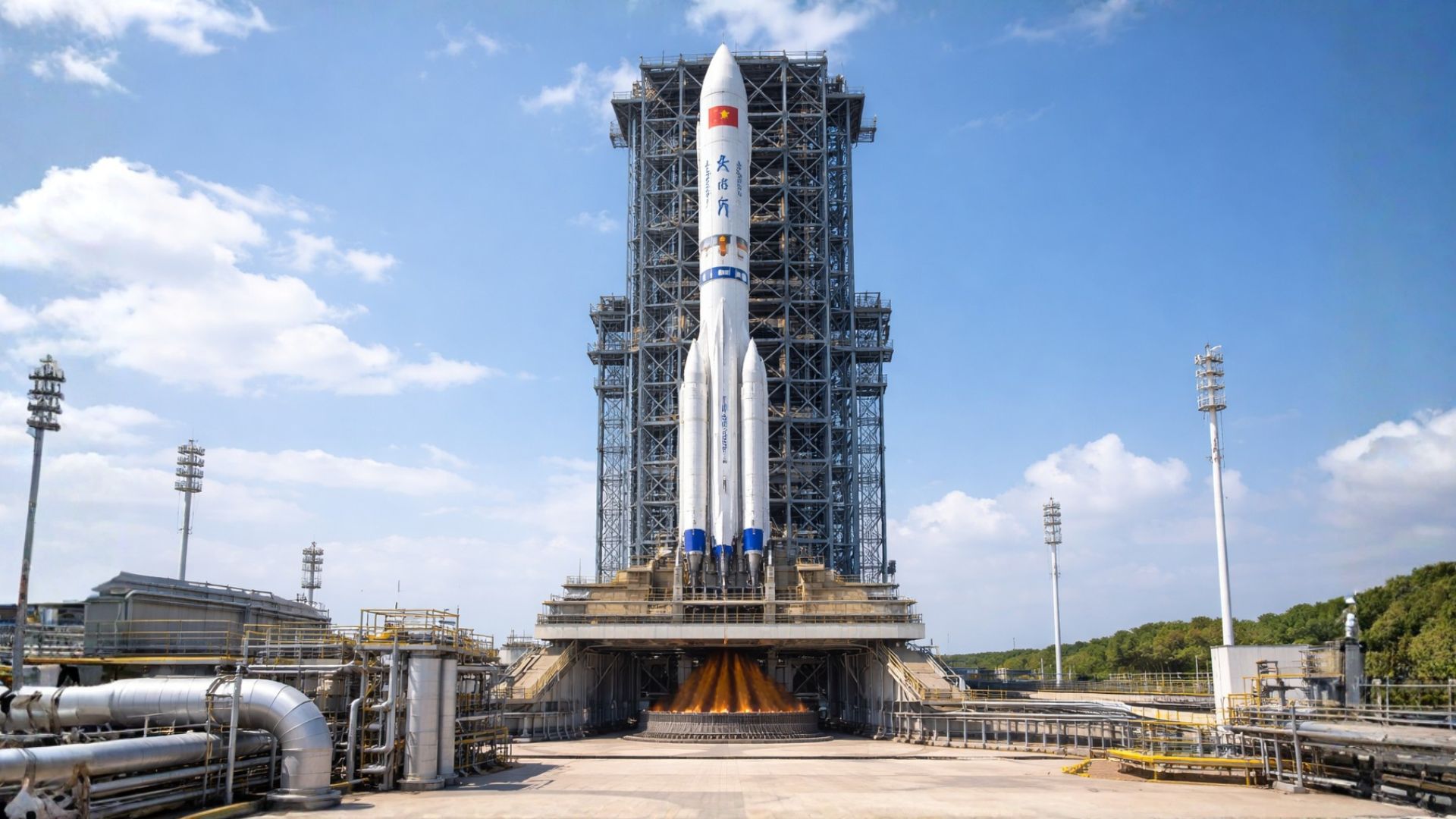
Unprecedented infrastructure in Hainan accelerates orbital launches, combining automation, advanced thermal engineering, and local rocket assembly, enhancing efficiency and reducing intervals between missions at the Chinese commercial spaceport, which already operates with two active sites and aims for weekly cadence.
China has put into operation the platform No. 1 of the Hainan commercial spaceport in Wenchang with the launch of a Long March-8 rocket that carried 18 satellites into low Earth orbit.
The mission marked the entry into service of the second launch site of the complex and consolidated operational capacity at two bases in the country’s first commercial spaceport.
The project gained relevance by bringing together, in one facility, solutions to reduce the interval between missions, strengthen thermal protection of the base, and enhance ground automation.
-
Brazilian family transforms old boathouse in Paraty and creates a refuge with glass walls, private beach, and three suites in a property that combines Atlantic Forest, exclusivity, and sophistication.

-
A crane with a reach of 69.5 meters and a lift of 53 meters unloads the largest container ships on the planet and accelerates the invisible machinery of global trade.
-
Diapers are being turned into solid fuel in Japan: an ambitious project could forever change the way cities deal with one of the most difficult types of sanitary waste to process.

-
Hyundai presents a luxury electric SUV with up to 7 seats, a range of up to 620 km, and futuristic technologies that redefine comfort and interior space.

According to the state agency Xinhua, the platform was specifically designed for the Long March-8 family and underwent practical validation during its debut, when the rocket and infrastructure were tested together under real launch conditions.
Modular structure and industrial launch rhythm
The tower is 83 meters tall and was built with a modular steel structure, a choice that facilitates maintenance, component replacement, and more intense operational reuse.

This design is part of the strategy adopted in Hainan to transform orbital launching into a less artisanal process and more akin to an industrial routine, with parallel steps and shorter preparation times between flights.
The facility integrates the Hainan commercial spacecraft launch site, construction of which began in July 2022.
The first mission of the spaceport occurred on November 30, 2024, when the complex conducted the inaugural flight of the Long March-12 from platform No. 2; months later, the debut of platform No. 1 completed operational readiness at two launch sites.
This advancement occurred while the expansion of the complex was still underway.
The second phase of the project began on January 25, 2025 and plans to construct two more platforms for liquid propellant rockets, a move indicating China’s intention to sustain a higher frequency of commercial missions from Wenchang.
Trenchless system redefines flame control
One of the most unusual aspects of the new base is how it handles rocket exhaust at the moment of liftoff.
Instead of using underground trenches found in many launch centers to channel flames and gases, platform No. 1 adopts a two-directional deflection cone, elevated 3.9 meters above the ground, capable of safely capturing and redirecting the jet.
According to Wang Peng, a specialist quoted by Xinhua, the device acts as a protective barrier for the base itself.
The agency described the system as the first successful application, in a medium-sized liquid rocket, of a ground-based exhaust solution designed to protect equipment and structure without relying on the traditional underground configuration.
Thermal engineering also deviates from the more common arrangement found in other platforms.

The project eliminated tanks installed at the top of the tower and adopted a rapid cooling system at high pressure mounted at ground level.
At ignition, two gas tanks and a reservoir release 500 tons of water in 15 seconds through precision nozzles, forming a curtain aimed at reducing thermal and acoustic impact.
Ge Lixin, head of engineering and equipment at Hainan International Commercial Aerospace, told Xinhua that the system can reduce heat and noise by about 30% and simultaneously helps protect equipment exposed to high-temperature exhaust.
This data helps explain why the base was presented as a key piece for a more frequent usage regime, with less wear between successive launches.
Local assembly reduces preparation to seven days
The debut of platform No. 1 also served to validate a new logistical arrangement.
Instead of transporting the rocket fully integrated to the base, the operation was carried out with the separate shipment of the vehicle sections and subsequent assembly in Hainan.
The spaceport features an integration and testing workshop equipped with dual-pulse production lines and three vertical work positions, allowing simultaneous assembly, testing, and fueling steps.
According to Song Zhengyu, a specialist from the China Aerospace Science and Technology Corporation, this flow reduced the pre-launch preparation cycle from weeks to seven days.
The same model, he said, also accelerated the recovery of the base after liftoff and increased efficiency by 30% compared to conventional methods, paving the way for a routine of weekly launches when the system reaches full operational maturity.
Artificial intelligence in launch control
Another axis of the project lies in launch control.

The platform received a system supported by artificial intelligence that allows engineers to remotely monitor procedures such as propellant loading and pressure checks.
According to the operator, the model reduces reliance on manual intervention in a scenario where the number of commercial missions tends to grow and requires faster coordination between teams and equipment.
During the inaugural mission of base No. 1, the system began to include an expanded equipment health management function.
According to Xinhua, the tool can detect anomalies, suggest responses, and forward alerts to an integrated operation and maintenance platform, as well as indicate when components are nearing the end of their lifespan, reducing the need for routine on-site inspections.
Long March-8 and the commercial launch strategy
The purpose of the new platform is directly linked to the Long March-8 rocket, developed by the China Academy of Launch Vehicle Technology for missions with multiple satellites in low and medium orbits.
In the inaugural flight of base No. 1, the version used was the Long March-8 Y6, responsible for placing the fifth group of satellites of the commercial constellation Spacesail into orbit.
In the Long March-8A configuration, used in later missions, the vehicle measures 50.5 meters, has a launch mass of 371 tons, and a capacity to carry up to 7 tons to a sun-synchronous orbit at 700 kilometers altitude.
Official data published indicates that this model was designed specifically for rapid and dense satellite deployment, in line with the operational proposal of the new commercial base in Hainan.
Expansion and increase in launch volume
After the entry into operation of platform No. 1, the Hainan spaceport accelerated its pace.
In January of this year, the complex had completed 10 consecutive successful launches and placed 92 satellites into orbit. This result reinforced Wenchang’s role as a hub of the new Chinese space economy.
By combining modular architecture, automated control, local integration of rockets, and thermal solutions aimed at intensive use, platform No. 1 has become a showcase of China’s effort to make orbital launches more predictable, frequent, and compatible with commercial market demand.






Seja o primeiro a reagir!