





 Portuguese
  English
  Spanish
  5 min of reading
  5 comments


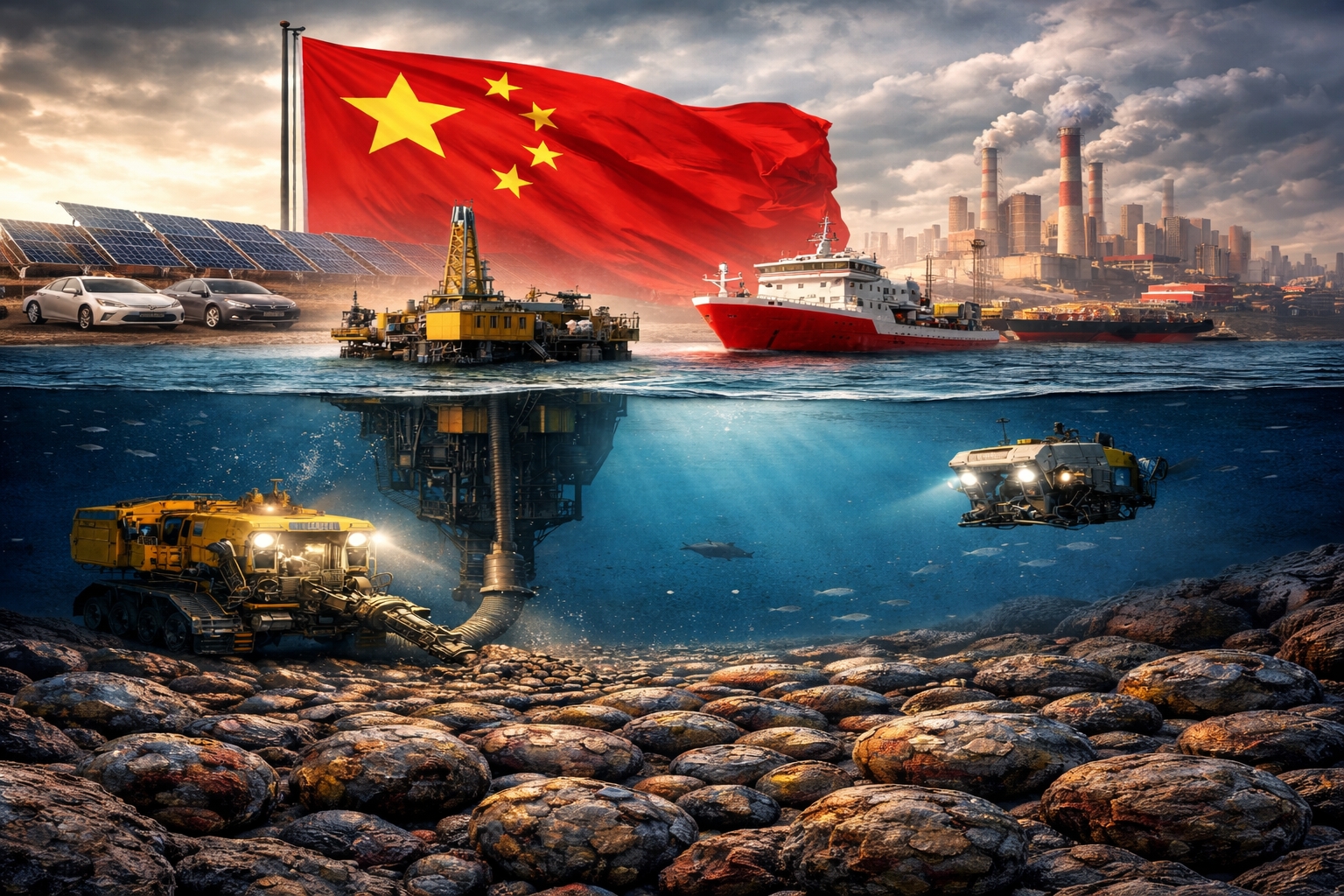


Submarine Mining of Minerals Advances at the Center of China’s Strategy: The Asian Giant Aims Deep in the Ocean to Extract Trillions of Tons of Copper, Nickel, Cobalt, and Manganese to Dominate Global Supply Chains and Hold the World Hostage on Critical Minerals and Military Operations. Understand the Economic Impacts of This Dispute.
The new race for minerals has already begun — and it takes place 4,000 meters deep. The struggle for strategic mineral mining has entered a quiet but decisive phase. At the center of this movement is China, which targets the ocean floor as an alternative source of copper, nickel, cobalt, and manganese — essential raw materials for batteries, electric vehicles, solar panels, and military technologies.
What is at stake is not just a green economy. It is geopolitical power.
Trillions of polymetallic nodules are scattered across the ocean floor, primarily in the Clarion-Clipperton Zone in the Pacific. These deposits hold volumes comparable to the largest known terrestrial reserves. Controlling this wealth could redefine the global balance in the coming decades.
-
Motorola launched the Signature with a gold seal from DxOMark, tying with the iPhone 17 Pro in camera performance, Snapdragon 8 Gen 5 that surpassed 3 million in benchmarks, and a zoom that impresses even at night.

-
Satellites reveal beneath the Sahara a giant river buried for thousands of kilometers: study shows that the largest hot desert on the planet was once traversed by a river system comparable to the largest on Earth.

-
Scientists have captured something never seen in space: newly born stars are creating gigantic rings of light a thousand times larger than the distance between the Earth and the Sun, and this changes everything we knew about stellar birth.

-
Geologists find traces of a continent that disappeared 155 million years ago after separating from Australia and reveal that it did not sink, but broke into fragments scattered across Southeast Asia.

Why Are Copper, Nickel, and Other Minerals So Strategic?
The demand for critical minerals is expected to more than double by 2040, according to projections from the International Energy Agency (IEA). The growth is primarily driven by the energy transition.
Electric vehicle batteries rely heavily on nickel and cobalt. Electrical systems and renewable infrastructure require large volumes of copper. Wind turbines, smart grids, and energy storage are highly dependent on these inputs.
The IEA itself warns:
“The transition to clean energy means a shift from a fuel-intensive system to a mineral-intensive system.”
In the case of China, this dependence is even more sensitive. The country leads global manufacturing of solar panels, electric vehicles, and batteries. According to the Center for Research on Energy and Clean Air (CREA), clean energy industries accounted for 40% of China’s GDP growth last year.
In other words: maintaining stable access to minerals is a strategic issue.
External Dependence Worries Beijing
Despite its industrial strength, China still relies on imports of raw materials from South Africa, Gabon, Australia, and the Democratic Republic of Congo.
Political instability, sanctions, or tensions with rivals, especially the United States, could jeopardize the supply.
It is in this context that deep-sea mining emerges as an alternative. By exploring international areas, away from the sovereignty of other countries, Beijing seeks to reduce vulnerabilities.
In 2016, Xi Jinping advocated for the exploration of the ocean’s “hidden treasures,” signaling that the seafloor would become part of the long-term national strategy.
The Role of the International Seabed Authority (ISA)
Mineral exploration in international waters is regulated by the International Seabed Authority (ISA), an entity linked to the UN.
Currently, the organization is still debating the rules to allow or restrict large-scale commercial mining. In recent meetings held in Jamaica, from July 29 to August 2, the topic divided nations.
On one side, environmentalists advocate for a total moratorium. On the other, governments and companies press for regulations that allow controlled exploration.
China is currently the largest donor to the ISA and has expanded its influence by offering, in 2020, a training facility in Qingdao. To date, the authority has granted 31 exploration licenses — five of which are under Chinese control, more than any other country.
Among the companies involved are:
- China Ocean Mineral R&D Association
- China Minmetals
- Beijing Pioneer Hi-Tech Development
Three licenses cover areas in the Clarion-Clipperton Zone in the eastern Pacific. The other two are located in the western Pacific and the Indian Ocean.
Underwater Technology: Robots, Ships, and Accelerated Advancement
Submarine mining requires robots capable of operating at depths of over 4,000 meters. In July, a team from Shanghai Jiao Tong University tested equipment that collected 200 kg of material at that depth.
The state media highlighted the use of domestic components, signaling technological independence.
Although countries like Japan and some Western companies have advanced technology, China’s advantage lies in its large-scale production capability. The country builds ships, robots, and industrial infrastructure quickly and with strong state support.
If commercial exploration is authorized, the trend is that China will lead production, driven by its enormous domestic demand for copper, nickel, and other minerals.
Environmental Impacts: A Little-Known Risk
The ocean floor is home to unique ecosystems. Species living near polymetallic nodules could be severely affected by extraction activities.
Plumes of sediment generated by the robots can spread for miles, altering habitats and affecting organisms that have not yet been fully cataloged.
The International Union for Conservation of Nature (IUCN) itself warns of significant environmental risks and advocates for a precautionary approach.
Even under strict regulation, there are relevant scientific uncertainties. And the environmental track record of Chinese mining companies on land adds further distrust.
Military Concerns and Geopolitical Tension
The debate is not just environmental.
There is concern that mining operations could serve as a facade for strategic underwater mapping. Detailed information about the underwater terrain benefits submarine operations.
In 2021, a research vessel linked to China Minmetals took a detour near Hawaii, where the United States maintains important military bases.
Meanwhile, the U.S. faces another challenge: the country has not ratified the United Nations Convention on the Law of the Sea (UNCLOS), which excludes it from formal decisions within the ISA.
In March, a group of former American officials urged the Senate to ratify the treaty, stating that the absence of the U.S. directly benefits China in defining global rules.
The Fear of Losing Strategic Space Has Mobilized Political Support in Washington
The dispute is not exclusive to China.
The Canadian company The Metals Company plans to apply for a commercial license from the ISA. Its founder, Gerard Barron, has already stated:
“The prospect of China controlling this industry is a very strong motivator.”
The fear of losing strategic space has mobilized political support in Washington.
Submarine Mining Could Redefine Global Supply Chains
The biggest Western concern is clear: whoever controls critical minerals controls the backbone of the clean energy industry.
Today, China already dominates essential stages of the global refining and processing of strategic minerals, according to data from the US Geological Survey (USGS). If it consolidates its presence on the seafloor, it will further expand this advantage.
The importance of these minerals for China’s future is often compared to oil and gas in the 20th century.
We Are Facing a New Global Race for Critical Minerals
Deep-sea mining still depends on definitive regulation. But the political, technological, and industrial movement shows that the dispute has already begun.
The seafloor has become a strategic frontier. And China wants to be in the lead.
The question that remains is: is the world prepared for the environmental, economic, and military consequences of this new race for copper, nickel, and other minerals?
What do you think about this dispute for the ocean floor? Leave your comment below and share this article with those who follow themes of geopolitics, energy, and mining.








El desarrollo tecnológico de China le permite liderar áreas mineras estratégicas, la explotación del fondo del mar permitira el desarrollo de su economía social y militar, asunto que pocos países pueden lograrlo.
Cómo mucho otros artículos, dejan a China como el malo de la película. Sabemos que EEUU., ya no respeta ni las mismas normas de la EPA. Se adueña criminalmente de recursos ajenos. Los artículos que se publican, deben ser equilibrados
Evidentemente el artículo enfoca el asunto de manera sesgada e intencionalmente dice que China busca explotar los minerales “con el fin de dominar las cadenas de suministro globales y mantener al mundo a merced de minerales críticos y operaciones militares.”
¿ Acaso EU, India, La Unión Europea no desarrollan tecnologías para explotar minerales y recursos que poseen para su propio desarrollo? Ah , Pero si los no lo hacen para ” dominar en el mundo” . China es el unico, verdad?