





 Portuguese
  English
  Spanish
  3 min of reading
  0 comments



Chinese Scientists Create A Supercool Cement That Reduces Up To 5.4 °C In Hot Environments, With High Resistance, Durability, And Sustainable Potential.
Researchers from Southeast University in China announced a breakthrough that could transform the construction industry. They created a cement capable of reducing temperatures by up to 5.4 °C during the day because, instead of absorbing sunlight, the material can disperse it.
Resistant And Efficient Material
The study revealed that the so-called “supercool cement” has high intrinsic strength and optical stability. It maintains its properties even when in contact with corrosive liquids, ultraviolet radiation, or freeze-thaw cycles.
Furthermore, it also has abrasive resistance and can be applied in different conditions without losing efficiency.
-
While the world looks at oil, the war with Iran is already disrupting helium supply from Qatar, affecting car and iPhone chips, threatening AI expansion, and putting pressure on aluminum packaging at the highest value in four years.

-
Global warming will expose a treasure hidden under the ice of Antarctica and may spark an international dispute over gold and valuable minerals.

-
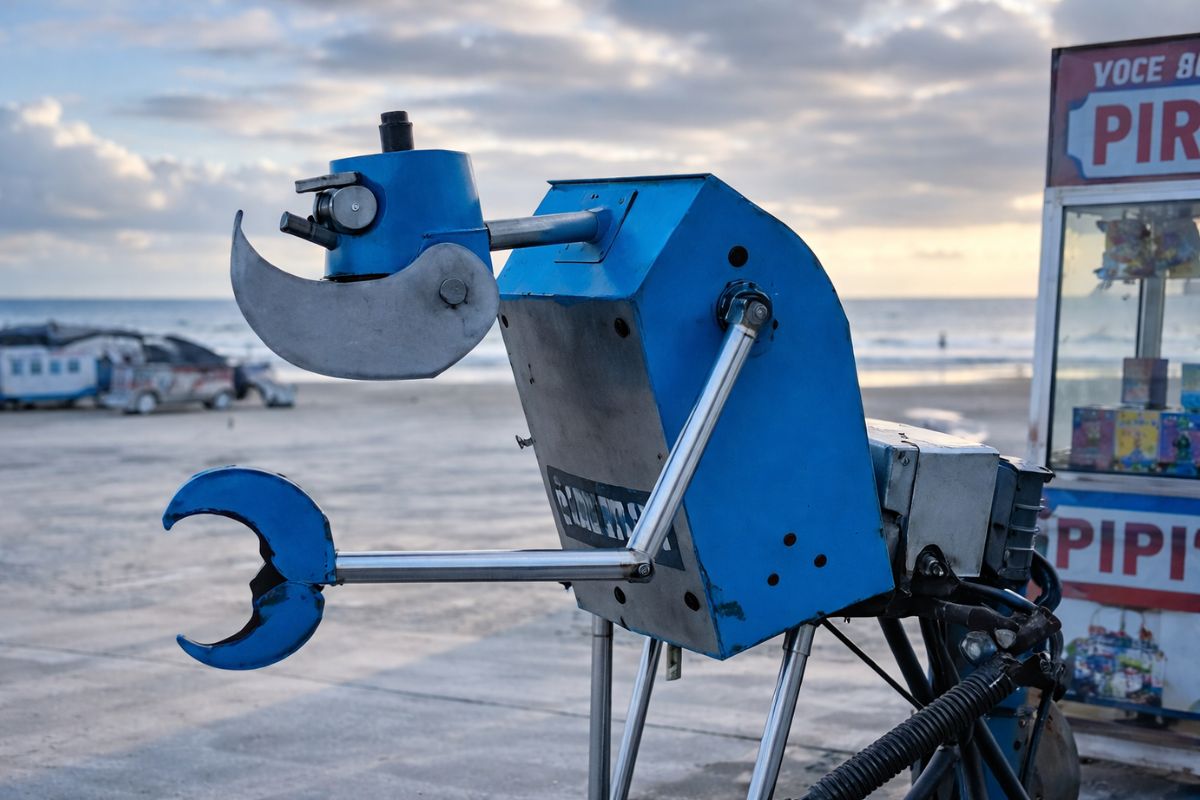
A street vendor from Praia Grande built a robot made of scrap from scooters and washing machines that pulls his popcorn cart on the beach, emits sounds, and interacts with customers, becoming an attraction on the coast of São Paulo.
-
The specifications of the Xiaomi 18 Pro Max have been leaked, and the highlight is a dual 200 MP camera with a new 22-nanometer technology that promises to consume less energy and capture details in shadows and bright areas using LOFIC HDR.


Another highlighted point by the team was mechanical strength. Tests confirmed resistance to compressive, flexural, and abrasive forces, as well as good plasticity for complex shapes. This ensures versatility in the design of roofs and walls.
Performance In Real Environments
Practical tests showed significant results. During the hottest part of the day, between 1 PM and 2 PM, when the ambient temperature reached 38.4 °C, the supercool cement remained 5.4 °C below the surrounding temperature.
In the same scenario, conventional cement heated up to 15 °C more, highlighting the performance contrast.
According to the researchers, the material can act as a radiative and structural cooler, functioning in roofs and walls. This application could significantly reduce the need for air conditioning systems in urban areas.
How The Cement Was Developed
The team began the process by adjusting the chemical composition of the clinker particles, which form the base of the cement.
The aim was to create a structure capable of efficiently dispersing sunlight. Then, they applied pressure to obtain the final material, already with cooling functionality.
The study, published in the journal Science Advances, showed that the self-assembly of reflective etringites in different sizes, combined with hierarchical pores, ensured a solar reflectance of 96.2%.
Additionally, the raw materials used, rich in alumina and sulfur, raised the emissivity in the mid-infrared to 96%.
Economic And Environmental Advantages
The supercool cement also stands out for its cost-effectiveness. The manufacturing processes are scalable, allowing for mass production.
This characteristic gives it an advantage over other cooling materials, which are often expensive or limited in practical applications.
Moreover, a life cycle assessment with machine learning indicated that the material has the potential to achieve a negative net carbon emission profile.
This means that its production and use can help reduce environmental impacts and contribute to climate response.
Large-Scale Application
Guo Lu, the researcher and first author of the study, stated that the use of cement in urban buildings could result in substantial energy savings.
According to him, the development transforms conventional cement, known for retaining heat, into a sustainable material capable of reflecting and emitting solar heat.
The scientists also emphasized that the technology is applicable to traditional Portland cement.
Through surface enrichment with etringite, it would be possible to achieve similar levels of performance, expanding the adoption of the solution across different types of construction.
A New Horizon In The Construction Industry
The results show that supercool cement combines energy efficiency, structural strength, and economic viability. As it adapts to severe environments, it can be used in roofs and walls without compromising its durability.
This advancement could represent a shift in the construction sector because it offers a concrete alternative to reduce urban temperatures while simultaneously decreasing electricity consumption for cooling.
Therefore, the innovation emerges as an important piece in the global challenge of addressing climate change.








Seja o primeiro a reagir!