Portuguese
  Spanish


China Takes the Lead in Shipbuilding Revolution, Launching the Eco Maestro, the World’s Second Methanol-Powered Container Ship, a Milestone for a Cleaner Industry.
In a demonstration of commitment to innovation and sustainability, China recently launched the Eco Maestro, the second methanol-powered ship on the planet, the first was from Maersk. This initiative positions Chinese shipbuilding at the forefront of cleaner technologies, aiming to reduce pollutant emissions.
On August 17, China introduced to the world the second methanol dual-fuel container ship, named Eco Maestro. This initiative is part of a comprehensive effort to accelerate the adoption of alternative fuels in the maritime industry.
Watch the Launch of the ECO MAESTRO, the 2nd Methanol-Powered Ship in the World
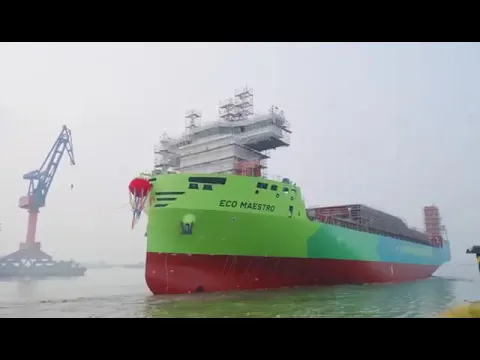

The vessel, a collaboration between German naval architects from TECHNOLOG Services and Singapore-based X-Press Feeders, is just the beginning of a series of 14 orders. Set to operate in the second quarter of 2024, the Eco Maestro will establish routes in Northern Europe, having the capacity to carry 950 TEUs and a deadweight of 13,900 tons.
-
Volvo’s New Loaders Feature Obstacle Detection, Automatic Braking, and 360-Degree Operator View

-
Chinese Manager Accused of Whipping Worker Sparks Protest by 1,200 Employees at Major Brazilian Factory

-
The FLIP: A 108-Meter Ocean Laboratory That Stood Vertically for 60 Years, Dismantled in 2023

-
France Revamps 530 Social Housing Units with Large Balconies and Glass Facades Without Demolishing Existing Buildings



In addition to its innovative design, the ship will feature a MAN dual-fuel engine, designed to operate on green methanol, strengthening China’s position in sustainable shipbuilding.
The vessel has been designed with several features that favor energy efficiency, including shaft generators, adjustable propellers, and a rudder with a lifted flap. With a projected speed of 14 knots, it will meet the requirements of the Energy Efficiency Index for Ships and Tier 3 standards.
X-Press Feeders, in line with Maersk, has used the ship’s appearance to emphasize its environmental message, with the slogan “The Greener Feeder Carriers of Choice” emblazoned on the hull of the Eco Maestro.
Future Orders and Advances in Onboard Living
China’s commitment to shipbuilding and the use of green methanol is not limited to a single project. The company has ordered six more ships from CSSC Huangpu Wenchong Shipbuilding, with deliveries scheduled from 2025 to 2026.
At the same time, it has signed an agreement with OCI Global for the supply of green methanol in Rotterdam starting in 2024, and OCI, in collaboration with Unibarge, is adapting a bunker tanker to supply methanol in the region.
In addition to its focus on sustainability, the Eco Maestro and its sister ships have been designed with a hatchless concept, lowering the center of gravity and increasing cargo capacity. Innovative engineering, with the positioning of the engine room at the bow and improvements on the first deck, also aims to enhance crew living spaces.
The first ship in this series, planned to operate from Rotterdam, will begin its journey in mid-2024, marking a new chapter in shipbuilding history, with China playing a key role in the transition to a cleaner and more efficient industry.
The launch of the Eco Maestro symbolizes a significant advancement in shipbuilding and underscores China’s commitment to innovation and sustainability. The future of the maritime industry is changing, and the world is closely watching this green revolution led by China, eager for what is to come.