





 Portuguese
  English
  Spanish
  5 min of reading
  1 comment


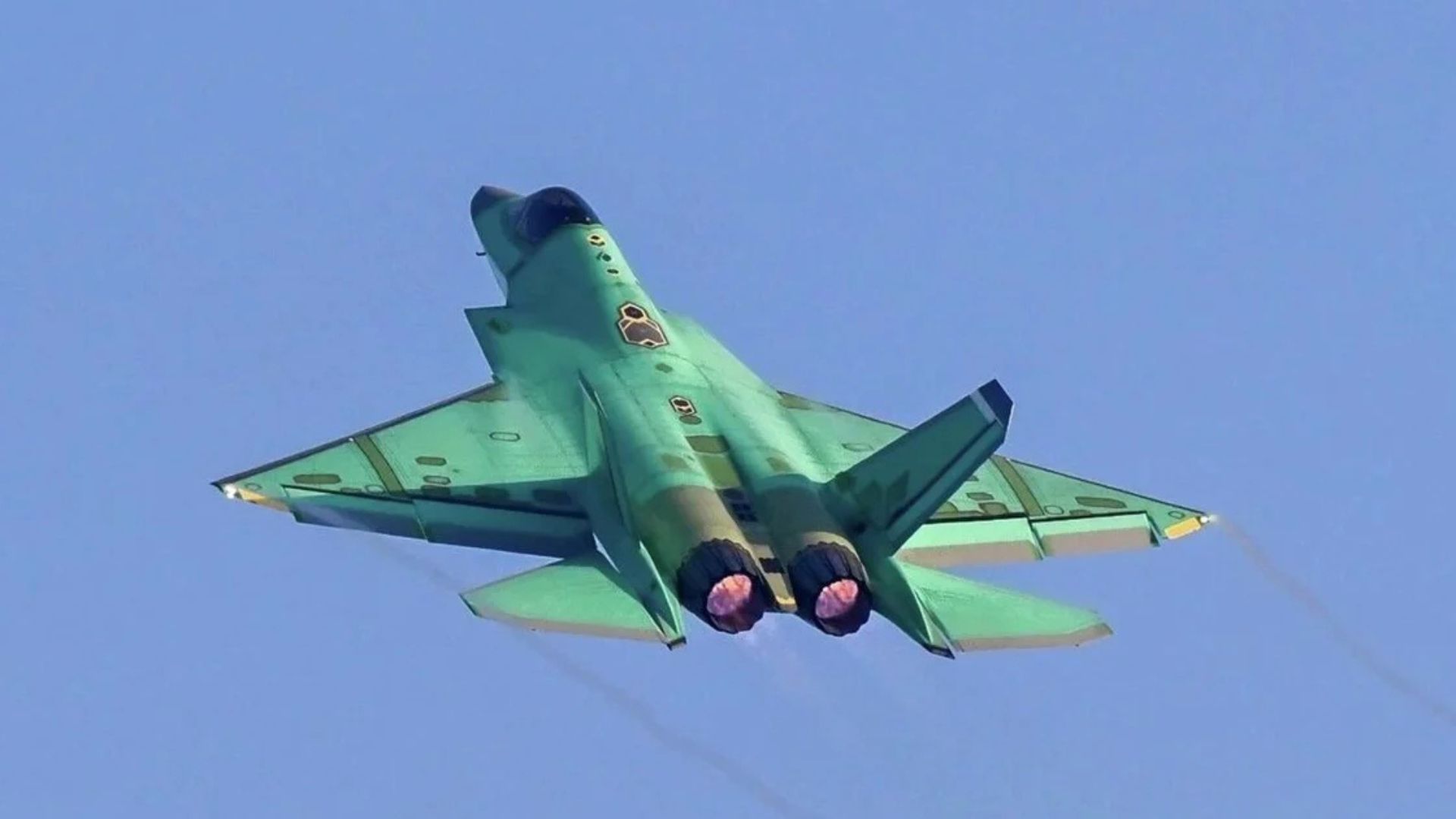


Unpublished Images of a Stealth Fighter Embedded in Industrial Stage Reveal Signs of Factory Expansion, Continuous Testing and a Communication Strategy Aimed at Highlighting Productive Capacity Without Exposing Sensitive Performance or Armament Data.
Official images released in early 2026 showed the J-35, a Chinese stealth fighter designed for operations on aircraft carriers, taking off with a uniform green coating that is not typically seen on aircraft already ready for service.
The material, published by state channels and reproduced by local media, indicates that the jet was in the factory testing stage and still required a final coat of paint, while simultaneously reinforcing a message of industrial capability from the manufacturer in Shenyang, Northeast China.
The very CGTN described the takeoff as the “first flight” of the year for the model and stated that the aircraft was “covered with a green primer,” an explicit indication that it was a specimen undergoing industrial testing routine.
-
He started running at 66 years old, broke records at 82, and is now a subject of study for having a metabolic age comparable to that of a 20-year-old, in a case that is intriguing scientists and inspiring the world.

-
Oldest tree on the planet reappears after 130 years of searches: Wattieza, 385 million years old, was 10 meters tall and had no leaves or seeds; Gilboa fossils in New York solved the mystery in 2007.

-
A 48-square-meter house assembled in hours with 4,000 bricks made of recycled plastic that does not absorb moisture, has natural thermal insulation, and costs less than 90,000 reais in a complete kit.

-
Luciano Hang revealed that Havan’s air fleet has already accumulated more than 20,000 landings, 10,000 flight hours, and 6 million kilometers traveled, and he says that without the planes, the company would never have grown so quickly.


The broadcaster added that the jet is in the phase of flight tests conducted from the factory and will receive a definitive paint job later.
The Meaning of the “Green Skin” in the J-35 Program
The green tone, informally referred to as “green skin” on social media, appears associated with the primer used in assembly and verification stages.
Instead of the usual gray associated with aircraft with tactical finishes, the material seen in the images suggests an earlier stage, where the priority is to validate adjustments and performance under factory standards before the final coating.
This interpretation was reinforced by reports that treated the episode as a showcase of the production process.

By showcasing a fighter still without the typical fleet finishing, the communication shifts the focus from the finished product to the assembly line, providing visibility to checking cycles and a testing cadence associated with future deliveries.
Origin of the Images and the Role of Shenyang
The Chinese state media located the flight recording at facilities linked to Shenyang Aircraft Corporation, a subsidiary of the AVIC conglomerate.
According to the Global Times, the images and video were published on the company’s official account on Chinese social media and showed the takeoff occurring in Shenyang, Liaoning province.
Along the same lines, the report described the J-35 as the naval variant of a family that includes the J-35A, associated with the Air Force.
The text also included the program in a sequence of recent public appearances, mentioning that the fighter had drawn attention since previous official presentations.
This framing is relevant as it connects the disclosure of the “green” to a broader context of selective exposure of the industrial process.
This is not just about showing a flight, but about recording the production environment and suggesting material advancement of the program, with aircraft already circulating in factory routines.
Goal of Doubling Production and Industrial Expansion
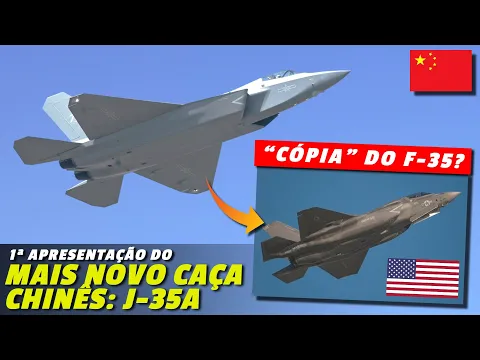

The movement gained another layer when the South China Morning Post related the release of the video to a goal announced by the manufacturer.
According to the newspaper, the plan is to double the production of warplanes within a timeframe of three to five years.
The material displayed a J-35 in green primer accelerating on the runway and taking off in Liaoning.
Additionally, images showed two specimens in the same shade parked at the airfield, described as freshly out of production because they did not yet exhibit the typical gray finish of aircraft in service.
In parallel, the report cited information attributed to Liaoning Daily, indicating that the main assembly plant of a new manufacturing complex would be completed by the end of June of the previous year.
The text stated that the assembly of products had already begun and that there was an expectation of entering into mass production in the following stage.
The data also included references to previous investments for the construction of a new production site.
The project was associated with a “aerospace city” planned for the Shenyang region.
In this context, the set of works and goals is used as a public signal of expansion, while the display of the fighter in primer serves as visual evidence of industrial activity.
Factory Testing and Strategic Communication

By defining the J-35 as a next-generation stealth fighter with multirole capabilities, the CGTN emphasized a broad mission profile without delving into sensitive operational details.
The approach reinforces a central argument of the disclosure.
A program of this scale requires repeated flights, validations and certifications before reaching a larger delivery cadence.
The released material was presented as part of this cycle.
Meanwhile, the Global Times added that the J-35 gained attention since its appearance at official events in 2025.
The newspaper positioned the model within a communication strategy in which the industry and state media show more cuts of the production process when the projects have already been presented to the public.
This type of exposure, although controlled, amplifies the perception of progress by shifting the narrative from the prototype to the factory flow.
International Impact of Selective Transparency
The display of a naval stealth fighter in the factory stage often draws attention for two reasons simultaneously.
The unusual appearance of the green primer serves as evidence of the industrial schedule, even if it does not reveal performance.
Additionally, the decision to release high-visibility images in a testing environment suggests an intention to communicate confidence in processes and manufacturing capability.
In this context, the “green skin” ceases to be just a finishing detail.
It becomes a phase marker, indicating that the filmed specimen was not, at that moment, the visual standard of an aircraft ready for service.
Nevertheless, the gesture of making this stage public can be interpreted as part of a broader strategy to demonstrate scale and production regularity.
If images of tests and aircraft in primer suggest industrial cadence and capacity expansion, what effect can this type of behind-the-scenes exposure have on how other countries evaluate the actual pace of stealth fighter manufacturing in China?








Eu tive a leve impressão quê a China copiou o caça americano,nossa eles são especialistas em falsificação.!