





 English
  Francês
  Alemão
  Italiano
  Japonês
  Norueguês
  Portuguese
  Spanish
  5 min of reading
  0 comments


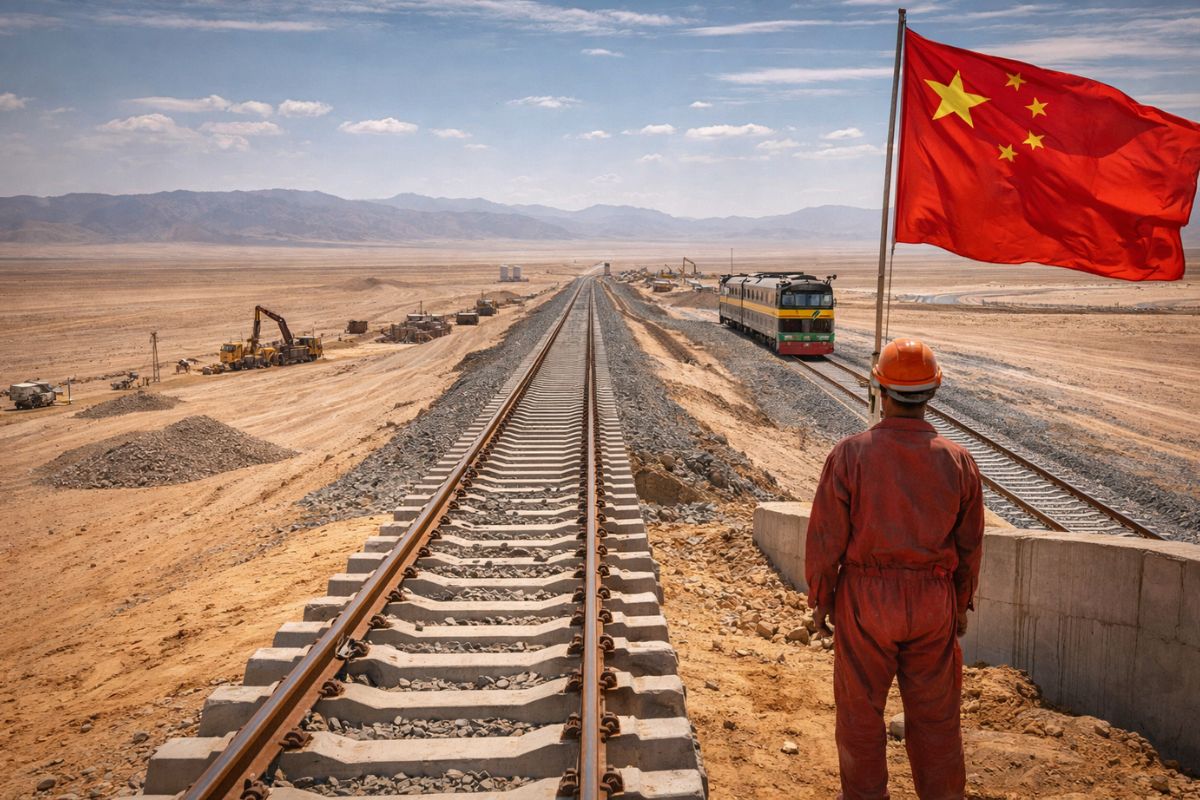
Since 2012, China and Mongolia have been trying to complete a 234-kilometer railway through the Gobi Desert to transport coal and metals without relying on trucks. The first phase was inaugurated, but the final section at the border encounters a gauge difference between the two countries that makes the last 20 kilometers the biggest logistical challenge in Central Asia.
China and Mongolia have been trying for over a decade to solve one of the most expensive logistical problems in Asia: transporting coal and metals from Mongolian mines to Chinese steel mills without relying on endless convoys of trucks crossing the Gobi Desert. The solution lies in a railway between the Tavan Tolgoi mines and China’s railway network, capable of transporting up to 50 million tons of cargo per year. The project has been under discussion since 2012 and, after delays and stoppages, the first phase has been completed. Nevertheless, the last 20 kilometers remain the most difficult section of the entire project.
The second phase began in 2025: a cross-border link of just 19.5 kilometers at the Gashuun Sukhait/Gantsmod pass, with completion expected in 2027. The fact that China can remodel a railway station overnight but takes 22 months to build less than 20 kilometers illustrates the exact nature of the technical and topographical challenges involved. The gauge difference between Mongolian and Chinese tracks is the core of a problem that seems simple on the map but is brutal in engineering.
Why Mongolia needs this railway: coal, copper, and dependence on China

Mongolia has some of the largest mineral reserves in the world but has no access to the sea. Tavan Tolgoi is one of the largest unexplored coking coal reserves on the planet, estimated at 6.4 billion tons.
-
Seen from space, a colossal ‘Y’ cuts through the largest desert in China, blending a jade-filled river, red and white mountains, and revealing the absurd scale of the transformation of the Taklamakan surrounded by a green wall with billions of trees.

-
The Pacific Ocean reveals what the cliffs of Big Sur have hidden for millennia: Pfeiffer Beach, in California, features swirling purple sand formed by garnet crystals and displays a stone arch that is illuminated by the sun in winter for just a few days each year.

-
Aursjøvegen in Norway is a 100-kilometer gravel road that crosses chasms and dark tunnels carved into the rock at an altitude of 947 meters in the fjords and is only open for four months a year.
-
With about 4,000 m², the building constructed in a traditional neighborhood in France looks like a rainbow, has a colorful facade, mixes vibrant glass, and creates one of the most unusual visuals in Bordeaux.


Oyu Tolgoi is rich in copper and gold, with projected production of 500,000 tons of copper per year by 2030. Historically, China has been the largest importer of Mongolian coal. Transportation still largely depends on huge lines of trucks crossing the Gobi Desert, in a slow, costly, and environmentally devastating method.
From an economic and environmental perspective, switching to rail transport is the most rational option. However, the Mongolian railway network faces serious limitations. There are 1,815 kilometers of Soviet-gauge tracks, mostly single track, with restricted capacity and vulnerable to snow in winter and sand from the Gobi Desert in summer.
For China, securing this corridor is strategic. A few years ago, the country faced a ban on Australian coal, forcing it to urgently seek supplies from Russia and Mongolia.
Phase 1 of the railway in the Gobi Desert: 234 kilometers of troubled works

The history of this railway is, at the very least, full of setbacks. It all began in 2012 when the Mongolian Mining Corporation announced the construction of a line between Ukhaa Khudag and the Gashuun Sukhait border, with completion expected in 2015.
Earthworks began, but the project was halted due to economic and political issues, including a dispute over the choice of track gauge, between the Soviet gauge and the international standard. Work only resumed in 2018 under new management.
Finally, the line was inaugurated in 2022, extending 233.6 kilometers through the Gobi Desert, with 16 bridges and a capacity to support axle loads of 25 tons.
According to Tavantolgoi Railway LLC, the price per ton of coal transported dropped from $32 to $8. This 75% reduction demonstrates the direct impact of the railway on logistical costs. However, the Mongolian line reached the border and stopped there. Coal continued to be unable to cross to the Chinese side by train.
The gauge problem: why the last 20 kilometers are the most difficult
The Mongolian railway reached the border in 2022, but a critical obstacle prevented the continuation of transport. Mongolia uses the Soviet gauge of 1,520 mm, while China uses 1,435 mm, the international standard gauge.
This difference of 85 millimeters may seem insignificant, but in practice, it forces the complete transshipment of goods at the Gashuun Sukhait crossing, with all the delays, costs, and inconveniences that this entails.
The solution found by China and Mongolia is the construction of a dual-gauge line, extending the tracks of both systems to a shared area, allowing Mongolian and Chinese trains to enter without transfers.
This cross-border link will be 19.5 kilometers long and will include bridges with heights between 8 and 31 meters, necessary to overcome the topographical difference between the two sides of the border. The Chinese side is being built by the state-owned China Energy Investment Corporation, and the Mongolian side by Tavantolgoi Railway LLC.
What China and Mongolia gain when the railway is ready
For China, the railway corridor closes a strategic logistics chain at a time when there is global pressure on the supply of essential raw materials.
The average export volume from Mongolia is expected to jump from 83 million tons to 165 million tons per year, representing an estimated increase of $1.5 billion (about R$ 7.7 billion), according to the Mongolian government. The railway will ensure China direct and stable access to Mongolian coking coal and copper, reducing its vulnerability to international sanctions and embargoes.
For Mongolia, the gains are evident but accompanied by a risk. The country already exports 90% of its raw materials to China, and the new railway is likely to reinforce this dependence.
Modern infrastructure facilitates export but also deepens the economic link with Beijing. It is a delicate balance between internal development and commercial sovereignty, and the railway in the Gobi Desert is at the center of this equation.
Extreme temperatures and sand: the challenges of building tracks in the Gobi Desert
Besides the gauge issue and political obstacles, the Mongolian section of the railway crosses one of the most hostile environments on the planet. Temperatures in the Gobi Desert range from −40°C in winter to over 40°C in summer, a temperature range that directly affects the structure of the tracks, causing expansion, contraction, and accelerated wear.
Sandstorms are another constant enemy: they bury sections of the track and require ongoing maintenance. Snow in winter further reduces the operational capacity of the line.
For China, which dominates high-speed railway engineering in its own territory, building less than 20 kilometers in an inhospitable region at the border with Mongolia is a reminder that not every project can be resolved with scale and speed.
The Gobi Desert imposes conditions that no schedule can tame, and the 22 months projected for the completion of the final section are already considered optimistic by industry analysts. If the 2027 deadline is met, the railway will have taken 15 years from announcement to full operation. An eternity for a project that spans just over 250 kilometers.
A strategic railway that will transform trade between two countries or yet another pharaonic project stuck in bureaucracy and geography? If China cannot complete 20 kilometers in 13 years, what does that say about the limits of modern engineering? Share your opinion in the comments.









Seja o primeiro a reagir!