





 Portuguese
  English
  Spanish
  5 min of reading
  0 comments


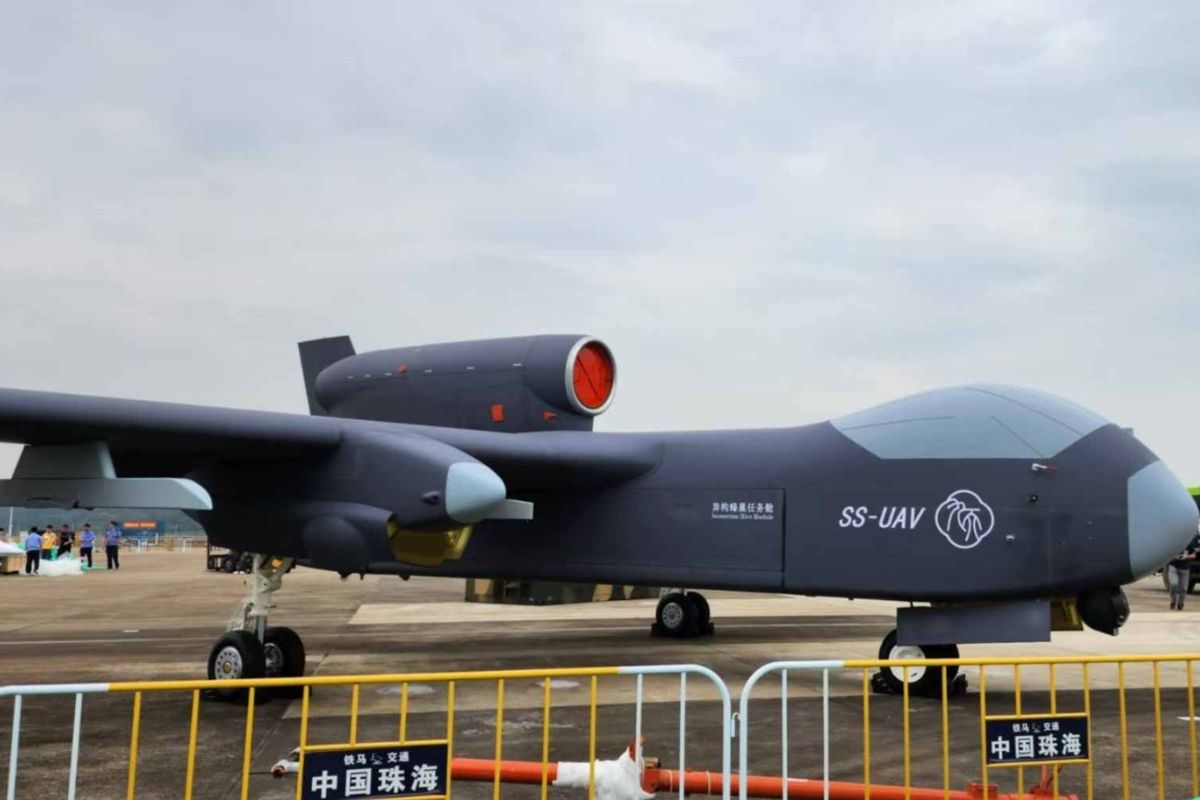
The giant Chinese drone Jetank, also known as Jiutian, completed its inaugural flight in Shaanxi province with a length of 16.35 meters, a wingspan of 25 meters, a maximum weight of 16 tons, a payload capacity of 6 thousand kilos, an autonomy of 12 hours, and a range of 7 thousand kilometers, in addition to a swarm module capable of launching multiple smaller drones or attack munitions directly from the air
China has completed the first flight of a giant drone that changes the understanding of the size and capacity that an unmanned aircraft can achieve. The Jetank, also called Jiutian in official Chinese reports, is 16.35 meters long, has a wingspan of 25 meters, and a maximum takeoff weight of 16 tons. This giant drone carries up to 6 thousand kilos of cargo, flies for 12 consecutive hours, has a range of 7 thousand kilometers, and, most concerning for defense analysts, has a swarm module capable of launching multiple smaller drones directly from the air.
According to Ecoticias, the inaugural flight of the giant drone took place in Pucheng, Shaanxi province, in northwestern China. The aircraft was developed by AVIC and uses a modular cargo system that allows reconfiguration for different missions. China presents the giant drone as a dual-use platform: for disaster relief, forest fire fighting, supply delivery in remote areas, and geographic mapping, but also for military operations with drone swarms and long-range attack munitions.
The numbers of the giant Chinese drone that impress even military analysts

The giant Jetank drone is far from the small quadcopters that most people imagine when they hear the word drone. With a wingspan of 25 meters, it is comparable in size to a manned fighter jet.
-
In the center of the Milky Way, there is a sleeping monster with a mass of 4 million suns, and NASA has already set the date for its awakening: in 2 billion years, a neighboring galaxy will collide with ours and feed it with fresh gas.

-
The Earth has just broken a record that almost no one noticed: the planet is retaining more heat than ever, and the UN warns that this invisible “thermal debt” could trigger heatwaves, storms, and coastal flooding for centuries.

-
Three submerged shipwrecks from the Iron Age found in the port of Dor challenge what was known about trade in the Mediterranean, and only 25% of the site has been excavated.

-
Dialysis as we know it may be numbered: researchers at the University of Southern California have managed to cultivate kidney cells in the lab that refuse to die and form mini-structures that mimic the actual functioning of a kidney.


The payload capacity of 6 thousand kilos is equivalent to that of many manned tactical transport aircraft, and the autonomy of 12 hours with a range of 7 thousand kilometers means that the giant drone can cover intercontinental distances without refueling.
The engine is of the turbofan type, the same principle used in commercial and military jets. The giant drone uses a modular cargo system with eight attachment points, allowing for configuration changes between missions without needing to build a different aircraft for each task.
CCTV reports described an open architecture that gives the giant drone flexibility to carry humanitarian supplies on one mission and attack munitions on the next.
The swarm module: how the giant drone launches other drones into the air
The most talked-about capability of the giant Jetank drone is the heterogeneous hive module. In simple terms, it is a compartment that houses multiple smaller drones and launches them directly from the air during flight.
The giant drone acts as a mothership: it flies to the operational area, opens the module, and releases a swarm of smaller drones that can perform reconnaissance, surveillance, or coordinated attacks autonomously.
Chinese state media and CCTV highlighted that the swarm module can carry not only smaller drones but also long-range attack munitions.
This combination transforms the giant drone into a platform that projects force thousands of kilometers away without exposing human pilots to risk, which alters the strategic calculus of any adversary that needs to face swarms of drones launched by an aircraft that flies for 12 consecutive hours.
The civilian missions of the giant drone: relief, fires, and inaccessible areas
China describes the giant Jetank drone as a dual-use platform, and the list of civilian missions is extensive: delivery of heavy supplies to remote regions in mountains and islands, restoration of communications after disasters, damage assessment, geographic mapping, mineral exploration, maritime enforcement, and forest fire fighting.
The advantage of a giant drone in these scenarios is the ability to transport heavy loads to hard-to-reach locations without building roads, sending truck convoys, or relying on expensive helicopters.
Previous experiences in China with large drones in Yunnan showed that aerial logistics for power lines reduced road construction costs by 80% and labor by 60% in fragile karst regions. Another project preserved nearly 7 hectares of rainforest and over 30 thousand trees in an elephant corridor.
If the giant Jetank drone fulfills its list of civilian missions in practice, it could become a relevant tool for emergencies in places where every hour counts and every open road leaves a permanent mark on the terrain.
The dual-use dilemma: the same giant drone that provides relief can attack
The central problem of the giant Jetank drone is that the same modular design that makes it flexible for humanitarian missions also makes it equally flexible for combat operations. The platform is neither green nor harmful by nature: the impact depends on the mission, the rules of use, and the transparency about where and how it operates.
A giant drone that delivers water and medicine to an isolated mountain on Tuesday can launch swarms of armed drones over disputed territory on Thursday, using exactly the same modular attachment points.
The giant drone is also not a zero-emission solution. Equipped with a turbofan engine, it burns aviation fuel like any conventional jet. Its environmental value would come from reducing ground damage and agility in emergencies, not from a clean operation.
The Jetank is the clearest demonstration so far that China is building unmanned aerial capabilities on a scale that rivals traditional manned aircraft, and this has military, humanitarian, and geopolitical implications simultaneously.
The giant drone that can save lives or change warfare forever
China tested a giant drone with a wingspan of 25 meters that carries 6 tons, flies for 12 hours, reaches 7 thousand kilometers, and can launch swarms of smaller drones directly from the air.
The Jetank is proof that the line between civilian drone and military drone has practically disappeared, and that a giant drone with the capacity of a manned fighter can be as useful for disaster relief as it is frightening for those on the other side of the conflict.
Technology already exists. The question is how and for what it will be used.
What do you find more impressive about the giant Chinese drone: its relief capacity or its military swarm module? Should drones of this size be regulated internationally? Which use should take priority? Leave your comments and share this article with those who follow military technology and innovation.







Seja o primeiro a reagir!