





 Portuguese
  English
  Spanish
  4 min of reading
  0 comments


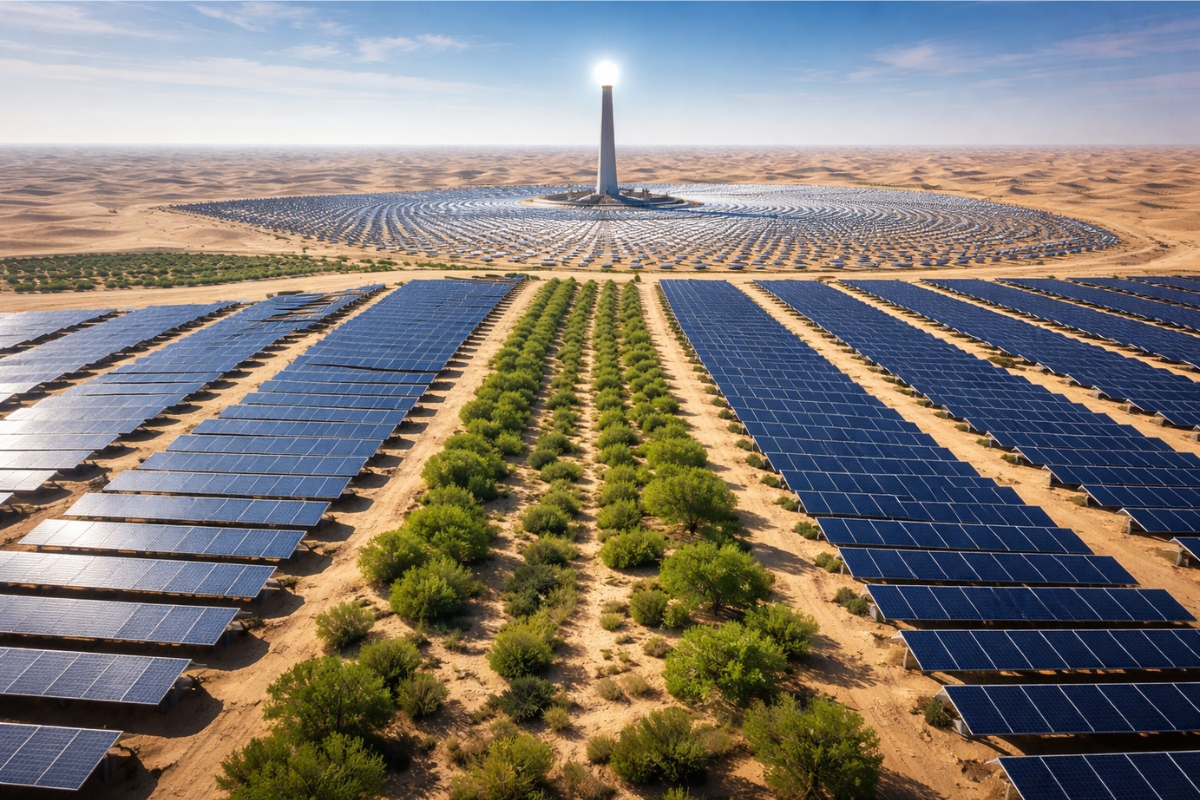
Heliostats Concentrate Light in a Central Tower, Heating Molten Salts That Store Heat for Hours After Sunset and Deliver Cleaner, More Consistent Energy, While Part of the Electricity Maintains Drip Irrigation in the Heart of the Desert
In the heart of one of the harshest deserts in China, a bold experiment aims to address two crises at once: the race for clean energy and the relentless advance of sand dunes.
The proposal is simple to explain and complex to execute: use solar plants and molten salt to generate energy while simultaneously creating green islands in the middle of the sand.
A Desert, A Lot of Sand, and a Plan
The project takes place in arid regions of northern China, such as areas near the Gobi and Taklamakan deserts, where water scarcity, strong winds, and sandstorms are part of daily life.
-
Motorola launched the Signature with a gold seal from DxOMark, tying with the iPhone 17 Pro in camera performance, Snapdragon 8 Gen 5 that surpassed 3 million in benchmarks, and a zoom that impresses even at night.

-
Satellites reveal beneath the Sahara a giant river buried for thousands of kilometers: study shows that the largest hot desert on the planet was once traversed by a river system comparable to the largest on Earth.

-
Scientists have captured something never seen in space: newly born stars are creating gigantic rings of light a thousand times larger than the distance between the Earth and the Sun, and this changes everything we knew about stellar birth.

-
Geologists find traces of a continent that disappeared 155 million years ago after separating from Australia and reveal that it did not sink, but broke into fragments scattered across Southeast Asia.

These zones have been suffering from desertification for decades, affecting crops, cities, and infrastructure, and pushing communities away from the land.
To transform this scenario, engineers and scientists decided to treat the sand not only as a problem but also as a resource.
Millions of tons are moved to level the terrain, stabilize the soil, and create a firm foundation to install solar panels and then plant resilient vegetation.
The goal is not to “end the desert,” but to tame part of it, reducing the impact of the dunes, creating green barriers, and showing that even almost sterile areas can have a new ecological and economic function.

How Solar Plants with Molten Salt Work
The technological heart of the project lies in concentrated solar power plants.
Instead of just covering the desert with photovoltaic panels, gigantic mirrors (heliostats) reflect sunlight to a central tower, where heat is concentrated.
Inside this tower circulates a special fluid: a mixture of molten salts heated to over 540–550 ºC.
This hot salt acts as a thermal battery, storing energy in the form of heat for hours, even after the sun sets.
When electricity needs to be generated, the heat from the salts is used to produce steam, which drives turbines, as in a traditional power plant.
Thus, the system can provide cleaner energy more consistently, avoiding the significant fluctuations typical of regular solar energy.
Part of this electricity feeds the grid, helping to replace coal on a significant scale.
Another part is dedicated to the “energy forest” project itself: pumping water, moving sensors, controlling valves, and ensuring that plants survive in an extreme environment.

Panels That Create Shade and Water the Desert
In addition to the molten salt towers, the project combines large areas of photovoltaic solar panels installed over the desert ground.
These panels form an artificial “ceiling” that creates shade, reduces soil temperature, and decreases the evaporation of the little available water.
Between the rows of panels and beneath them, researchers plant drought-tolerant species, grasses, shrubs, and even experimental crops.
The height and spacing of the modules were adjusted precisely to allow for the passage of machinery, diffuse light, and the growth of vegetation.
The irrigation systems are powered by the energy generated right there.
Pumps draw water from underground aquifers or brackish sources, which are directed by drip irrigation, reducing waste and using plants capable of withstanding high salt levels.
Over time, these green islands help to fix the soil, slow down wind speed at the surface, and retain more moisture, creating a slightly more favorable microclimate.
The visible result is a strong contrast: bands of blue (panels) and green (plants) gaining ground over the yellow of the sand.
Energy, Climate, and Future of Desertification
From an energy perspective, some of these solar complexes are gigantic.
There are stations with capacities of 100 megawatts or more, capable of producing more than 1 billion kilowatt-hours per year, saving hundreds of thousands of tons of coal.
At the same time, the country has launched national plans to expand this “solar + ecological restoration” model on a large scale.
By 2030, the goal is to install more than 250 gigawatts of solar capacity in arid northern regions, recovering hundreds of thousands of hectares of degraded land.
But the project is not free of criticism and challenges.
Recent studies remind us that, in previous desert forest experiments, massive planting consumed a lot of water and altered water availability in some areas, forcing adjustments in strategy.
Now, the promise is to learn from the mistakes.
By combining high-efficiency solar energy, molten salt, more intelligent water management, and better-adapted plant species, China is trying to prove that it is possible to generate electricity while pushing the green frontier a few kilometers into the desert.
This article was created based on reports and analyses from international outlets such as Xinhua News Agency and China Daily, which have been documenting Chinese solar energy generation projects in desert areas combined with ecological restoration and desertification combat actions.








-

-

-

-

19 pessoas reagiram a isso.