





 Portuguese
  English
  Spanish
 5 min of reading
  0 comments


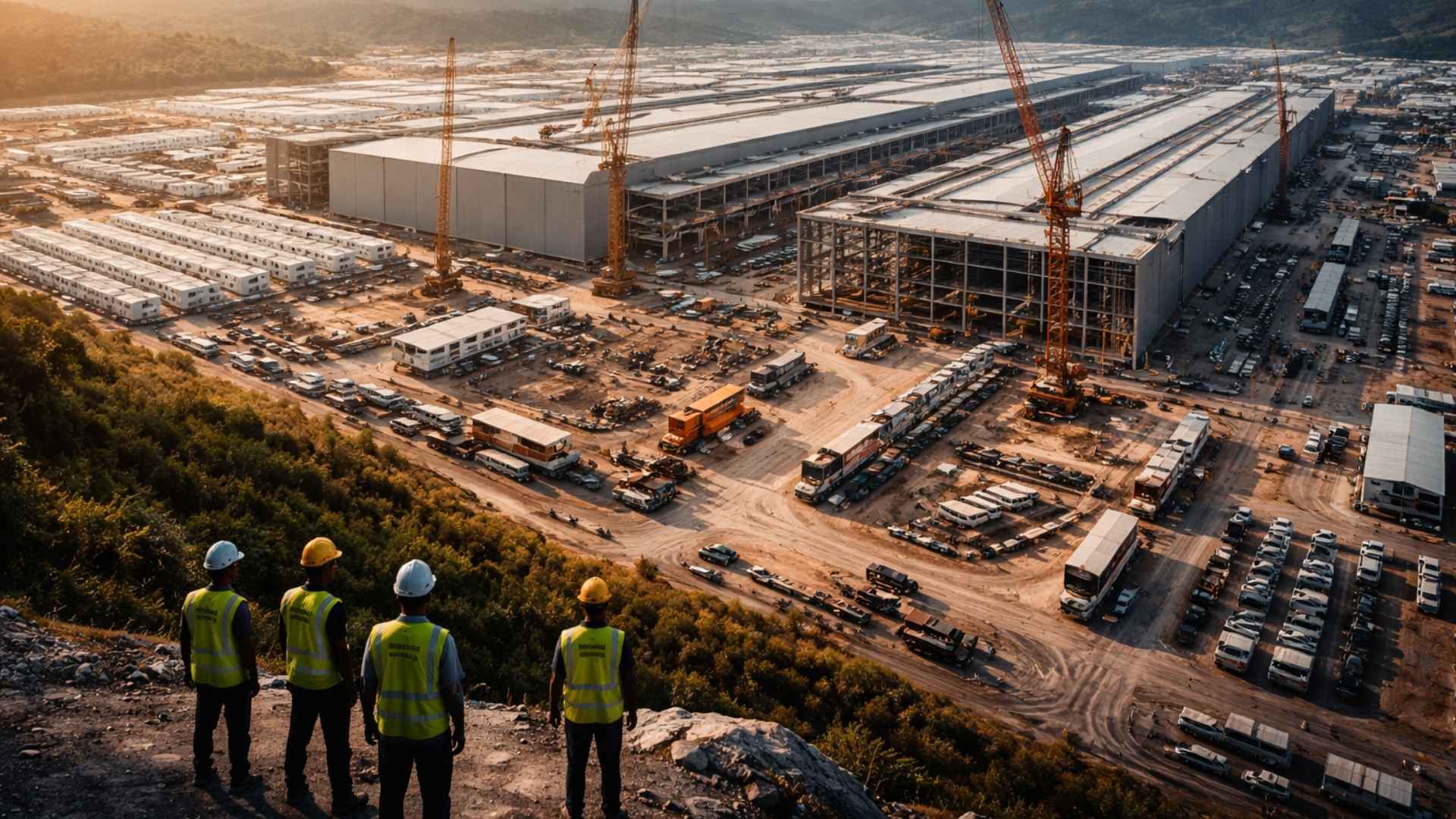
Billion-dollar industrial structure in former Ford area, with growing production, internal accommodations, and labor controversies, raises questions about economic impact, foreign presence, and narrative of “Chinese city” in the Camacari pole in Bahia.
What is advancing in Camacari, in the Metropolitan Region of Salvador, is not a “Chinese city,” but a automotive industrial complex established in the area that belonged to Ford.
The BYD project occupies about 4.65 million square meters, received an investment forecast of R$ 5.5 billion, and has an initial capacity of 150 thousand vehicles per year, with a goal of reaching 600 thousand units annually in subsequent phases.
The operation has already begun, while a significant part of the infrastructure is still being implemented.
-
While Argentina buys old war equipment, Brazil is keeping an eye open and joins the select group of nations with advanced military technology by investing $5.2 billion, producing 36 Gripen fighters in the country, and reducing operational costs.
-
Brazil on alert? Why invading Brazil is a NIGHTMARE for the USA: 8.5 million km², 213 million inhabitants, Amazon covering 60% of the territory, trillion-dollar war, and resistance that even 13,000 aircraft could not control.

-
How to build a floating island from scratch with reeds, giant blocks, and stakes in the lake in a process that needs to be repeated almost every day.
-
A forgotten cord on the floor of a basement in Vienna leads a plumber to a box containing 30 kilograms of gold with Mozart’s face, hidden before World War II. The treasure, worth 2.3 million euros, was just centimeters away from a worker who ignored the sign a day earlier.

The scale of the project helps explain why it has gained so much visibility beyond the limits of the industrial pole.
Instead of a single warehouse, the area includes assembly lines, operational buildings, logistics sectors, yards, areas for suppliers, and support structures that have been adapted or built on the former site of the American automaker.
This set is part of BYD’s strategy to transform the Bahia unit into its largest industrial complex outside of China.
Former Ford factory gives way to electric vehicle pole
The choice of Camacari carries economic and symbolic weight.
The departure of Ford left a significant void in the Bahia automotive chain, impacting employment, tax revenue, and the network of suppliers.
By taking over the area, BYD has been presented by the Bahia government and the company as part of a new phase of reindustrialization associated with electrified and hybrid vehicles, with an expectation of generating up to 20 thousand direct and indirect jobs throughout the consolidation of the project.
This plan, however, is not limited to the final assembly of cars.
The factory was designed to progress in phases.
In the initial stage, production began with assembly in SKD mode, where vehicles arrive partially disassembled for local completion.
At the same time, the company is preparing for the gradual nationalization of more complex industrial stages, such as stamping, welding, and painting, in addition to expanding the supplier base around the plant.
Internal accommodations and origin of the narrative of “Chinese city”
It was in this environment of accelerated implementation that the housing structures emerged that fueled the narrative of the so-called “Chinese city.”
In large industrial projects, especially when teams are relocated for machine installation, building adaptation, and system assembly, it is common to have accommodations and support areas close to the construction site.
In Camacari, these spaces began to house workers linked to the construction and technical preparation of the unit, including foreigners hired by subcontracted companies.
In practice, this arrangement does not constitute a new city or an autonomous neighborhood in formation.
What exists is a large industrial area, with internal infrastructure typical of construction and industrial operation, where accommodation, food, and circulation follow a business logic rather than an urban one.
The lack of clear information in the early moments, combined with the size of the project and the visible presence of Chinese workers, opened space for distorted interpretations on social media.
Rumor about “10 thousand Chinese” and official data
One of the most widespread versions claimed that BYD would be bringing 10 thousand Chinese to fill positions that would belong to Brazilians.
This claim was debunked in recent fact-checks.
According to the company, the number circulated in misleading content referred to the projected jobs generated by the project, not the importation of foreign labor.
In March 2026, the announced expansion was for 3 thousand new hires in Camacari, reinforcing the increase of the local workforce and the start of a new operational rhythm.
Today, the Bahia unit already produces locally the Dolphin Mini, the King, and the Song Pro, while the complex continues to undergo construction to incorporate new production stages and expand the scale.
This means that the factory already exists and operates, but is not yet complete in the form envisioned by the automaker.
In other words, what is being built in Camacari is a partially operational industrial plant, surrounded by a larger expansion project.
Inspection, workers, and impact on construction
The main turning point of the project came with labor inspection conducted at the end of 2024.
In December of that year, a task force formed by public agencies rescued 163 Chinese workers in conditions analogous to slavery at the factory construction site and shut down accommodations and sections of the site.
Later, the Ministry of Labor reported that, in one of the inspection actions, 471 Chinese workers were identified as having been brought to Brazil irregularly, including the 163 rescued.
Auditors reported exhausting work hours, document retention, restrictions on freedom, and degrading accommodation conditions.
The repercussions of the case shifted the focus of public discussion.
The debate moved from merely discussing the size of the investment to involving governance, outsourcing, and responsibility for working conditions at the site.
In June 2025, the federal government reported that the inspection had issued more than 60 notices of violation and attributed direct responsibility to the automaker for the irregular arrival of workers to the site.
BYD severed ties with one of the contracted companies after the case was made public.
The developments continued in the following months.
At the end of 2025, BYD and contractors reached a R$ 40 million agreement as part of the civil public action filed by the Labor Public Prosecutor’s Office.
The amount was allocated for individual compensations and collective reparations, closing one of the most sensitive judicial fronts of the episode.
Although production and expansion of the factory have progressed, the case has permanently accompanied the image of the project in Bahia.
What is being built in Camacari in practice
From an industrial perspective, Camacari is receiving an automotive hub focused on assembly and, progressively, on the more complete manufacturing of electrified vehicles.
From an economic perspective, it is a bet to reposition Bahia on the map of the national automotive industry after Ford’s departure.
From a social and institutional perspective, the complex has become a test of how large foreign investments will be monitored, integrated into the local economy, and held accountable for labor standards compatible with Brazilian legislation.
Therefore, the expression “Chinese city” oversimplifies a much more concrete and delicate situation.
What exists in Camacari is an operational factory, a construction site still expanding, accommodations linked to the project, and an unusual industrial scale plan for the Brazilian automotive sector.
The size of the investment is real, the promise of economic reactivation is also real, but the recent history shows that the impact of the project will not be measured solely by the number of cars produced or the billions announced, but by how this new structure connects to work, the regional chain, and the territory that has once again concentrated one of the largest industrial bets in the country.





Seja o primeiro a reagir!