





 Portuguese
  English
  Spanish
  4 min of reading
  0 comments


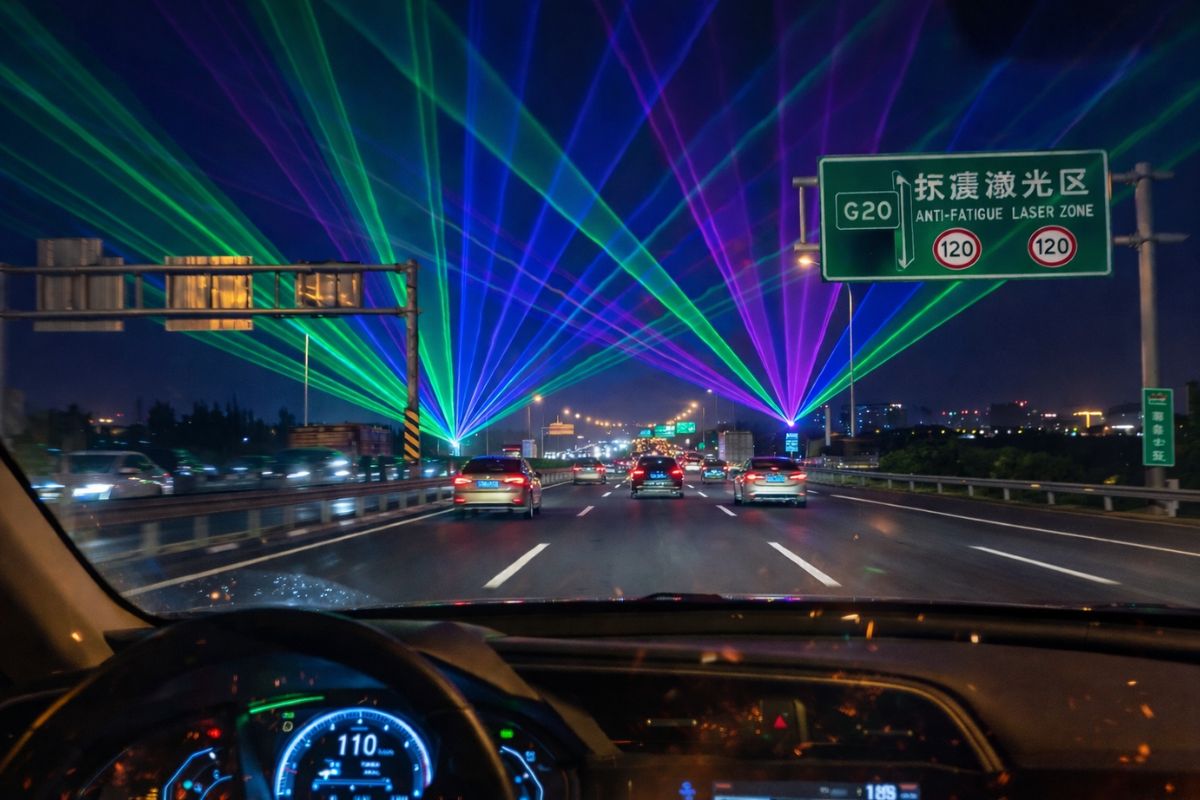
China has installed laser projectors at strategic points on highways that emit beams of green, blue, and red light above the drivers’ field of vision, creating peripheral stimuli that force the brain to regain attention on a road network where fatigue accounts for about 20% of fatal accidents.
Images of highways in Shandong province, China, went viral on social media showing a scene that looks like it’s straight out of science fiction: colorful laser beams sweeping the sky and the barriers in colors like green, blue, and red. But behind the visual spectacle lies engineering focused strictly on preserving life. China has installed anti-fatigue laser lights on high-speed highways to solve one of the oldest and deadliest problems in ground transportation: drivers falling asleep at the wheel on long and monotonous routes.
The problem is real and measurable. China has the largest high-speed highway network on the planet, and fatigue while driving is responsible for about 20% of fatal accidents on these stretches. On straight routes that extend for hours, the human brain tends to enter a hypnotic state; the monotony of the road, the constant darkness, and the repetition of the scenery induce drowsiness. The laser lights in China attack this phenomenon before it happens, functioning as a visual alarm that operates continuously at the most critical points.
How the laser lights that China installed on highways work
The system consists of projectors installed on elevated gantries or on the sides of the road, at strategic points where the monotony of the road reaches its peak. According to information from the portal Agron and CNN Brazil, the devices emit beams that sweep the sky and the protective barriers in a rhythmic manner, but a crucial detail is that the laser is not aimed directly at the driver’s eyes. The light is projected above or around the central field of vision, creating a peripheral stimulus that forces the brain to regain attention without causing glare.
-
American couple renovates over 100-year-old castle in Texas and transforms historic building with Italian marble, mahogany panels, and eight fireplaces into a retreat that blends memory, grandeur, and comfort.

-
Japan is transforming used disposable chopsticks into an ambitious and surprising project that could forever change the way restaurants and offices handle one of the most common waste products of urban life.

-
Father wins a brand new car in a raffle he organized himself at church.

-
Embraer presents the KC-390 Millennium, the largest military aircraft in Latin America, capable of transporting 26 tons, evacuating 74 patients, conducting in-flight refueling, and operating tactical missions with advanced technology, showcased at FIDAE 2026.
In practice, China’s technology functions as an active visual alert. While traditional methods, such as sound emitters on the asphalt, rely on the driver having already made a mistake by leaving the lane to act, the lasers work on prevention.
Experts point out that the variation of colors and movements is essential to keep the visual cortex engaged, preventing the driver from losing depth or speed perception due to accumulated fatigue.
The absolute darkness that usually dominates nighttime stretches of highways is broken by light patterns that the brain cannot ignore.
Why China needs this technology more than any other country
The scale of the problem in China explains the investment. The country has more than 177,000 kilometers of expressways, the largest network of its kind in the world, and millions of trucks circulate daily on routes that can last 10, 15, or 20 hours.
A serious accident on a vital highway in China is not just a human tragedy; it is a logistical disruption that can last for hours and generate cascading economic losses for transport companies and entire industries.
The cost of installing the lasers is significantly lower than the expenses generated by traffic accidents, which include everything from medical rescues to complex structural repairs. The economic logic of China is clear: prevention is cheaper than remediation.
A loaded truck driver who begins to lose focus after hours of travel, upon entering a zone with laser lights, receives an immediate visual stimulus that acts as a silent alarm, allowing them to regain the situational awareness needed to arrive safely at the next stop.
Questions about safety and the limits of laser technology
Despite the reported success, legitimate questions arise. Could people with photosensitivity or photosensitive epilepsy be affected by the pulsing light patterns?
The Chinese authorities assure that the lasers undergo rigorous calibrations to ensure that the light intensity is effective without being harmful; the power is calculated to stimulate peripheral vision without reaching the threshold of glare or discomfort.
There is also the question of whether the lasers could, paradoxically, distract instead of alert. The answer lies in the positioning: the beams are projected above and around the central field of vision, not within it.
The driver does not need to look at the lasers; the light automatically reaches peripheral vision, a channel that the brain processes without requiring conscious attention. It’s the same logic that makes you notice a flash of light in the corner of your eye even when you are focused on something else.
What this technology from China could mean for Brazilian highways
In Brazil, highways like BR-116 and BR-101 are known for high rates of nighttime accidents caused by fatigue.
Fatigue while driving is still primarily combated with passive signage and enforcement methods that are often insufficient to overcome the extreme physical fatigue of truck drivers who travel hundreds of kilometers at night. China’s laser technology could be an applicable solution for these critical stretches.
The use of anti-fatigue laser lights proves that road safety is evolving beyond asphalt and concrete. While full automation of vehicles is not a reality for everyone, protecting the most vulnerable link—the human driver—remains a priority.
China demonstrates that visual innovation can be a powerful ally of modern traffic engineering, transforming lighting into a survival tool. The question remains: how long will it take for other countries to adopt something that already works?
Do you think anti-fatigue laser lights should be installed on Brazilian highways?






Seja o primeiro a reagir!