





 English
  Francês
  Alemão
  Italiano
  Japonês
  Norueguês
  Portuguese
  Spanish
  3 min of reading
  0 comments


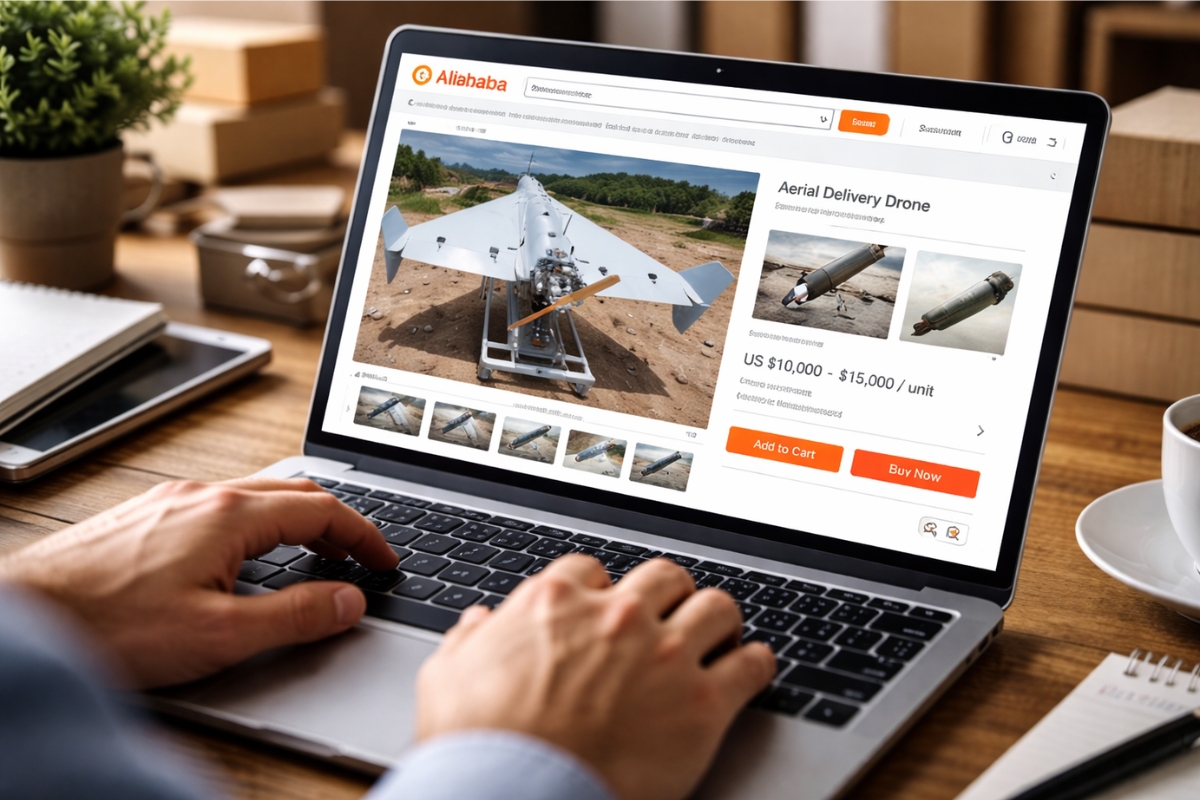
China sees increased pressure on digital trade after offer of drones similar to the Shahed 136, capable of carrying explosives and circulating as civilian products in mass sales channels
Drones advertised as tools for agriculture, logistics, and remote inspection circulated in catalogs of sellers linked to Alibaba in China. The most sensitive detail appeared outside the public showcase, when buyers received private materials with a different product description.
In these documents, the equipment was presented as models capable of carrying bombs of up to 2 kg for up to 100 kilometers. The case raised an alert about the ease of offering items with military potential on widely accessible digital platforms.
Public catalogs hid the real use of drones
In the presentation open to customers, the drones appeared as solutions for aerial mapping, agricultural spraying, deliveries, and inspections in remote areas. The proposal seemed commercial and common, with no clear signs of military purpose.
-
Seen from space, a colossal ‘Y’ cuts through the largest desert in China, blending a jade-filled river, red and white mountains, and revealing the absurd scale of the transformation of the Taklamakan surrounded by a green wall with billions of trees.

-
The Pacific Ocean reveals what the cliffs of Big Sur have hidden for millennia: Pfeiffer Beach, in California, features swirling purple sand formed by garnet crystals and displays a stone arch that is illuminated by the sun in winter for just a few days each year.

-
Aursjøvegen in Norway is a 100-kilometer gravel road that crosses chasms and dark tunnels carved into the rock at an altitude of 947 meters in the fjords and is only open for four months a year.

-
With about 4,000 m², the building constructed in a traditional neighborhood in France looks like a rainbow, has a colorful facade, mixes vibrant glass, and creates one of the most unusual visuals in Bordeaux.


The situation changed when the contact advanced. From there, reserved catalogs emerged with more explicit descriptions, including images and functions related to the transport of explosives and attack operations.

Models resembled the Shahed 136 used in recent wars
The images showed drones very similar to the Shahed 136, known for its delta wing shape and frequent use in armed conflicts. Other models also appeared with a profile closer to missiles and variants aimed at aerial launches.
In addition to payload capacity, sellers highlighted features such as thermal cameras. In some cases, the materials even displayed the type of explosive that could be carried and released on the battlefield.
ABC News enters the case and Alibaba removes accounts and products
According to ABC News, a U.S. news outlet with international coverage, journalists had access to these catalogs and spoke with sellers who explained how they avoided penalties on the platforms by classifying the equipment as for commercial use.
After the alert, Alibaba removed the listings and also took down the involved accounts. The company emphasized that its terms of use prohibit the sale of military products, signaling a direct reaction to the exposed risk.

Commercial strategy tried to evade platform rules
Some sellers argued that the drones could not be called combat drones because they were sold without ammunition and without installed weapons. The logic used was that the product would leave the factory without the final configuration for offensive use.
There were also those who compared the sale to a car, claiming that the manufacturer would not control the use made by the buyer. This line of defense shows how classification loopholes can be used to push equipment with clear military potential into the market.
Digital offer of military drones increases international pressure
The case amplifies concerns about the online circulation of equipment that can be quickly converted for attacks. When this type of product enters broad sales channels, control becomes less dependent on technology and more on oversight.
It also weighs the fact that the models are similar to systems already associated with recent wars. This alters the reading of digital trade, security, and regulation, as it places civilian platforms within a discussion that already pressures governments and defense forces.
The removal of the listings does not end the problem. The episode shows that commercial presentation can hide much more sensitive capabilities, especially when the decisive material only appears in private contact.
In the end, the impact goes beyond a simple removal of products. The exposure of this parallel market changes the strategic reading and pressures the region.









Seja o primeiro a reagir!