





 Portuguese
  English
  Spanish
  4 min of reading
  1 comment


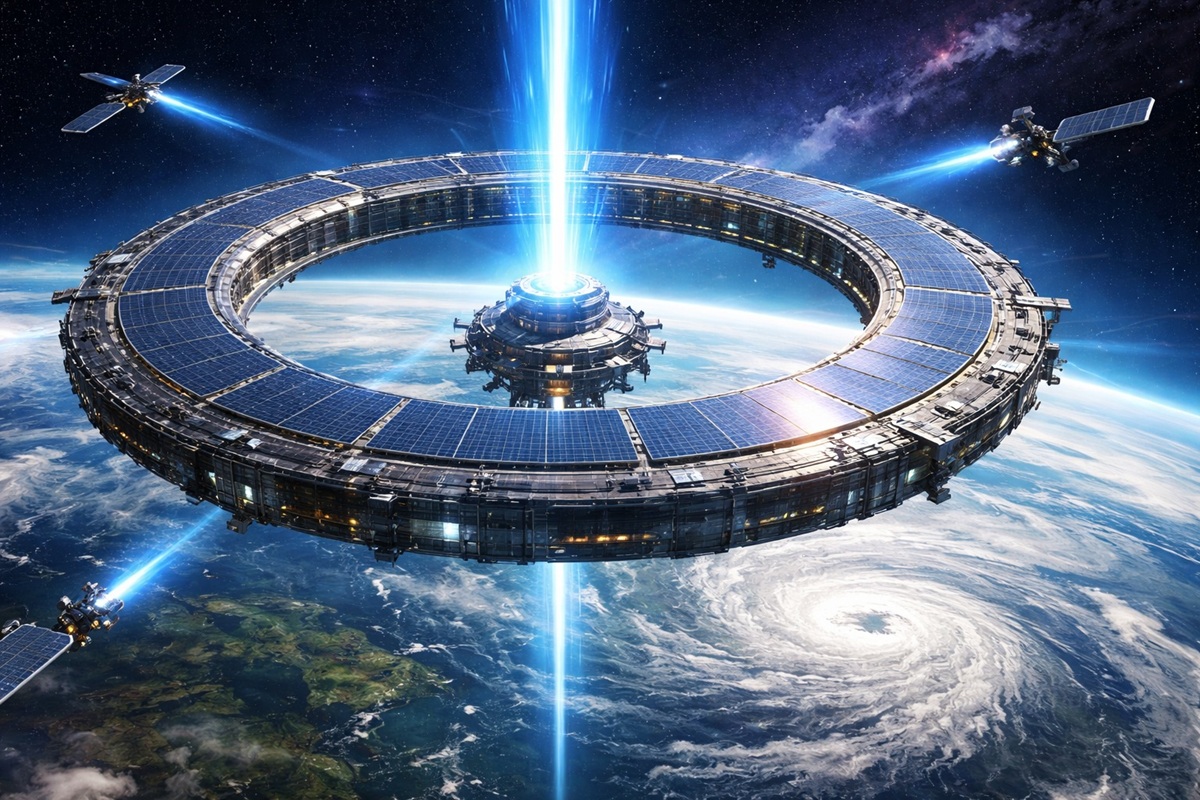


Chinese Project Predicts Testing By 2030 A Space Power Bank Capable Of Generating 1 Megawatt In Orbit, Charging Satellites Wirelessly, Transmitting Electricity Via Microwaves, And Integrating A Circular Solar Power Plant Of 1 Kilometer Positioned 36,000 Kilometers From Earth
China is developing a space power bank linked to the Zhuri project, which plans an orbital test in 2030 capable of generating 1 megawatt of electricity. The proposal involves energy transmission, support for satellites, and potential applications in storm modulation.
The plan integrates an initiative aimed at constructing a solar power plant in space. If implemented, the system could function as a space power bank intended to provide continuous clean energy and support space infrastructures in orbit.
Zhuri Project Predicts Space Power Bank In Geostationary Orbit
The Zhuri project, whose name means “In Search of the Sun,” seeks to install a large solar power plant in space. The proposal includes the creation of a space power bank capable of continuously collecting solar energy.
-
A British startup creates tires that generate electricity in electric vehicles when passing over potholes, speed bumps, and cracks.

-
Scientists have created robots made with living cells that have their own nervous system, swim on their own, explore the environment, and self-organize without any genetic engineering, and now they want to do the same with human cells.

-
Students create a solar-powered ambulance that operates without a plug, without fuel, and still keeps medical equipment running in remote areas.
-
French “ghost” submarine lost in World War II reappears after more than 80 years on the seabed near the coast of Spain.


The disclosed roadmap indicates an orbital test in 2030. This test would have the capacity to generate 1 megawatt of electrical energy.
To achieve this goal, it would be necessary to construct an orbital structure with weight exceeding that of the International Space Station.
The final project envisions a circular power plant with approximately one kilometer in diameter. The installation would be positioned in a geostationary orbit about 36,000 kilometers from Earth.
At this altitude, the power plant could generate electricity at a gigawatt level and transmit energy back to the planet.
Energy Efficiency In Space Can Be Up To 10 Times Greater
Solar power generation in space presents operational advantages. Without clouds and night cycles, energy production can be approximately 10 times more efficient than systems installed on the ground.
This efficiency would allow for a constant flow of clean energy sent from orbit to Earth.
In addition to energy transmission, the technology was designed to operate as a space power bank meant to supply orbiting infrastructures.
Among the equipment expected to receive energy are satellites, future space stations, and long-duration probes.
With continuous power supply in orbit, space missions could have greater reach and duration.
Space Power Bank Can Charge Satellites And Support Missions
The space power bank was designed to operate as an orbital energy station. The proposal includes wireless charging of satellites and other space structures.
This model would allow for continuous energy supply to networks of satellites and equipment in orbit.
According to experts involved in the project, this energy infrastructure could support future lunar bases and global networks of space internet.
The constant availability of energy in orbit could extend the lifespan of missions and reduce limitations related to energy storage in space equipment.
Microwave Beams Can Influence Storms
In addition to energy transmission, the technology is also being studied for climate applications.
An article published in the People’s Daily mentioned that microwave beams used to transmit electricity could be redirected.
Professor Duan from Xidian University suggested that these beams could heat atmospheric moisture during storms.
According to the proposal, directed thermal energy could disturb regional atmospheric circulation.
In theory, this could allow for changes in the intensity or trajectory of typhoons approaching coastal areas.
The project’s chief scientist, Baoyan, stated that if energy production is sufficiently high, the technology could alter regional atmospheric circulation and modify the path of a typhoon.
He noted, however, that this hypothesis still needs to be demonstrated.
Technical Challenges And Risks Of The Orbital Energy System
Since its conception in 2013, the project has evolved from the theoretical phase to experimental development stages.
In 2022, a 75-meter-tall ground testing tower was built. The structure was created to simulate the complete cycle of converting solar energy into microwaves.
Among the recent technical advances is the “one-to-many” transmission. This system allows a single energy beam to supply multiple moving targets simultaneously.
The team also worked on improving beam precision and miniaturizing equipment.
These advances are considered necessary to make large-scale space structures lighter and more viable.
Nevertheless, experts point out potential risks. A microwave beam at gigawatt levels could be considered a high-energy weapon.
If there is any slight deviation in the beam, electronic components of satellites could be damaged.
There is also the risk of electrical discharges in areas already congested in low Earth orbit.
Global Race For Space Solar Energy
The development of space solar energy is also the subject of initiatives in other countries.
While China operates its 75-meter test tower, Caltech has successfully transmitted energy to orbit.
Japan is also conducting its own tests of active energy transmission.
The reduction in launch costs has increased interest in projects of this kind.
As a result, space is now being considered a possible environment for installing large-scale energy infrastructures.






FANTÁSTICO….PELO SIMPLES FATO DE NESTA ALTURA A RADIAÇÃO FV SOLARES GERADAS, SER, ABSURDA EM POTÊNCIA… NÃO HÁ NOITE OU NUVENS.
PORÉM RESIDE UMA GRANDE DIFICULDADE A SER SUPERADA….A TRANSMISSÃO PARA A TERRA,SEM FIOS, DE TANTA ENERGIA!!
MAS COM CERTEZA,ESTAMOS NO CAMINHO CERTO. QUE PENA,COMO SEMPRE,O BRASIL DE GESTÃO CRIMINOSA E SEUS ABUTRES DOS 3 PODERES,PREOCUPAREM SE, APENAS EM ROUBAR, SE ARRUMAR A VIDA,VIVER EM PALACETES,VIAJAR PRÁ DUBAI 3 VEZES AO ANO, E POSSUIR E ANDAR,DE FERRARI,ETC.