





 Portuguese
  English
  Spanish
  3 min of reading
  0 comments


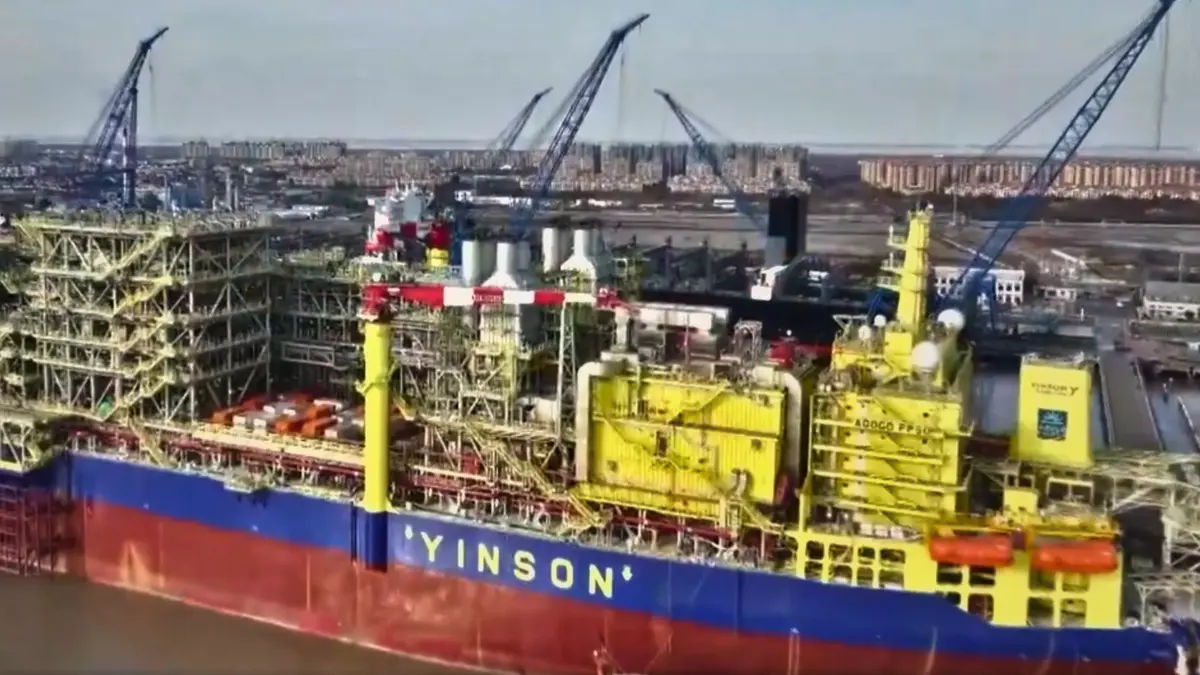
China Completes FPSO with Carbon Capture, Innovating in Offshore Oil Production. Project Aims to Reduce Emissions and Reinforce Commitment to Renewable Energy and Environmental Solutions
China has taken an important step in the fight against carbon emissions by completing what it claims to be the world’s first Floating Production, Storage and Offloading (FPSO) vessel equipped with a carbon capture system.
The 330-meter vessel was developed by the state-owned Cosco Ocean Shipping Heavy Industry Company and is set to be delivered this month.
Ship Production Capacity
The FPSO has the capacity to produce up to 120,000 barrels of oil per day. However, its major innovation lies in the carbon capture and storage system.
-
A study confirms that the natural gas sector will reduce greenhouse gas emissions in Brazil by 0.5% and accelerate the energy transition by 2026.

-
Petrobras implements a severe adjustment and confirms a 55% increase in the price of aviation kerosene with a proposal for installment payments for the companies.

-
The rise in oil prices could ensure an extra revenue of R$ 100 billion for the Federal Government, indicates a recent economic study.

-
Naturgy begins an investment of R$ 1.6 million to expand the gas network in Niterói and benefit thousands of new residences and businesses.


During its operation, it captures the CO2 generated by removal and travel processes, storing it on board without releasing the gas into the atmosphere.
This represents a significant advancement in the search for solutions to reduce emissions in offshore oil production.
According to the International Energy Agency, the removal and processing of oil and gas accounted for 5.1 billion tons of greenhouse gases in 2022, which corresponds to 15% of global energy-related emissions.
In this context, the creation of the FPSO with carbon capture could be a model for other operations in the sector, helping to increase the environmental impact of the oil industry.
China’s Initiatives in Reducing Carbon Emissions
China, the world’s largest carbon emitter, has also invested in other technologies to combat emissions.
In 2023, China National Offshore Oil Corporation launched the first offshore carbon capture facility at Enping 15-1 oil field in Guangdong.
The facility can store up to 300,000 tons of carbon dioxide per year, a significant contribution to emission reductions.
In addition to carbon capture, China has been dedicated to large-scale renewable projects. Wind turbine manufacturers have been developing increasingly powerful models capable of generating more energy with less impact.
However, the country faces challenges related to the disposal or reuse of large components of these turbines, especially their blades, which have a lifespan of 20 to 25 years.
Researchers are exploring ways to repurpose them into construction materials, such as cement and asphalt, to minimize environmental impact.
Hydropower: A Pillar of the Energy Strategy
Hydropower also plays a key role in China’s energy strategy. The government recently approved a large-scale project in Tibet, on the Yarlung Tsangpo River.
When completed, this hydropower project will be capable of generating 300 billion kilowatt-hours per year, surpassing the production of the Three Gorges Dam, one of the largest in the world.
With all these initiatives, China is demonstrating a strong commitment to meeting the growing energy demand, while also seeking to reduce its emissions and tackle future environmental challenges.
With information from Interesting Engineering.






Seja o primeiro a reagir!