





 Portuguese
  English
  Spanish
  4 min of reading
  13 comments


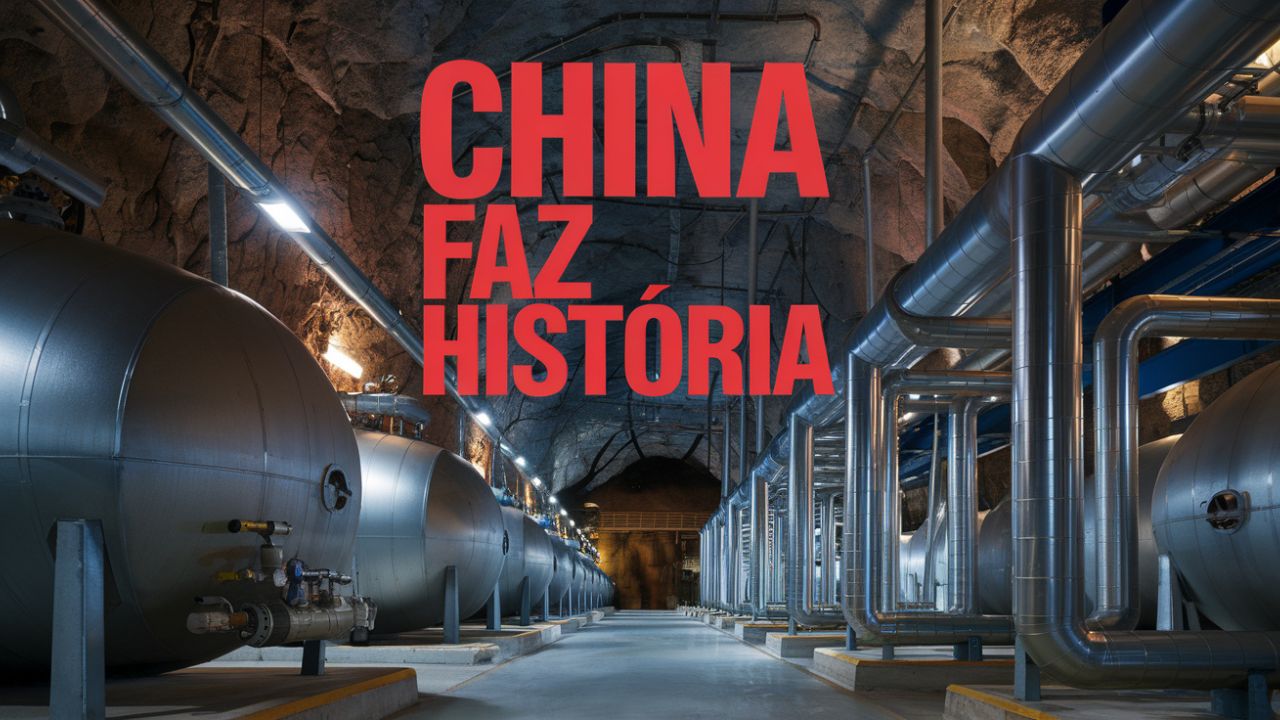


With Capacity to Store 2.8 GWh, the System Uses Salt Caverns to Innovate in Compressed Air Energy Storage, Eliminating Carbon Emissions and Achieving Efficiency Above 60%.
In recent years, China has surprised the world with gigantic and innovative projects in renewable energy. This time, the country has raised the bar by developing the world’s largest compressed air energy storage (CAES) system. The project, led by the Huaneng Group, impresses not only with its size but also with its efficiency and contribution to global sustainability. But how does this system work that promises to revolutionize the energy market?
How Does Compressed Air Energy Storage (CAES) Work?
Imagine a spring being compressed to store energy. Now, replace the spring with air and add a touch of high technology. CAES works like this: air is compressed and stored in large underground reservoirs, such as salt caverns. When energy is needed, this compressed air is released to drive turbines and generate electricity.
The most impressive thing is that the Jintan project does not use external fuels. It reuses the heat generated during air compression, making the system highly efficient and eliminating carbon emissions. In simple terms, it’s like having a machine that turns excess energy into a clean reserve ready for use.
-
Renewable energy advances over protected areas in Brazil, and a survey by the Energy Transition Observatory reveals silent impacts that challenge environmental conservation and pressure sensitive traditional territories.

-
Rio Grande do Sul accelerates energy transition: State invests in renewable technologies and consolidates decarbonization strategies and pathways to attract billions in new industrial investments.

-
With 160,000 m² of collectors, an area larger than 20 football fields, Silkeborg, in Denmark, hosts a solar thermal plant that heats 19,500 homes and could become the largest solar heating plant in the world.

-
A study reveals the expansion of renewable energy procurement in Brazil and shows how companies are taking advantage of opportunities to reduce expenses, ensure energy efficiency, and strengthen strategic environmental commitments.


The Jintan Project: A Global Landmark
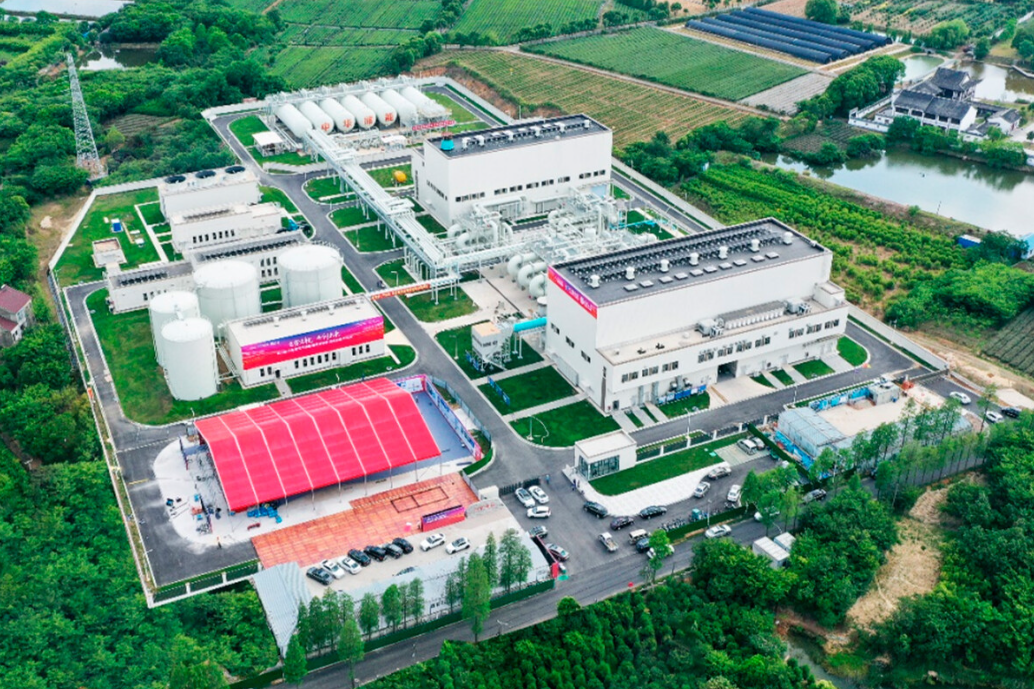
The second phase of the Jintan project, located in Jiangsu province, is the star of this development. With two units of 350 MW each, the system can store up to 1.2 million cubic meters of air, equivalent to an impressive 2.8 GWh of energy. This is enough to meet the demand of thousands of homes for hours.
This new stage operates with over 60% efficiency and can be started in just five minutes, while previous systems needed 20. These technological advancements place China’s CAES at the forefront of the energy sector.
This system is a game-changer in the fight against climate change. By eliminating the need for fossil fuels to operate, the project drastically reduces carbon emissions. With China leading the demand for coal, initiatives like this signal a significant shift towards a cleaner future.
The Role of Salt Caverns in Energy Storage
Salt caverns play a fundamental role in the Jintan project. Being naturally airtight and resistant, these geological formations are perfect for storing large volumes of compressed air. Studies indicate that these caverns could be used in the future to store hydrogen, a promising bet in the global energy transition.
Several European countries are already exploring the use of salt caverns for hydrogen distribution. This places the Jintan project in a strategic position not only for the present but also for the next steps in the renewable energy sector.
The Impact of China in the Race for Renewable Energies
China is already known for its ambitious projects in renewable energy, such as offshore wind turbines and giant liquid batteries. The Jintan CAES system joins this list, proving that the country is committed to finding storage solutions for its growing energy capacity.
What sets China apart is the scale: the country always thinks big. This is crucial at a time when global demand for clean energy is high. The Chinese energy transition is not just a domestic issue, but an example for the world.
The Future of Storage
With projects like Jintan, the future of energy storage looks promising. Technologies like CAES are essential to ensure that energy generated from renewable sources is maximized. The global challenge of meeting the growing energy demand with clean solutions can be overcome with innovations of this scale.
The largest compressed air energy project in the world is not just a technological feat, but also a symbol of China’s commitment to sustainability. Combining efficiency, innovation, and positive environmental impact, the Jintan project redefines the standards of the energy sector. As the world searches for alternatives for a greener future, initiatives like this show that large-scale solutions are the way forward. And you, are you ready to follow this transformation?







Isso é bom para calar a boca daqueles **** que criticaram a fala da Ex-Presidenta Dima quando disse: ” Ainda não podemos ensacar vento”. Toma mas fuças gadaiada.
Tecnologia semelhante pode chegar as residências. Imagine um sistema de tubos verticais inseridos sob o terreno parar armazenagem de ar comprimido. Como um “poço” de energia. A China tem projeto semelhante com energia potencial, que ao invés de comprimir o ar, massas são elevadas para depois descerem com a gravidade e produzir energia.
Sem dúvida é um grande feito,e também uma ideia que pode ser seguida por outros países que tenham condições geológica parecida, parabéns aos chineses 👏👏👏
A mídia dos Brasileirinhos fizeram CHACOTA da DILMA. Nossa ela estava certa…..kkkk