





 Portuguese
  English
  Spanish
  4 min of reading
  0 comments


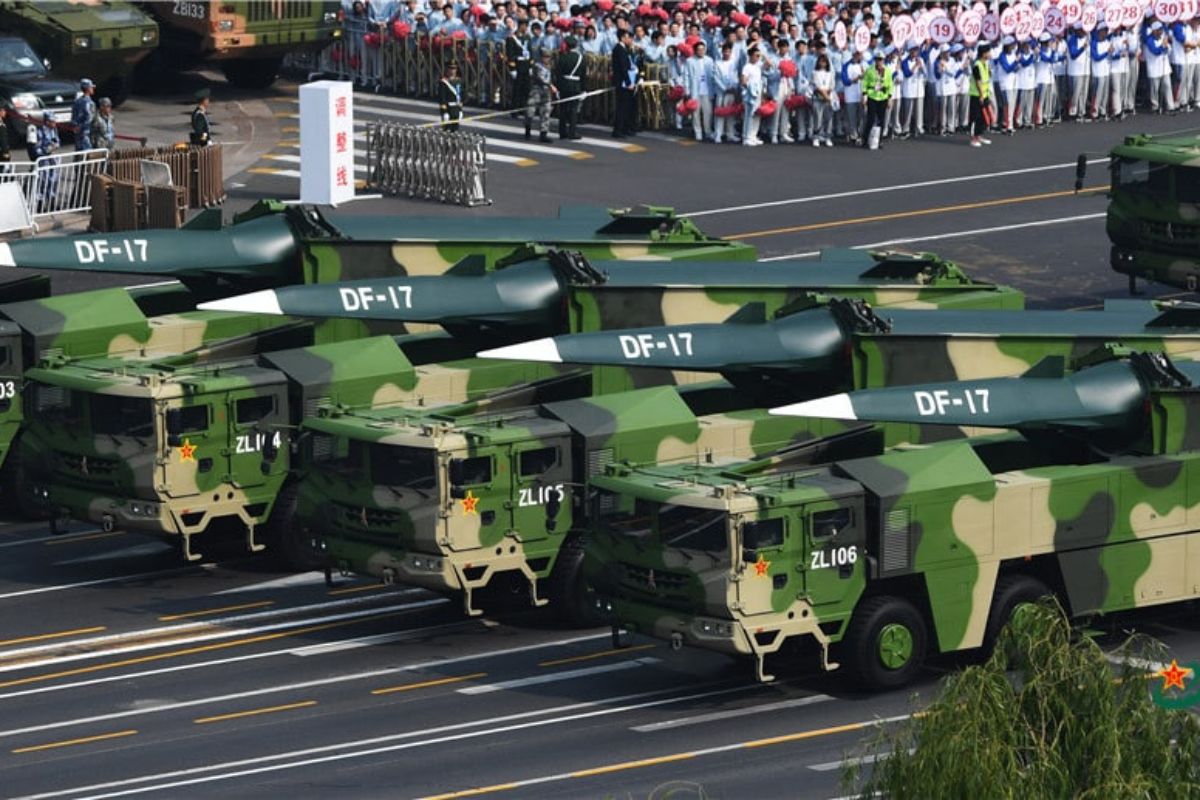
China Has Been Operating the DF-17 Since 2019, a Medium-Range Missile with Hypersonic Glide Vehicle Launched from a Road-Mobile Base. At Approximately 11 m and 15,000 kg, It Uses Solid Fuel, Claims Mach 5-10 and 1,800-2,500 km, Following Prototypes Confirmed in 2014 and Tests in Taiyuan, Shanxi Province.
China has come to be regarded as a new military power in part due to what it has included in its inventory with the DF-17: a medium-range system equipped with a hypersonic glide vehicle, announced with speeds between Mach 5 and Mach 10 and a range of 1,800 to 2,500 km, designed to tighten the adversary’s decision-making timeline.
The DF-17 appears as a response to a modern dilemma: how to reduce the reaction time of those reliant on alerts, tracking, and interception while simultaneously complicating missile defense with maneuverability and flying at a lower altitude than traditional ballistic standards.
What the DF-17 Brings to the Field

The DF-17 (Dong Feng-17) is described as a medium-range ballistic missile coupled with a hypersonic glide vehicle (HGV).
-
Archaeologists have discovered a colossal submerged wall in the Atlantic, dating back 7,000 years and weighing 3,300 tons, regarded as the largest prehistoric submerged structure ever found in France.

-
Scientists have discovered a gigantic magnetic anomaly hidden beneath the soil of Australia that mirrors the shape of the entire continent and holds geological records of two and a half billion years that could change what we know about the Earth.

-
The heatwave that has been affecting Brazil in recent weeks is coming to an end: a cyclonic vortex is moving in during Holy Week with heavy rains, and a cold air mass is already threatening to lower temperatures in the South starting in April.

-
(VIDEO) Cameras from an astronomical observatory captured two meteors falling over Santa Maria in Rio Grande do Sul with only a one-minute difference and such close trajectories that scientists are now investigating whether the two objects have the same origin.


It is presented as a road-mobile system, approximately 11 m long and weighing around 15,000 kg, powered by solid fuel, with a payload described as either conventional or nuclear.
On paper, the system draws attention for two key aspects: declared speed of Mach 5 to Mach 10 (approximately 1.72 to 3.43 km/s, based on the cited reference) and an estimated range of 1,800 to 2,500 km.
This pushes the debate beyond “can it reach or not” and into “how much time is left to decide”.
Why the Hypersonic Glide Vehicle Changes the Defense Equation

The central justification attributed to the program is to neutralize adversarial missile defenses and create a capability for rapid, long-range, and high-precision attacks, leaving “little time to react.”
The logic of the HGV is not just to be fast but to combine speed with a less predictable trajectory for legacy ballistic missile defense systems.
There is a technical detail that weighs in the argument: even though they are described as slower than a conventional ballistic reentry vehicle, HGVs gain an advantage due to greater maneuverability and flying at lower altitudes, which complicates tracking and trajectory prediction.
Practically, this means forcing the adversary to deal with more uncertainty along the way, not just at the final impact.
Timeline of Tests and Public Signals from the Program
The existence of prototypes associated with the DF-17 was confirmed by U.S. authorities for the first time in 2014, with designations noted during that period as DF-ZF and Wu-14.
Between January 2014 and November 2017, China conducted at least nine flight tests, with records situating the launches at the Taiyuan Satellite Launch Center in Shanxi Province.
Reports mention instances of failure and success, as well as performance descriptions: in some tests, U.S. defense authorities attributed to the glide vehicle “extreme maneuvers” and “evasive actions.”
On November 1, 2017, there is reference to a flight of approximately 1,400 km in 11 minutes, with the heavy vehicle flying at a reduced altitude of around 60 km.
When these numbers emerge, the message is simple: shorten decision windows.
Who Develops and How China Organizes This Effort
The responsibility for development is attributed to the 10th Research Institute of China, cited as the “Near-Space Vehicle Research Institute,” operating under the 1st Academy of the China Aerospace Science and Industry Corporation (CASIC).
This is the type of structure that indicates a program with institutional support, not an isolated experiment.
There is also a perception of scale in the effort: in 2018, an American official noted that China had conducted about 20 times more hypersonic weapon tests than the United States in the previous decade.
More than a “race” statistic, this signals a volume of learning and rehearsal repetition, which often separates prototype from operational status.
Range, Precision, and Regional Employment Hypotheses
Seven cited U.S. intelligence assessments attribute to the DF-17 a range between 1,800 and 2,500 km.
The combination of range and declared speed is what sustains the reading of “little time to react,” especially when the system is described as operational and in service since 2019.
In the debate about military effect, two layers appear.
The first is precision: there is mention that a test warhead reportedly struck a stationary target “within a few meters” of the intended point.
The second is mission flexibility: Chinese commentators reportedly emphasized conventional mission, but the missile is described as capable of being equipped with a nuclear warhead.
An additional hypothesis arises: reports suggest the possibility of the DF-17 evolving into a second-generation anti-ship ballistic missile, with PLA officials stating in January 2019 that an anti-ship variant was under development.
It is here that range becomes geography and “time” becomes strategy.
China has positioned the DF-17 at the center of discussions about deterrence and missile defense by combining hypersonic glide vehicle, road mobility, declared speeds between Mach 5 and Mach 10, and a range of 1,800 to 2,500 km, along with a history of tests between 2014 and 2017 in Taiyuan, Shanxi, and public exposure in 2019.
The most sensitive point is not just speed, it is the attempt to reduce reaction time and make trajectory prediction more difficult.
If you look at this type of system, what do you consider more decisive: the declared speed, the range, or the maneuverability that complicates missile defense? And in your view, when a country like China exhibits such equipment, does it reduce risk through deterrence or increase tension through uncertainty?








-

-

-

-

-

-

24 pessoas reagiram a isso.