





 Portuguese
  English
  Spanish
  5 min of reading
  0 comments


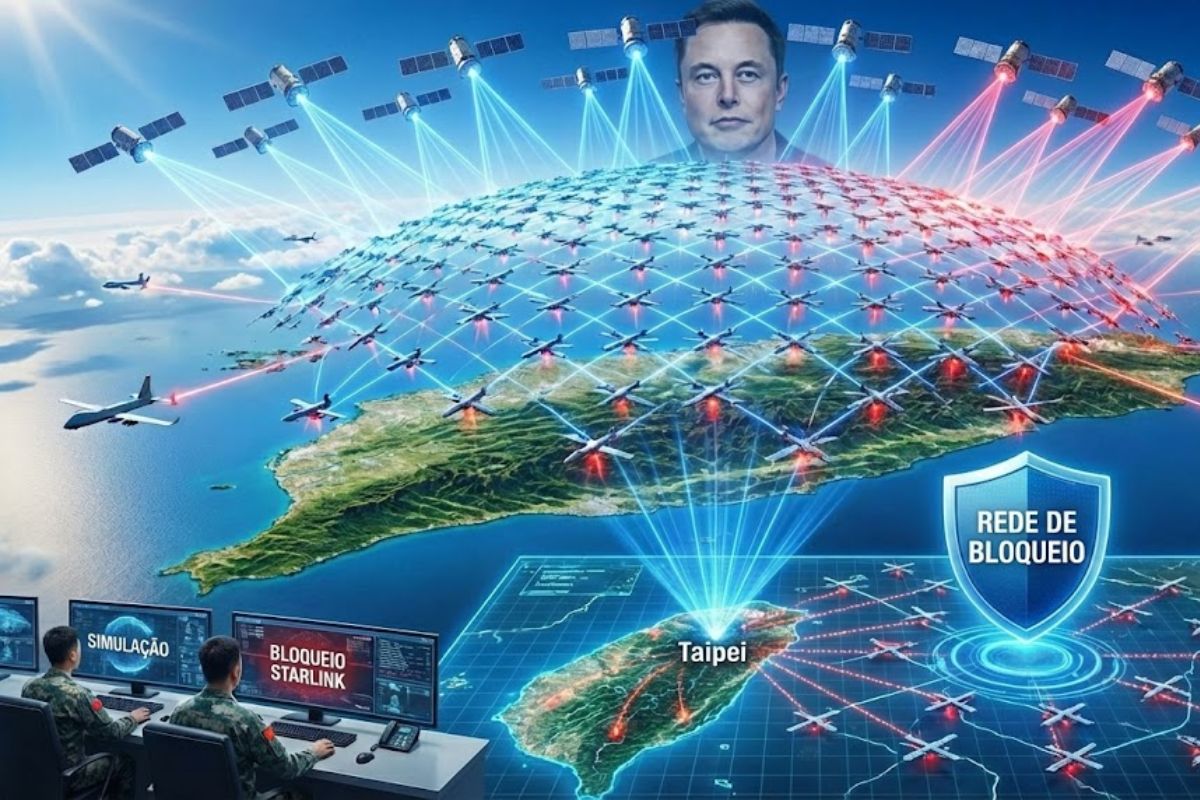
Chinese Researchers Modeled In Laboratory What Would Be Necessary To Block Starlink Over An Area The Size Of Taiwan And Concluded That A Single Transmitter Is Not Enough, Requiring Almost One Thousand Coordinated Blocking Drones To Generate Significant Interference Against A Constellation Designed To Withstand Jamming And Maintain Communications
Communications have become the invisible infrastructure of any modern military operation. Without network, sensors, and real-time command, armored vehicles, aircraft, and missiles lose efficiency, and this is precisely what the war in Ukraine has exposed by placing Starlink at the center of the debate. Elon Musk’s constellation has shown the capacity to keep troops connected under heavy pressure, and since then it has been viewed as a strategic piece in conflict scenarios. In this context, Chinese researchers decided to test, in simulation, whether it would be possible to block Starlink over a territory the size of Taiwan.
The result of the study is uncomfortable for those who bet on electronic warfare as a simple and cheap weapon. The conclusion is that there is no easy solution for blocking Starlink on a large scale: a powerful jammer on the ground is not enough, nor are a few aircraft equipped with high-power transmitters. To degrade the service significantly in a regional area, calculations indicate that hundreds, possibly almost one thousand aerial platforms with coordinated blockers would be necessary, operating at high altitudes and aligned with the orbital dynamics of the constellation.
Why Blocking Starlink Became A Strategic Priority

Starlink does not operate like the old constellations of few satellites in fixed orbits.
-
China has launched the world’s first floating artificial island, a scientific structure designed to face open seas, test equipment weighing hundreds of tons, and reach depths of 10,000 meters.

-
China accelerates global science and may surpass the United States in 2 years with increased public investment, continuous growth, and direct impact on the global technological competition.

-
Scientific studies indicate that drought may be strengthening a much greater silent threat: more resistant superbugs.

-
Man builds functional 5-meter submarine in his garage using gas cylinders, PVC pipes, and a refrigerator motor, and navigates with the vessel on a lake in Colombia.

Instead, the network is formed by thousands of satellites in low orbit, with variable trajectories, that pass quickly over each region of the Earth.
In practice, this means that a terminal on the ground does not always communicate with the same satellite, but alternates the link in a matter of seconds as new satellites enter the field of view.
This architecture makes it much more difficult to block Starlink with classic jamming techniques.
When a hostile transmitter interferes in a link, the terminal can switch to a different satellite, channel, or frequency in almost real time, leveraging both the constellation’s redundancy and the highly directional antennas that focus the signal beam.
Instead of a static target, the network behaves like a mobile and adaptive target, designed specifically to resist interference and localized disruptions.
This is why, in debates about electronic warfare, Starlink stands out as a unique case.
It combines network resilience with routing flexibility, which forced the Chinese researchers to consider a distributed and persistent blocking approach, rather than seeking a technological “silver bullet.”
The Chinese Simulation To Block Starlink In Taiwan
The work that quantified the effort necessary to try to block Starlink at a regional scale was published on November 5 in the Chinese journal Systems Engineering and Electronics, under the title “Simulation Research of Distributed Blockers Against Downlink Communication Transmissions of Mega Constellations.”
The authors are a team from Zhejiang University and the Beijing Institute of Technology, institutions linked to defense research.
The authors make it clear that this is not an operational plan of the Chinese Armed Forces, but an academic simulation.
The goal was to evaluate, in technical terms, what would be the order of magnitude of a blocking effort against a network like Starlink over an area comparable to Taiwan.
To do this, they used real data from the orbital configuration of the constellation and modeled the behavior of signals over 12 hours in eastern China, extrapolating the results for the island.
Almost One Thousand Coordinated Blocking Drones In The Sky
Instead of imagining just one high-power transmitter, the study assumes a distributed network of blockers positioned at about 20 kilometers altitude.
In the simulation, these blockers form a sort of chessboard in the sky, with nodes every 5 to 9 kilometers, as if they were aerial platforms equipped with interference systems.
The researchers considered that these platforms could be drones, stratospheric balloons, or other vectors capable of remaining at altitude for long periods.
Each node, operating with about 26 dBW of power and using narrow-beam antennas, could block an average area of 38.5 square kilometers in the simulation. From there, the calculation is straightforward.
To cover an area equivalent to Taiwan, at least 935 blocking aerial platforms working in a coordinated manner would be necessary, not counting redundancy, losses due to equipment failure, and terrain effects, such as mountains that create signal shadows.
In other words, broadly blocking Starlink would require almost one thousand drones or similar platforms aligned in real time with the movement of the satellites and the terminals on the ground, a large-scale logistical and technological effort.
Limitations Of The Simulation And What The Model Sees Of Starlink
The authors of the study themselves acknowledge that their model has important limitations.
They do not have classified data on precise radiation patterns of the terminals, real signal suppression coefficients, or internal details of the network’s adaptation algorithms in the face of coordinated interference.
Some of the parameters used in the simulation are technical estimates, not field measurements.
Still, the team argues that the work is useful for sizing the problem.
Even under conservative assumptions, the need for hundreds or almost one thousand platforms to block Starlink in a single region already indicates a huge operational challenge.
The study, therefore, does not provide an attack recipe, but suggests that an electronic warfare strategy against the constellation requires resources and coordination on a much larger scale than previously imagined in centralized approaches.
Starlink, Electronic Warfare, And The Board Around Taiwan
By choosing Taiwan as a territorial reference, the Chinese researchers directly engage one of the most sensitive scenarios of current geopolitics.
An eventual military operation over the island would place blocking Starlink at the center of the dispute between those trying to maintain resilient communications and those seeking to blind them.
On the defensive side, the constellation offers redundancy, link mobility, and quick adaptation. On the offensive side, the simulation suggests a heavy, costly, and technically demanding effort.
Meanwhile, Starlink continues to expand its civil and commercial presence, including terminals compatible with smartphones from manufacturers like Samsung, Apple, Motorola, and Google, which tends to spread even more access points around the world.
Each new terminal potentially enters the equation of a future conflict scenario, reinforcing the importance of understanding what it means, in practice, to attempt to block a constellation of this size.
Given a network designed to resist interference and a study that points to the need for almost one thousand platforms to block Starlink in an area like Taiwan, do you think electronic warfare can still be a decisive weapon or is it likely to become just a complementary element in modern conflicts?








-

-

-

-

-

-

49 pessoas reagiram a isso.