





 Portuguese
  English
  Spanish
  5 min of reading
  3 comments


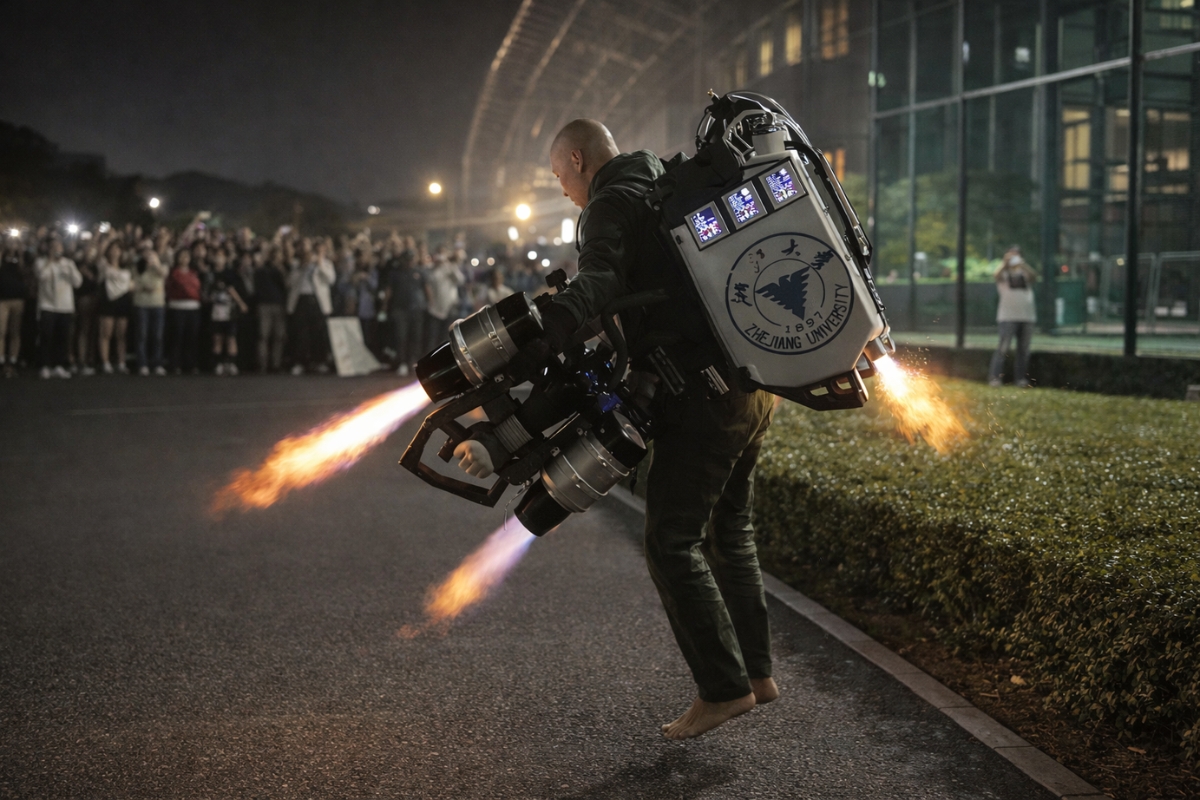


Jetpack JetRob Uses Five Jet Engines, Reaches Speeds of Up to 100 km/h and Minutes of Flight, Focusing on Testing, Safety, and Intensive Pilot Training
The scene looks like something out of a Marvel movie, but it happened on a university campus in China: an engineer taking off from the ground with a jetpack on his back, soaring through the sky like a real-life “Iron Man.” Behind this flight is the JetRob team from Zhejiang University, which has just showcased a functional prototype of a jetpack fully designed and built in the country.
While many countries are still debating regulations and conceptual designs for personal air mobility, China goes straight to the point: it builds, tests in public, and goes viral on social media, reinforcing the image of a technological powerhouse that already dominates sectors like clean energy, electric cars, and batteries. Now, it is also advancing in a market that until recently was merely a fantasy of comic books and science fiction films.
How the JetRob Jetpack Works
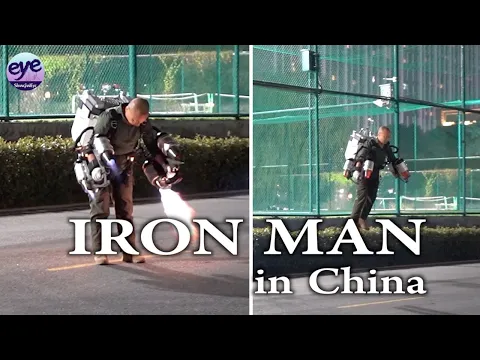

The JetRob jetpack is not a futuristic toy, but a high-precision engineering machine. The system uses five small jet engines: one main module on the back and two additional sets on the arms, allowing the pilot to control direction, altitude, and stability with body movements. In practice, the arms function as human “rudders,” redirecting thrust forward, upward, or sideways.
-
With a cost per shot close to zero, the DragonFire laser could change naval warfare in 2027 and provide British ships with nearly unlimited defense against drones.

-
A British startup creates tires that generate electricity in electric vehicles when passing over potholes, speed bumps, and cracks.

-
Scientists have created robots made with living cells that have their own nervous system, swim on their own, explore the environment, and self-organize without any genetic engineering, and now they want to do the same with human cells.

-
Students create a solar-powered ambulance that operates without a plug, without fuel, and still keeps medical equipment running in remote areas.

According to information released by local reports and the university itself, the backpack weighs around 31 kg without fuel and reaches approximately 46 kg when fueled. In tests, the setup is designed to reach speeds of up to 100 km/h, fly at altitudes of about 1,000 to 1,500 meters, and stay airborne for 3 to 5 minutes, depending on load and flight conditions.
It’s not much time for a sightseeing tour, but it is more than enough for quick missions, demonstrations, and future rescue or defense operations.
Safety, Training, and the “Non-Glamorous” Side of Human Flight
On social media, what appears is the epic moment: the engineer taking off, hovering over the campus, and crossing the sky amidst applause. But behind this image lies a huge challenge of safety and training.
The project’s leaders admit that operating the jetpack requires strength and coordination in the arms, as well as emotional control to deal with speed, height, and the intense noise of the engines. Some reports compare the learning process to “learning to ride a bike”: initially unstable, but it tends to become more intuitive with practice.
Another sensitive point is the heat from the exhaust gases. The system has been designed to direct hot jets away from the pilot’s body and people nearby, but any operational error or loss of balance can pose risks.
Therefore, tests are conducted in controlled areas, with a support team, protective equipment, and strict protocols. JetRob is also studying improvements in stability and even the future inclusion of “autopilot” modes to reduce total dependence on the operator’s skills in critical situations.

Why China Is Betting on Jetpacks
The jetpack from Zhejiang University is not an isolated project. It fits into a larger strategy of the country to develop what the government refers to as “low-altitude economy”: an ecosystem involving transport drones, electric air taxis, unmanned aircraft for logistics, and now, individual flight systems.
The aim is to occupy the airspace close to the ground with homegrown technological solutions, generating new value chains, skilled jobs, and, of course, geopolitical power.
If today China already stands out as the world’s first “electrostate,” with a strong dominance in clean energy, batteries, electric cars, and digital infrastructure, investing in personal air mobility is another step to maintain technological leadership.
Whoever controls the routes, vehicles, and systems that will circulate in the skies of cities in the coming decades will have a significant economic and strategic advantage, just as those who controlled railroads, oil, and telecommunications in the past.
From Spectacle on Social Media to Real Use in Rescue and Defense

For now, the JetRob jetpack is in the experimental phase, with demonstrations at university campuses and significant impact on social media, where videos of the “Chinese Iron Man” have accumulated millions of views.
However, the researchers themselves point to concrete applications beyond the spectacle: rescue in hard-to-reach areas, support for special operations, inspection of structures, and even high-standard extreme sports for an audience willing to pay dearly for minutes of flight.
In a scenario of natural disasters, for example, a rescuer equipped with a jetpack could reach isolated victims in mountainous, flooded, or destroyed areas more quickly, bringing basic medical equipment or flares.
In defense and security, trained operators could use the system for rapid infiltration, visual reconnaissance, and tactical support in locations where helicopters or larger drones cannot operate discreetly. Everything is still in the testing and simulation stage, but the technology needed for this is beginning to come to life.
The Boundary Between Science Fiction and Reality Is Shrinking
The main message behind the JetRob project is simple: what was once a joke or fantasy a few years ago—people flying solo with jetpacks—is becoming a functional prototype, tested in real environments by universities and engineering teams. The boundary between cinema and real life is getting narrower, and China shows that it wants to be at the forefront of this transformation.
If the next stages of development manage to increase autonomy, reduce costs, and enhance safety with semi-autonomous systems, it will be no surprise to see jetpacks being used in specific niches of industry, public safety, and even adventure tourism.
For now, flying with a jetpack remains a privilege for a few bold engineers, but all indications point to the fact that the future of individual flight is much closer than previously imagined, and Zhejiang University has already secured its place in the history of this new race for the skies.








R
Nas olimpiadas de Los Angeles, em 1984 já houve um voo de um piloto usando um jetpack, portanto, isso não é novidade. A pergunta é: por que não houve evolução desse transporte a partir dessa exibição?
Ele vieram no brasil e fizeram exibição no desfile da grande rio tambem.
Quanto a evolução, vieram os drones e os carros voadores.
Porque levar um se pode levar 4 ou 5 com o menor custo