





 Portuguese
  English
  Spanish
  3 min of reading
  17 comments


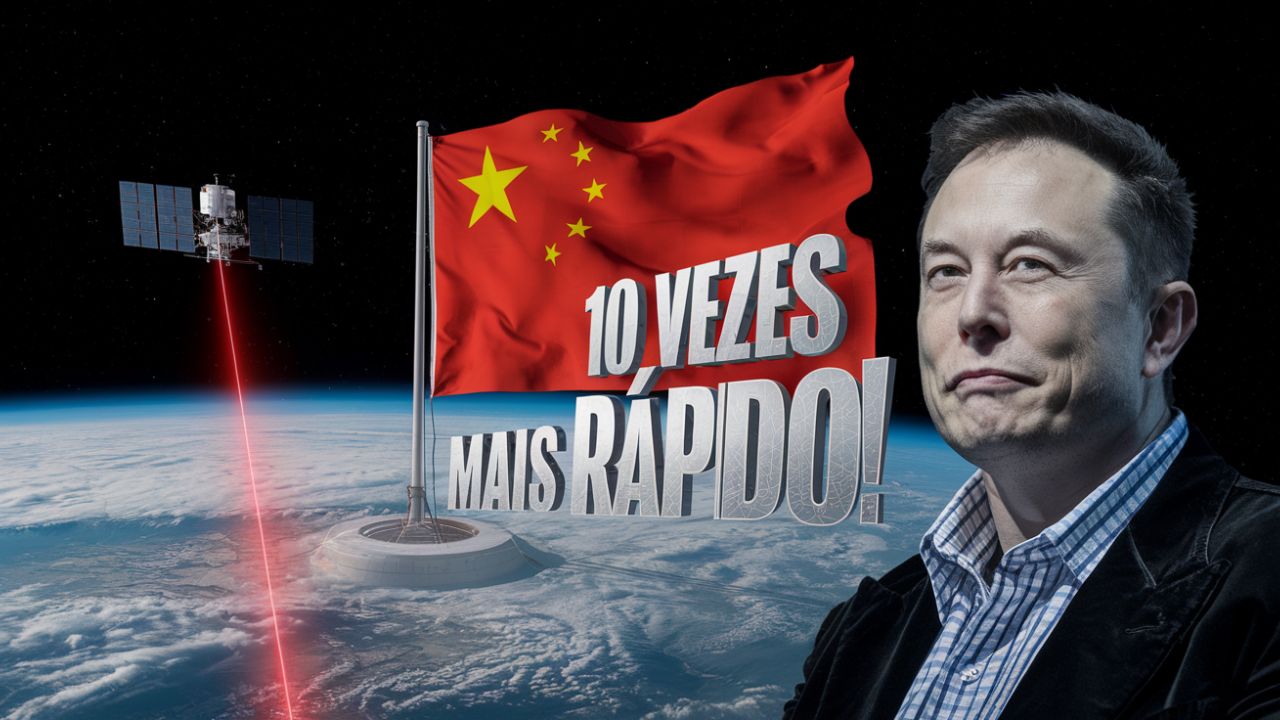


With Ten Times Faster Advances Than The Previous Record, Chang Guang Satellite Technology Implements Space-Ground Laser Communication, Challenging Starlink And Boosting Technologies Like 6G, Remote Sensing, And Satellite Positioning.
Space technology is in full swing, with giants like Starlink leading the industry for years. But now, a heavyweight competitor is emerging on the horizon: Chang Guang Satellite Technology Co. from China. Recently, they set an impressive record by achieving a transmission rate of 100 gigabits per second using space-ground laser communication. And this is just the beginning!
The Race for Laser Communication Between Satellites
Laser communication is like an “invisible fiber optic cable” that connects satellites and ground stations. It allows for incredibly fast and precise data transmission, essential for the future of 6G. Unlike radio waves, lasers offer less interference and greater efficiency, making this technology the foundation for more advanced systems.
While Elon Musk’s Starlink is known for its innovations in space, it still lags behind in the large-scale implementation of space-ground laser communication. On the other hand, Chang Guang is already applying this technology in its Jilin-1 satellite constellation. It seems that leadership is changing hands!
-
China has launched the world’s first floating artificial island, a scientific structure designed to face open seas, test equipment weighing hundreds of tons, and reach depths of 10,000 meters.

-
China accelerates global science and may surpass the United States in 2 years with increased public investment, continuous growth, and direct impact on the global technological competition.

-
Scientific studies indicate that drought may be strengthening a much greater silent threat: more resistant superbugs.

-
Man builds functional 5-meter submarine in his garage using gas cylinders, PVC pipes, and a refrigerator motor, and navigates with the vessel on a lake in Colombia.


China’s Historic Milestone in Laser Transmission

Chang Guang utilized a mobile ground station, installed in a truck, to communicate with one of the 117 satellites of the Jilin-1 constellation. The result? A speed record 10 times greater than what was previously achieved. This advancement is not just technical; it is strategic, placing the company at the forefront of space technology.
With such high speeds, the potential for 6G becomes tangible. Imagine an internet so fast that it would make even today’s most advanced services seem outdated. This technology, besides being a strong competitor to Starlink, also boosts areas like security and artificial intelligence, increasing its geopolitical significance.
Remote Sensing with Ultra-High Resolution
Imagine cameras in space capable of capturing images of Earth with nearly perfect accuracy. That is what the Jilin-1 constellation promises. These images can be used for environmental monitoring, urban planning, and even national security.
In addition to images, laser transmission also improves satellite positioning. This means GPS navigators and other location systems will be able to operate with unprecedented accuracy, which is essential for sectors like transportation and logistics.
Starlink Competitor: What Comes Next?
The Chinese company isn’t stopping there. They plan to expand their constellation to 300 satellites by 2027, all equipped with laser communication. This will further increase efficiency and transmission capacity, consolidating their position as a direct competitor to Starlink.
Starlink has the know-how and resources, but it needs to hurry to implement similar systems on a large scale. The fierce competition between the two companies promises to accelerate the development of this technology, benefiting consumers and industries worldwide.
China has taken a giant step toward dominating space communication with Chang Guang Satellite Technology. The advancement in space-ground laser transmission not only challenges Starlink but also opens doors for 6G and other technological innovations. With such a tight race, humanity is the winner, getting ever closer to turning science fiction into reality.








Amei espero que não demore muito pra usarmos, pois vivi, Tim e claro são um. Lixo mais é o que se tem aqui.
Quando não se sabe nada de tecnologia e segredos é pago pelos interessados para escrever qualquer coisa, da nisso. Uma profusão de asneiras. O sistema de comunicação por laser é velho de décadas! É veloz, sim, mes tem problemas homéricos caracterizados pelo próprio princípio do laser. Vai bem no espaço Já espaço terra é uma ****. E para piorar, a comunicação com objetos móveis é complicada e cara demais, .mesmo com o uso de sistemas piezoeletricos de foco e direcionamento.
O SISTEMA CHINES AINDA NÃO EXISTE, NUNCA VAI USAR LASER PARA COMUNICAÇÃO e é TOTAKMENTE INSEGURO PARA OS USUARIOS, PIIS A **** CHINESA É TRUCULENTA, INVASIVA E **** DADOS DE TODO MUNDO QUE CONSEGUE. Mesmo que essa **** um dia venha a funcionar, nem de graça deve ser utilizada! É ficar na mão de gente sem qualquer tipo de escrúpulos. Quem tem tik tok, já tem todos os seus dados de bancos, senhas, deslocamento, predição de gastos, consumos, vida, amigos, agendas todas, tudo do seu celular, INCLUSIVE I NOME DE CASA ARQUIVO QUE VC TEM NELE, gravações de voz, sistema operacional , marca modelo do celular, e todos os demais dados que nele tiver, INCLUSIVE O QUE VC DIGITA! SIM, ELE GRAVA E MANDA A DIGITAÇÃO, POR ISSO TEM AS SENHAS..
Não acredita? Sabe ler? Pega as políticas de operação e tratativas de dados do próprio tik tok. É só ler. Para melhorar, pega a de um pais honesto e que não seja uma **** como os USA. Está tudo isso lá por escrito. E ainda pensa em usar uma **** de rede dessa gente? Depois não reclama……
Dou muitas risadas ao ver essa guerra ideológica aqui numa simples reportagem.