





 Portuguese
  English
  Spanish
  4 min of reading
  0 comments


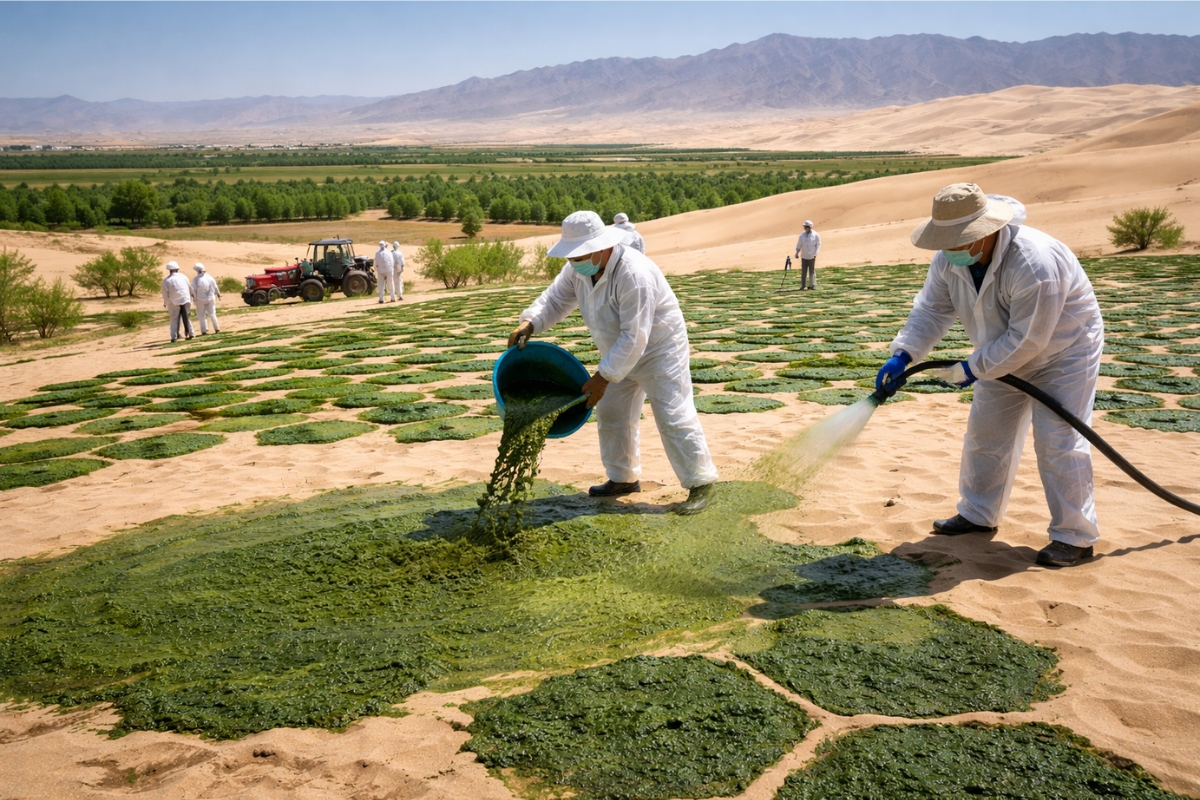
Technique Creates Fertile Crust in About a Year, Stabilizes Dunes, and Expands Farming Capacity in Arid Areas
Scientists in China are applying cyanobacteria in the Tengger Desert to transform sand into arable soil. The strategy uses cyanobacteria that can withstand extreme heat and long periods of drought.
When it rains, these microorganisms rapidly expand and form a biomass-rich crust. This layer helps hold the sand, stabilizes dunes, and creates more favorable conditions for planting.
The goal for the next five years involves treating between 5,333 and 6,667 hectares of desert in the Ningxia Hui Autonomous Region in the northwest of the country. The advancement is part of the Great Green Wall, an initiative focused on combating desertification.
-
While Brazil wants to end the 6×1 work shift, the president of Argentina wants 12 hours for his workers, increasing political tension in the country.

-
The village where two rivers run side by side without mixing in Santarém and Alter do Chão reveals some of the most beautiful freshwater beaches on the planet.
-
Mars is accelerating, and scientists have discovered that the planet’s day is getting shorter, revealing surprising signs of internal activity.

-
Artemis 2 is set to launch on April 1 at 7:24 PM to orbit the Moon with four astronauts, but a class X solar flare and coronal mass ejection could interfere with communications and threaten the launch.


What Happened and Why It Got Attention
The application of microorganisms on a large scale to reshape a natural environment has drawn attention for directly impacting the soil structure. The formation of biological crusts makes the surface less loose and reduces sand displacement.
The basis of the technique is the creation of a layer that functions like skin over sandy soil. This way, the land gains greater stability and has a more suitable environment for vegetation.
The work was conducted at the Shapotou Desert Experimental Station, affiliated with the Chinese Academy of Sciences, in the city of Zhongwei. The objective was to make the algae accumulate in areas of stable sand and bind to soil particles.

How Biological Crust Made with Cyanobacteria Works
Cyanobacteria are photosynthetic microorganisms found in various ecosystems, such as soil, freshwater, and marine environments. In the desert, they can survive and expand when water is available.
Once formed, the crust acts as a protective layer over the sandy terrain. This structure can withstand winds of up to 36 kilometers per hour, helping to reduce dune displacement.
The result is a firmer surface, with a greater accumulation of organic matter and a better base for plant development.
What Changes Practically in the Speed of Soil Recovery
Traditional methods of sand stabilization require at least five to ten years for a natural crust to establish. The new approach significantly shortens this timeline.
With the use of algae, the formation of soil crusts can occur in approximately one year. This accelerates land preparation and expands agricultural potential in arid regions.
The practical consequence is a quicker response to desertification, with a direct impact on soil stability and the possibility of cultivation.
What Are the Rules, Deadlines, and Conditions of the Project in Ningxia Hui
The Ningxia Hui Autonomous Region has incorporated the technique into its sand control strategy. The plan for the next five years is to treat between 5,333 and 6,667 hectares of desert.
The focus is on areas of the Tengger Desert, where large-scale application aims to create more favorable conditions for vegetation and reduce dune movement.
This initiative is part of the Great Green Wall, a program that combines planting actions and desertification containment in northern China.
How the Technique Became Solid Seeds to Facilitate Transport and Application
The development began to take shape in 2010, when it was determined that a type of cyanobacteria could generate soil in the desert. The initial challenge was maintaining survival outside the lab.
In 2016, pressure application helped increase the survival rate to over 60% by forcing the cyanobacteria into the sand grains. Even so, this method relied on electricity and road access, limiting its scale.
The solution involved creating solid seeds. Seven strains were selected from over 300 species, mixed with fine particle organic matter to form a mass. This mixture was placed into molds with hexagonal grids, producing blocks resembling soil clumps that are easy to transport and capable of growing rapidly after rain, forming stable crusts.
What Could Happen from Now On with the Advancement of This Technology
The Shapotou Desert Experimental Station, established in 1955, is already recognized for sand control techniques, such as the straw checkerboard method. This idea uses a network of straw in a grid pattern to assist in stabilizing the terrain and supporting re-vegetation.
In the last four decades, there has been progress in combating severe desertification, sandstorms, and soil erosion in arid northern regions, with actions consolidated in the Three-North Shelter Forest Program, the official name of the Great Green Wall.


With the expansion of this effort to include initiatives in Africa and Mongolia, the application of biological crusts may gain greater reach and strengthen strategies for restoring degraded areas.
China is betting on algae and cyanobacteria to transform sand into arable soil and accelerate dune stabilization. The goal of treating between 5,333 and 6,667 hectares in five years shows the size of the ambition.
By reducing the crust formation time to about one year, the technique paves the way for enhanced control of desertification and creates faster conditions for farming in arid regions.








-

-

-

-

-

18 pessoas reagiram a isso.