





 Portuguese
  English
  Spanish
  4 min of reading
  3 comments


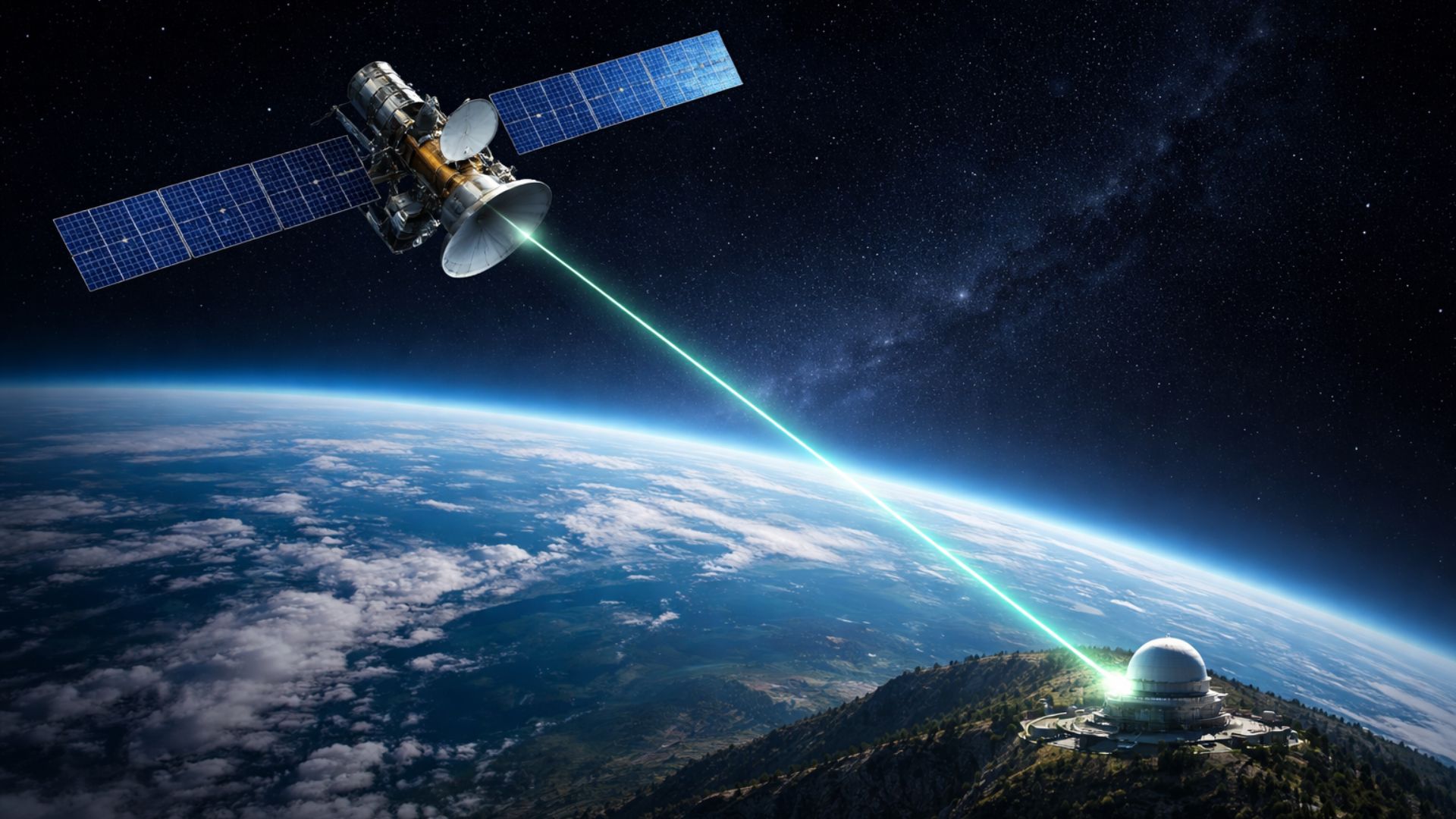


Chinese Experiment Establishes Laser Communication Between Geosynchronous Satellite and Ground Station Over 40 Thousand Kilometers, Achieving Two-Way Transmission of 1 Gigabit Per Second, Connection Established in Four Seconds and Stable Link for Over Three Hours in Test Directed to Future Space Missions.
Research institutions in China conducted an experiment on laser communication between a geosynchronous orbit satellite and a ground station and achieved two-way data transmission at 1 gigabit per second at a distance of up to 40,740 kilometers.
The test established the connection in four seconds and maintained the continuous link for over three hours, according to information released on March 3 and 4, 2026, by Chinese state media.
The link was made between an observatory in Yunnan Province, in the southwest of the country, and a geosynchronous satellite, a type of platform that matches the Earth’s rotation and appears fixed relative to a single point on the planet.
-
The most feared warplane of the United States is over 70 years old, carries 32 tons of explosives, flies 14,000 kilometers nonstop, and has just been sent to the United Kingdom amid escalating tensions with Iran.

-
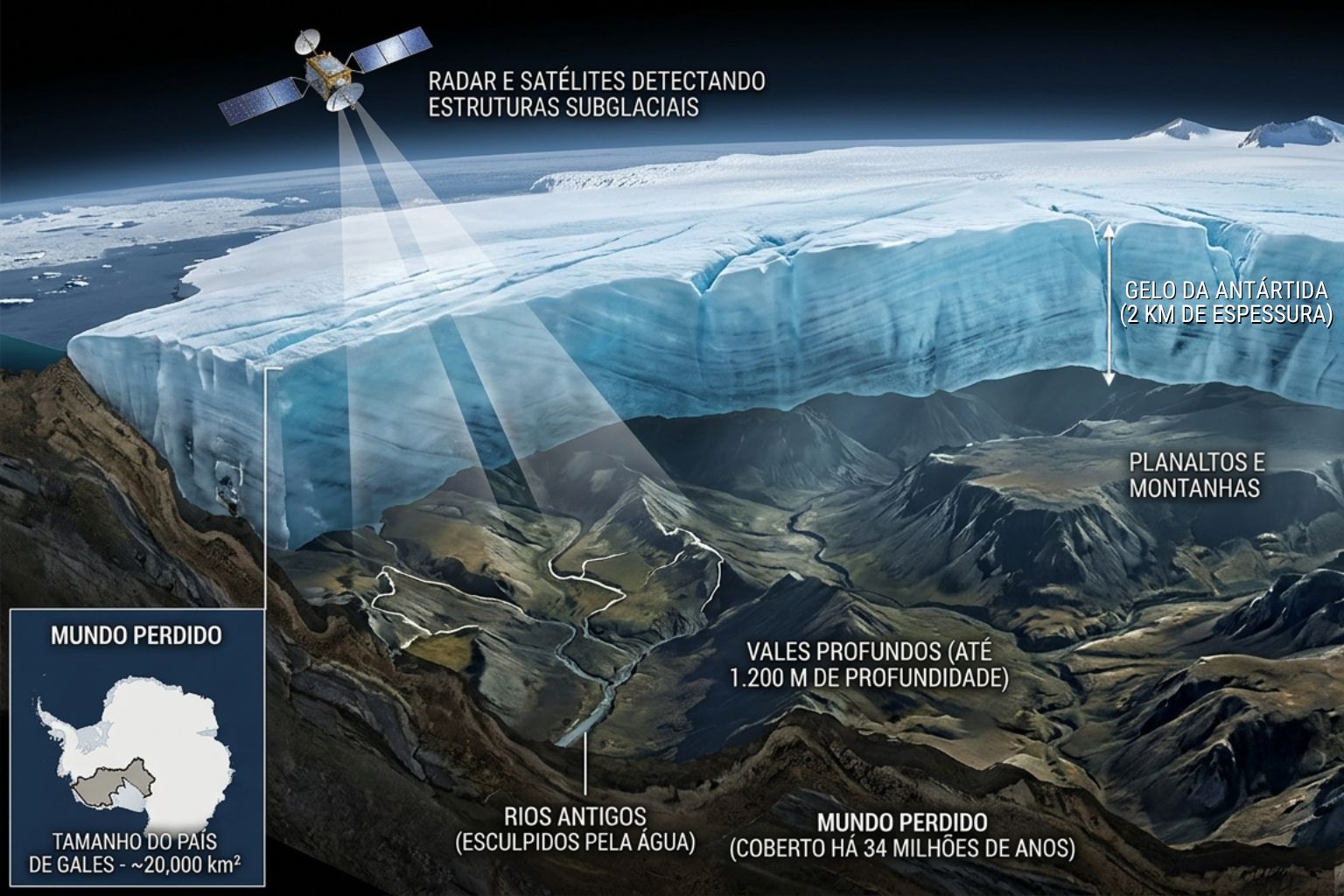
Satellites and radars revealed, beneath 2 kilometers of ice in Antarctica, a lost world the size of Wales, with rivers, valleys 1,200 meters deep, and plateaus sculpted by water, frozen for 34 million years, when the continent had temperate forests and was part of a supercontinent that included South America.
-
A 2 kg exoskeleton with an 800-watt motor and artificial intelligence that predicts movements in 2 milliseconds reduces the load on the legs by up to 30 kg, increases strength by 40%, and allowed an 84-year-old woman to climb mountains without falling behind.

-
The Senna Tower in Balneário Camboriú is using stakes considered unique in the world that go down 40 meters and are driven 5 meters into the hardest rock on the planet, with technology approved by the same engineer who designed the Burj Khalifa.


In this scenario, beam stability and pointing speed are critical factors because any deviation can interrupt transmission.
Laser Communication Between Satellite and Earth

The researchers reported that the system was able to operate in uplink and downlink, meaning sending data from Earth to the satellite and in the reverse direction, with the same rate of 1 gigabit per second.
In addition to the speed, the team highlighted two operational milestones: the time of just four seconds to establish the link and the maintenance of the communication channel for over three hours without interruption.
This result was presented as a significant advancement for communications in high orbits, where the technical demands are greater than in tests conducted at lower altitudes.
According to reports published in the Chinese media, the experiment extended the stable communication duration from minutes to hours, preserving real-time two-way transmission.
Technical Challenges of Geosynchronous Orbit
Optical laser communication requires extreme precision of alignment between emitter and receiver.
In geosynchronous orbits, the distance exceeds 40,000 kilometers, making it more challenging to maintain a stable beam over time and compensate for disturbances associated with both the space environment and atmospheric conditions on the ground.
Thus, the combination of long range, fast connection, and continuous link stability emerges as the main outcome of the experiment.
According to coverage by Chinese agencies, the work was conducted by the Institute of Optics and Electronics of the Chinese Academy of Sciences in partnership with the Beijing University of Posts and Telecommunications, the Chinese Academy of Space Technology, and other institutions.
The operation was based on an observatory in Yunnan, a province that already houses structures aimed at astronomical observation and testing of optical technologies.
Global Race for Optical Communication in Space
Research in this area is advancing, according to consulted sources, in two main directions.
One of them seeks to elevate peak speeds in downlink, especially to address scenarios where large volumes of data need to be offloaded quickly from the satellite to Earth.
The other focuses on stable, long-lasting, and real-time two-way links, which is seen as strategic for more complex space systems.
The Chinese test fits precisely into this second front.
More than demonstrating high transfer rates, it was presented as a proof of operational reliability in a high-orbit environment.
In practice, this means that the satellite not only transmits data at higher speeds but can also receive more sophisticated commands in real time, expanding its function beyond the traditional role of retransmitter.
Impact for Future Space Missions
The researchers stated that the experiment also served to validate the deep space communication capability of the involved ground stations.
This step is considered important because it brings the application of the technology closer to more distant missions, including future optical links with the Moon, Mars, and space probes sent to more remote areas.
Although the test has been described as a milestone, the information released treats the result as a technological basis for subsequent stages, rather than an immediate large-scale deployment.
What has been consolidated so far is the demonstration that an optical link in geosynchronous orbit can combine distance, stability, and two-way communication over an extended period, something treated by Chinese institutions as a sufficiently mature engineering model for future applications.
How the Advance Fits into the New Space Infrastructure
In recent years, laser communication has gained traction in the space sector for offering high transmission rates and less signal dispersion compared to traditional radio frequency systems.
The experiment announced now adds to this technological race by shifting the focus to high orbits, where the demand for stability tends to be even more critical in integrated networks between Earth and space.
In this context, the result disclosed by China reinforces a line of development aimed not only at increasing speed but at building infrastructure for more sophisticated operations beyond low orbit.
From this type of capability, satellites can participate in networks with faster response times, larger data volumes, and the potential to support scientific and strategic missions at increasingly greater distances.




Hola,
La altitud de un satélite geoestacionario es de unos 35.786 Km sobre el nivel del mar, no 40 km. Ningún satélite está por debajo de la línea de Kármán, a unos 100km. A 40 km estaríamos hablando de la estratósfera. A esa altura lo que podríamos encontrar son los globos de helio, como los del proyecto Loon, o los HAPS, una especie de drones.
Yes. You are absolutely correct.
Please fire the idiot that write this article.
Na matéria de jornal de Macau está 36.000