





 Portuguese
  English
  Spanish
  4 min of reading
  0 comments


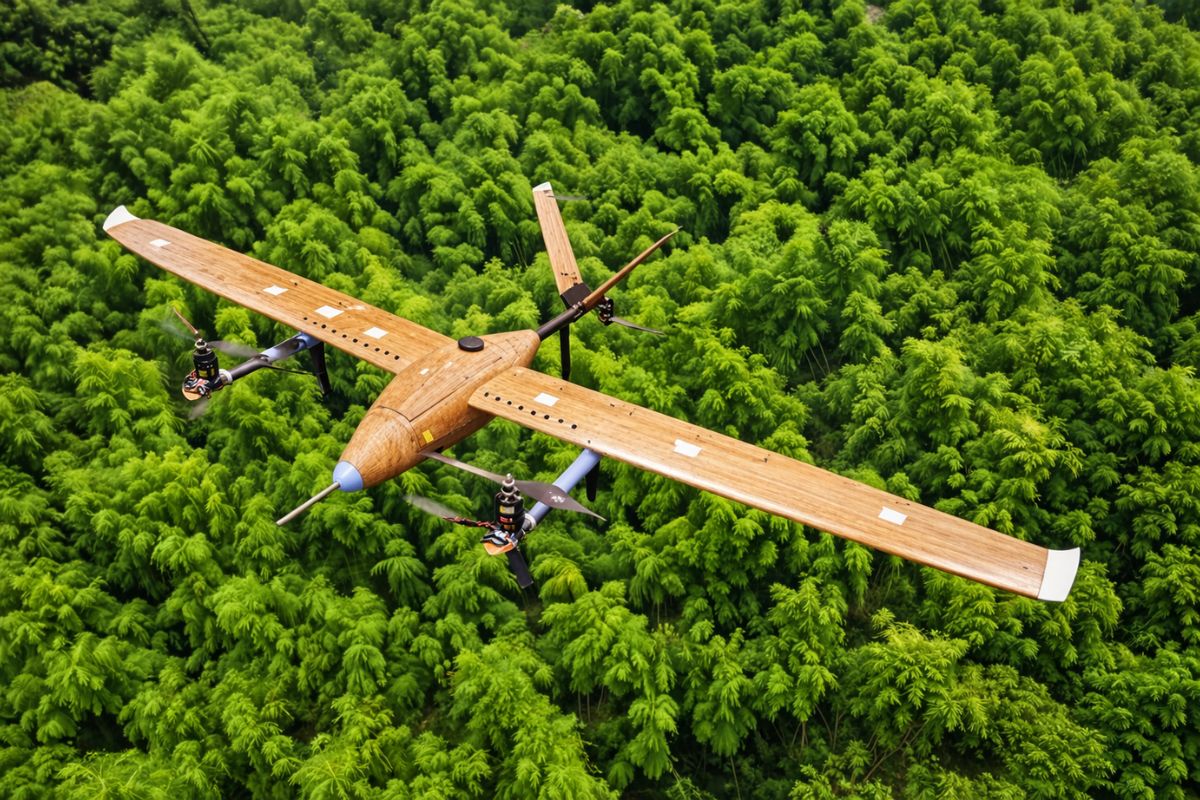
The bamboo drones developed at the Northwest Polytechnical University of China have solved the historical problem of low-frequency vibrations that prevented the material from being used in autonomous aircraft, and now the complete open-source system is available for anyone to adapt and use
Researchers from the Civil Aviation School at Northwest Polytechnical University in China have created something that aerospace engineering considered unfeasible until recently: bamboo drones that fly with the same stability and precision as models built with conventional composite materials. The system includes dedicated hardware, control algorithms redesigned for the specific characteristics of bamboo, and the game-changing detail has been released as open source, free for anyone in the world to use, adapt, and improve.
The use of bamboo in drones was hindered by a technical problem that seemed unsolvable. According to information from the portal interestingengineering, the bamboo structure generates low-frequency vibrations, typically between 8 and 20 hertz, that traditional flight controllers cannot filter. This made flight unstable and unpredictable, dismissing bamboo drones as a serious alternative for advanced applications. The Chinese team not only solved this problem but also developed an entire platform designed for other researchers and manufacturers to build their own bamboo drones without needing to start from scratch.
The problem of vibrations that prevented bamboo drones from flying properly
To understand what the Chinese researchers did, it is necessary to first understand why no one had succeeded before. Bamboo is lightweight, strong, renewable, and theoretically abundant, making it an ideal material for sustainable aircraft.
-
Russia reveals that it is already conducting 95% of all its business with China without using a single dollar; dedollarization has ceased to be a promise and has become a reality in record time, and the West watches helplessly.

-
While Brazilians work more than 44 hours a week, Norwegians leave the office at 3 PM and are now testing a four-day workweek with full pay and no loss of productivity.

-
A legend of Brazilian TV is 75 years old, returned to narrate the World Cup for SBT, and still finds time to manage a farm of over 100 hectares in Rio Grande do Sul where she produces award-winning wines, olive oil, and raises cattle.

-
Family buys mansion destroyed by fire for $1.5 million, faces over 500 days of construction, transforms loss into high-end property, and leaves neighbors in awe.

In practice, the bamboo structure behaves very differently from carbon fiber or aluminum composites when subjected to stress: it vibrates at low frequencies that confuse conventional sensors and flight controllers.
Commercial flight controllers, whether closed or open source, were designed for rigid materials with predictable vibration patterns.
When installed on bamboo drones, these systems simply do not work; they interpret the natural vibrations of the material as instability and attempt to correct something that does not need to be corrected, generating even more instability.
It was a cycle that seemed insurmountable and, according to the researchers, “historically limited the viability of bamboo as a structural material in advanced drone applications.”
How the Chinese researchers solved the technical challenge of bamboo drones

The team led by senior engineer Tian Wei tackled the problem on three fronts simultaneously. First, they developed a dedicated flight control board based on an industrial-grade chip, different from the generic controllers available on the market.
Second, they integrated a dual inertial measurement unit system—two sets of sensors that complement each other to filter vibrations accurately. Third, and most importantly, they redesigned the control algorithms to fit the unique structural characteristics of bamboo.
The technical result is impressive. Through the precise adjustment of an extended Kalman filter—a mathematical tool that separates signal from noise in real-time—and leveraging the natural damping properties of bamboo itself, the system reduced control latency from 15-20 milliseconds to just 8-10 milliseconds.
This means that bamboo drones respond faster than many conventional models, maintaining stable flight even in conditions that previously made operation impossible.
Why releasing the software for free changes the game for bamboo drones
The decision to make the entire system open source is what transforms this research from an academic experiment into something with real impact potential.
Both the flight control software and the structural parameter settings are available for free, and users can adapt the system to different bamboo fuselage structures without needing to rewrite the core algorithms.
In practice, this means that a researcher at any university in the world can download the software, adjust the configuration files for their own bamboo drone design, and have a functional platform without investing in software development from scratch.
The system uses a modular publish-subscribe architecture that allows for parallel data processing, is compatible with conventional electronics, and communicates via the MAVLink protocol—the industry standard for drones. Bamboo drones, with this technology, can integrate into existing workflows and platforms without requiring proprietary infrastructure.
Where bamboo drones can be used in practice
Tian Wei’s team has mapped applications ranging from environmental monitoring and forest inspections to teaching science in universities and technical schools.
In regions where bamboo is abundant and composite materials are expensive or difficult to import, bamboo drones can democratize access to autonomous aircraft technology—especially in Southeast Asian countries, Latin America, and Africa.
The educational potential is also significant. With open source and transparent documentation, engineering programs can use the platform as a learning tool, allowing students to build and program their own sustainable drones.
The researchers claim that the approach “dramatically reduces barriers to secondary development” and can accelerate the adoption of bamboo drones in industrial and educational applications.
Bamboo ceases to be an exotic alternative material and becomes a viable, tested, and documented option for those who want to build eco-friendly drones without relying on expensive materials or proprietary software.
Would you use a bamboo drone? Do you think open source will accelerate the adoption of this technology? Let us know in the comments.








Seja o primeiro a reagir!