





 Portuguese
  English
  Spanish
  5 min of reading
  0 comments


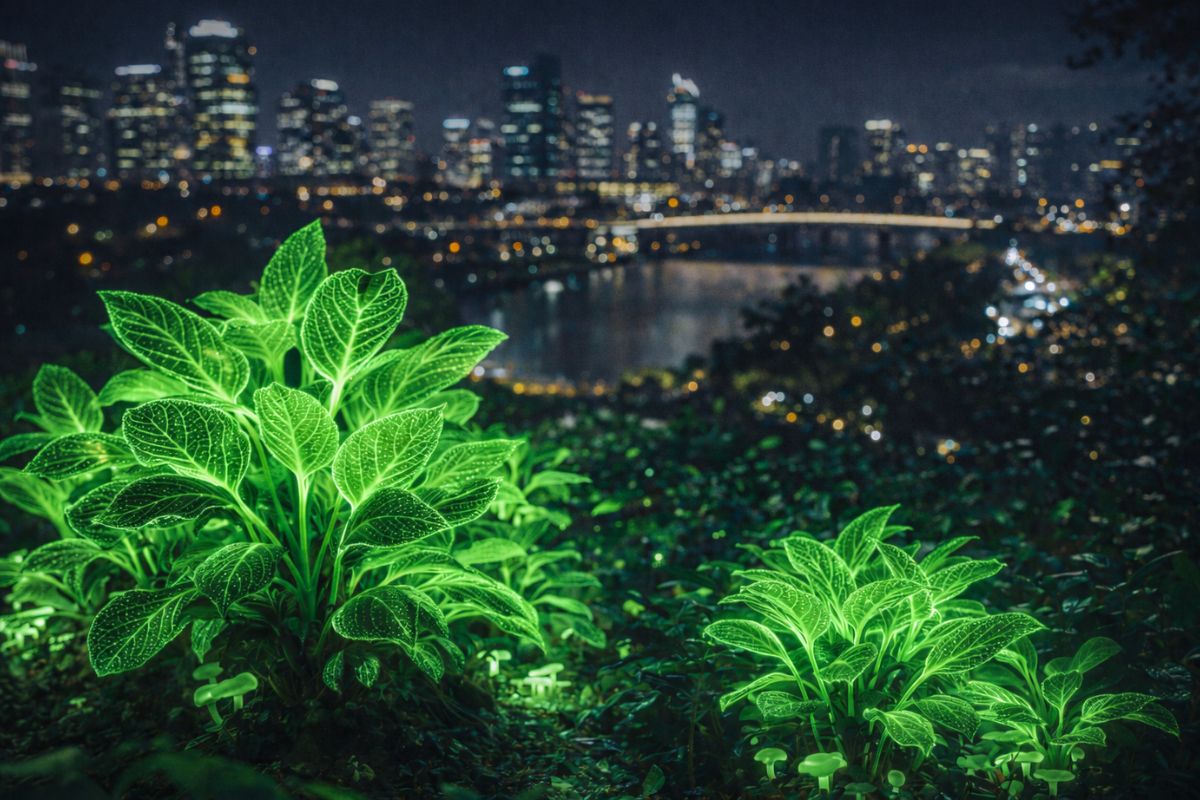
More than 20 species of bioluminescent plants have been modified by Chinese scientists with genetic editing using genes from luminescent fungi and fireflies, and researchers claim that the technology could generate lighting without electricity for parks and urban public spaces
Chinese scientists have just presented to the world something that seems to have come straight out of the movie Avatar: bioluminescent plants that glow in the dark using genes transferred from fireflies and luminescent fungi to plant cells. More than 20 species have already been modified with genetic editing, including orchids, sunflowers, and chrysanthemums, and all emit a soft and natural glow without needing any external power source.
The most interesting part is that the proposal goes beyond aesthetics. Dr. Li Renhan, founder of the biotechnology company Magicpen Bio and a PhD from China Agricultural University, claims that these bioluminescent plants could provide lighting without electricity for entire parks and public spaces. The plants do not consume a cent of energy: they only need water and fertilizer to function, save energy, reduce emissions, and can illuminate cities at night. If this is confirmed on a large scale, we are talking about a silent revolution in how we think about urban lighting.
From a childhood memory in the countryside to plants that glow in the dark

The story behind the discovery has a personal touch that says a lot about how real science happens.
-
Motorola launched the Signature with a gold seal from DxOMark, tying with the iPhone 17 Pro in camera performance, Snapdragon 8 Gen 5 that surpassed 3 million in benchmarks, and a zoom that impresses even at night.

-
Satellites reveal beneath the Sahara a giant river buried for thousands of kilometers: study shows that the largest hot desert on the planet was once traversed by a river system comparable to the largest on Earth.

-
Scientists have captured something never seen in space: newly born stars are creating gigantic rings of light a thousand times larger than the distance between the Earth and the Sun, and this changes everything we knew about stellar birth.

-
Geologists find traces of a continent that disappeared 155 million years ago after separating from Australia and reveal that it did not sink, but broke into fragments scattered across Southeast Asia.

Dr. Li Renhan grew up in the countryside, in a resource-poor family, and his nights were spent in a hammock in his grandfather’s bamboo grove, where fireflies landed on his arms. That natural light stuck in his memory as a possibility.
Years later, already studying genetic editing at China Agricultural University, Li began to investigate whether the biological mechanisms that make fireflies glow could be transferred to plants.
The idea was simple in essence and absurdly complex in execution: to take genes from luminescent fungi and fireflies and insert them into plant cells so that the bioluminescent plants would produce light on their own. The Chinese scientists succeeded, and the result was publicly demonstrated at the Zhongguancun Forum.
Genetic editing transfers genes from luminescent fungi to more than 20 species
The technique used by the Chinese scientists is based on genetic editing, the same technology that is already applied in agriculture and medicine around the world.
The process involves transferring light-producing genes from luminescent fungi and fireflies to the DNA of plants, causing plant cells to produce the proteins responsible for bioluminescence.
So far, more than 20 species have already been successfully modified, including orchids, sunflowers, and chrysanthemums. The bioluminescent plants emit a visible glow without external power sources, which means that the light comes exclusively from the plant’s metabolism.
The luminescent fungi used as a genetic source are already known in biology, but the innovation lies in making this mechanism work stably within plant species that normally do not produce light.
Lighting without electricity: how plants can replace poles and lamps
The most ambitious application proposed by the Chinese scientists is to use bioluminescent plants as a source of lighting without electricity in urban spaces.
According to Dr. Li Renhan, parks, squares, sidewalks, and public spaces could be illuminated by vegetation that glows naturally, without any expenditure of electrical energy, just with the same care that any garden already receives: water and fertilizer.
The proposal sounds futuristic, but the logic is straightforward. If a plant can emit visible light from its own metabolism, it is enough to plant it in sufficient quantity for a public space to have functional lighting at night.
The system is described as highly efficient and low-carbon, as it eliminates the need for wiring, poles, lamps, and all the associated electrical infrastructure. For cities looking to reduce emissions and energy costs, lighting without electricity from bioluminescent plants could become a real alternative.
Avatar in real life: tourism and night economy with glowing plants
Beyond urban utility, the Chinese scientists see enormous potential in tourism.
Dr. Li Renhan described the possibility of creating entire valleys filled with glowing plants that would transform landscapes into scenes worthy of the movie Avatar, attracting visitors and boosting the night economy of regions that currently remain dark after the sun sets.
The comparison to Avatar is not rhetorical exaggeration. The bioluminescent plants emit a soft and natural glow that resembles the most iconic scenes from James Cameron’s film, and the idea of walking through a garden or forest where the entire vegetation glows in the dark has immediate tourist appeal.
The genetic editing that makes this possible using luminescent fungi and genes from fireflies has already been publicly demonstrated, and the transition from laboratory to commercial application now depends on scale and regulation.
The same genetic editing is already advancing in medicine and agriculture
The technology of genetic editing used to create bioluminescent plants is not an isolated line of research.
The Chinese scientists involved in the project claim that similar techniques are already helping researchers observe how diseases develop at the cellular level, accelerating the discovery of drugs and improving treatments for previously difficult-to-treat diseases.
In agriculture, the same approach has allowed the creation of rice varieties resistant to multiple pests through the editing of susceptibility genes.
The fact that genetic editing can simultaneously make plants glow, combat diseases, and protect crops shows the versatility of a technology that is just beginning to reveal its reach. The luminescent fungi and fireflies were the starting point, but the destination of this research seems much larger than lighting without electricity.
Would you live in a city lit by plants?
The Chinese scientists transformed a childhood memory with fireflies into bioluminescent plants created with genetic editing and luminescent fungi that can provide lighting without electricity for entire cities.
The technology already works in more than 20 species, has been publicly demonstrated, and has concrete proposals for application in parks, tourism and urban spaces.
Do you think we will one day see streets lit by plants in Brazil? Would you buy a plant that glows in the dark for your home? Let us know in the comments what you think about this discovery.








Seja o primeiro a reagir!