





 Portuguese
  English
  Spanish
  6 min of reading
  0 comments


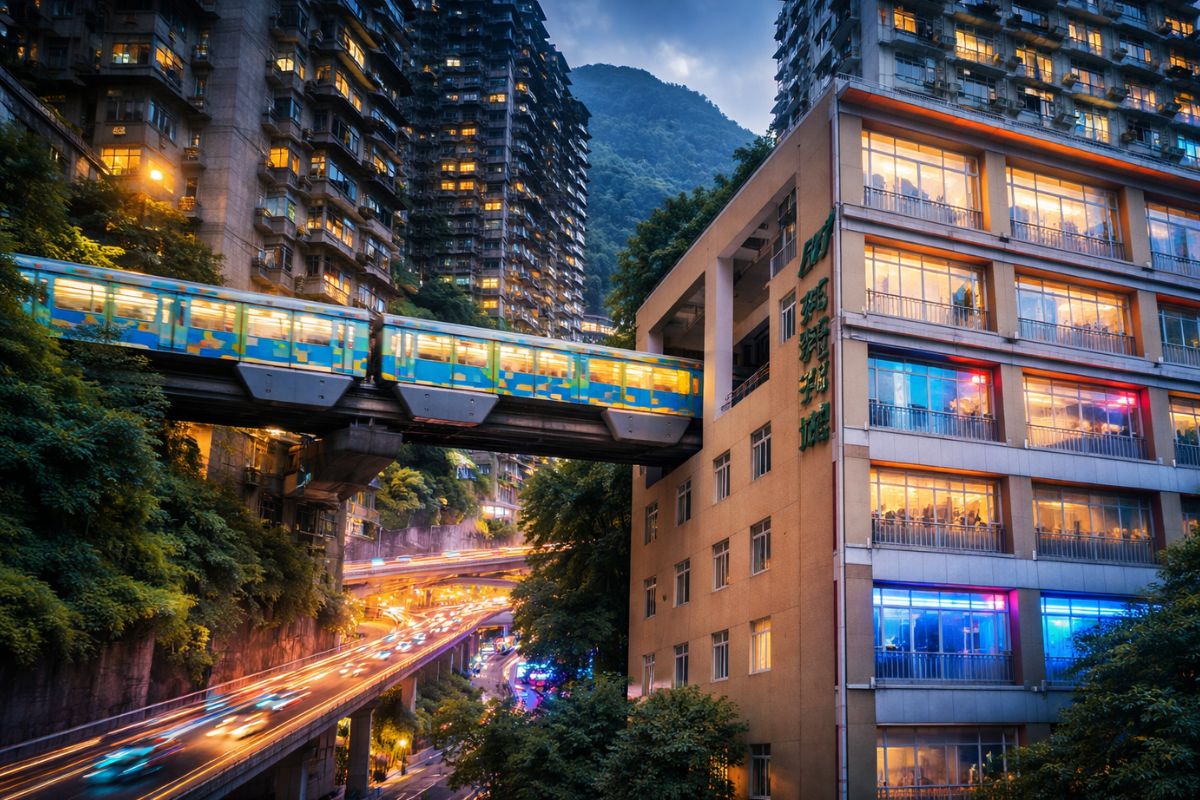
Located in Southwest China, Chongqing Grew Without Sea and Horizontal Space, Stacking Neighborhoods on Top of Neighborhoods in a Hilly Terrain. The City 8D Combines Futuristic Architecture, Neon Lights, and Scenes That Confuse Orientation: There is a Building Whose Ground Floor Appears on the 12th Floor, and Even a Train Crossing Condominiums That Have Become a Fad in Videos.
Chongqing does not resemble most metropolises because everyday experience there requires relearning the basics: where the street is, what “going up” means, and even what “ground floor” signifies. The City 8D, a nickname that became a global label, arose from a geography that pushes the city upward and inward, creating layers of circulation and buildings that seem to fit together like pieces of an urban puzzle.
At the same time, this verticality ceased to be merely an adaptation and became a visual language. With futuristic architecture, intense lighting, and “improbable” scenes captured by smartphones, Chongqing entered the circuit of international tourism with strength, driven by viral videos and changes that facilitated the entry of foreign visitors.
Where Geography Rules and the City Responds with Height

Chongqing is located in the southwest of China, surrounded by mountainous terrain. Without access to the sea and with little space to expand horizontally, the metropolis followed an almost inevitable path: to grow vertically. It is not just an aesthetic choice; it is an urban solution for a topography that limits wide avenues and “flat” neighborhoods as seen in other big cities.
-
Italian researchers have detected what appears to be a second Sphinx buried under the sands of Egypt, and satellite scans reveal a gigantic underground megastructure hidden beneath the Giza Plateau for over 3,000 years.

-
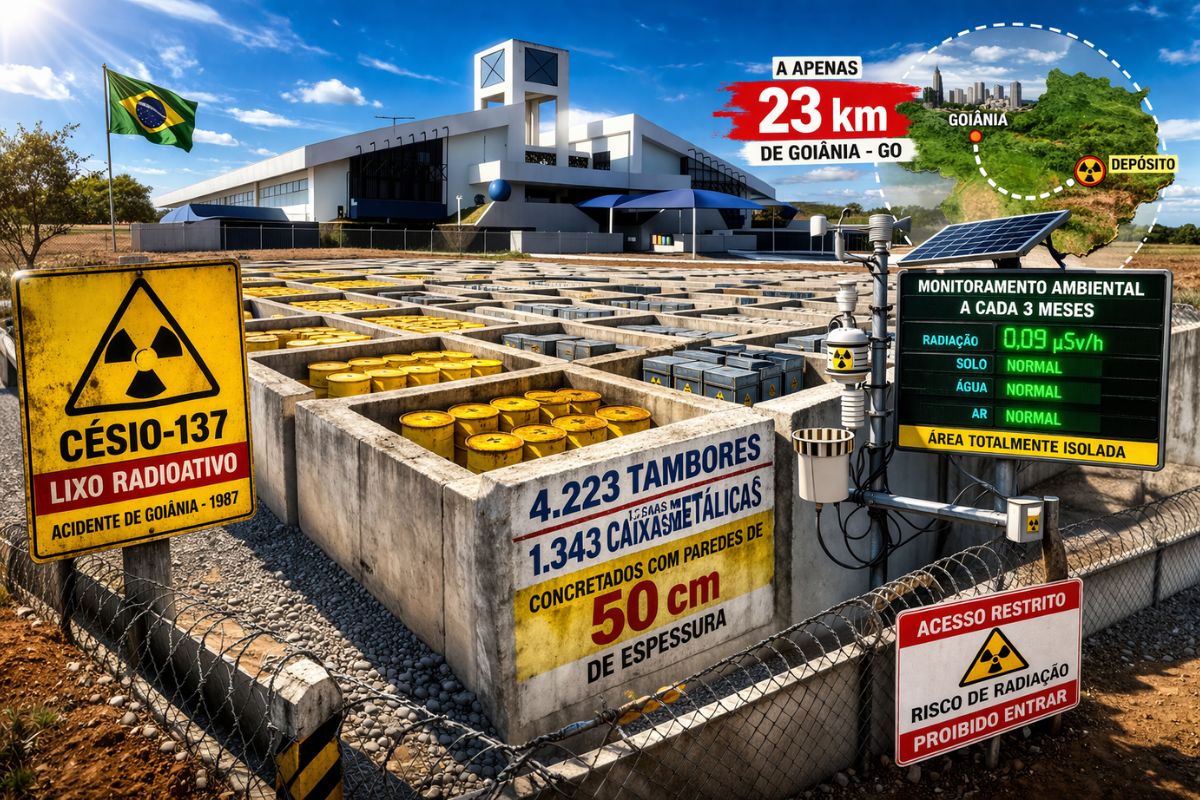
There are 4,223 drums and 1,343 metal boxes concreted with 50-centimeter walls that store the radioactive waste from Cesium-137 in the worst radiological accident in Brazil, just 23 kilometers from Goiânia, with environmental monitoring every three months.
-
Giant Roman treasure found at the bottom of Lake Neuchâtel in Switzerland reveals an advanced trade system, circulation of goods, and armed escort in the Roman Empire about two thousand years ago.

-
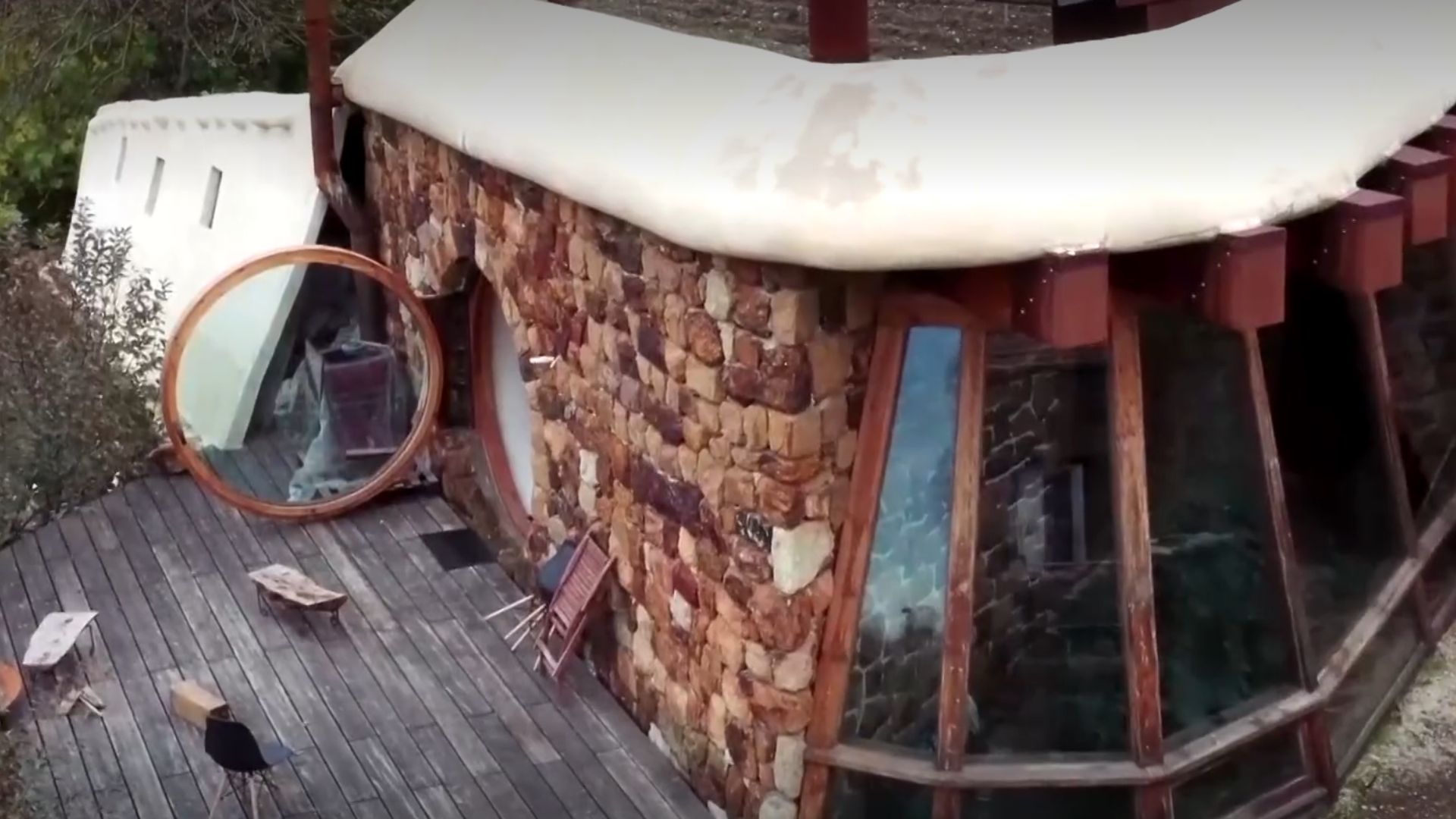
He buried 1,200 old tires in the walls to build his own self-sufficient house in the mountains with glass bottles, rainwater, and an integrated greenhouse.

This condition helps to explain why the city can have an area equivalent to Austria yet still concentrate everyday life in stacked structures, with roads, walkways, and buildings fitted at different levels.
The result is a landscape that confuses traditional references of “center” and “periphery”, because movement does not happen just in a straight line: it happens in altitude.
The Logic of the City 8D and the “Ground Floor” That Appears on the 12th Floor
The nickname City 8D does not refer to a secret technology, but rather to a sensation: the impression that the city has more dimensions than the usual four on the map.
At some points, the same building can connect to different streets at different heights. Therefore, a floor that serves as the main entrance can be high up, while lower levels fit into another access, on another road, in another urban “layer.”
This is where one of the most talked-about scenes emerges: a building whose “ground floor” is on the 12th floor. The detail grabs attention because it dismantles the visitor’s expectation: what seems to be the beginning of the building is actually just one of the possible entrances. In a city designed by slopes and hillside cuts, “ground floor” becomes a relative term depending on where you arrive.
Trains Crossing Buildings and Urbanism as Layered Engineering

Chongqing also gained fame for situations that seem impossible at first glance, such as a train passing through a residential building.
It is the type of landscape that doesn’t need a filter to look futuristic.
This integration between infrastructure and housing indicates a city that needed to blend transport, buildings, and circulation in a three-dimensional space.

When roads and tracks meet slopes, urban design tends to create solutions in “layers”: bridges over streets, pathways above rooftops, lateral access to buildings, and connections that completely change the sense of “near” and “far.” For visitors, this appears “surreal”; for residents, it is daily logistics.
Neon, Cyberpunk Aesthetics, and the Push from Viral Videos in Tourism

The nighttime landscape became a signature. Since 2019, facades and monuments have been bathed in neon lights, creating a visual spectacle that fits perfectly into the language of short videos.
The city operates as a ready-made set for going viral, and this weighs heavily when the travel decision is influenced by striking images on social networks.
The numbers associated with this turnaround help to quantify the phenomenon: in 2024, Chongqing received about 1.3 million international tourists, a growth of 184% compared to the previous year.
Li Tian, a manager at a local travel agency, reports a 20% to 30% increase in the influx of foreigners and the offering of tours in various languages including English, Spanish, Thai, Japanese, and Korean in response to the demand. Additionally, drone shows and fireworks are now part of the cultural agenda, reinforcing the “cyberpunk” aesthetic circulating on screens.
Who Visits, Why They Can Enter, and How This Changed the Rhythm of the City

The boost did not come solely from the image: there was also facilitation of entry. Since December 2023, citizens of countries such as France, Germany, and Spain have been exempt from visas to visit Chongqing.
When barriers fall, curiosity turns into real movement, and official data associates the measure with a 245% increase in the arrival of foreign visitors in the first months of 2025.
This set of factors viral videos, photogenic urban lighting, tours offered in various languages, and simpler entry rules creates a typical cycle of contemporary tourism: the city appears on screen, sparks interest, receives more visitors, adapts services, generates more content produced by travelers, and then circulates with even more strength.
Canadian Joshua Guvi, who experienced the local life, summarizes this effect by saying he regrets not having stayed longer.
War Past, Underground Shelters, and Hot Pot Amid Futurism
The image of Chongqing as the “city of the future” hides an important detail: the past is present, and not as a piece of a distant museum. The city served as the provisional capital of China during World War II, and marks from that period remain integrated into urban life, including how some spaces were repurposed.
A direct example is old air-raid shelters that now operate as hot pot restaurants, a traditional local dish. It is an uncommon mix: structures designed for survival during bombing turn into meeting places and food.
This coexistence of history and neon helps to explain why Chongqing attracts so much attention: it is not merely “modern”; it is a collage of times, stacked just like its streets and buildings.
Mega Station, Logistics, and the Economic Weight Behind the Landscape
The recent infrastructure also points to a strategic role beyond tourism. In June 2025, Chongqing opened a high-speed train station covering 1.22 million square meters an area equivalent to 170 football fields.
It is not just about size; it is a sign of logistical centrality, because such a large structure tends to reorganize flows, connect regions, and reinforce the city as a transportation hub.
In the economic landscape, Chongqing appears as the fifth-largest economy in China, surpassing Guangzhou and only ranking behind Shanghai, Beijing, and Shenzhen.
This information helps tie the picture together: what looks like a “scene” in videos is also a consequence of urban investment, intense circulation, and large-scale transportation integration. City 8D becomes a visual symbol, but also reflects an economic and logistical engine working behind the lights.
Chongqing attracts attention because it forces the visitor to accept that the traditional map does not suffice: the path may be above, below, or crossing a building, and “ground floor” may appear where no one expects it.
The City 8D transformed a challenging terrain into an urban language, blending engineering, light, history, and a type of daily life that seems improbable until you understand that it is just different.
If you could spend a day in a place where streets, bridges, and entrances change levels all the time, what would be your strategy: follow a planned itinerary or get lost on purpose?
And what city gave you the most sense of being “in another dimension” when you walked through it?









-

-

2 pessoas reagiram a isso.