





 Portuguese
  English
  Spanish
  3 min of reading
  0 comments


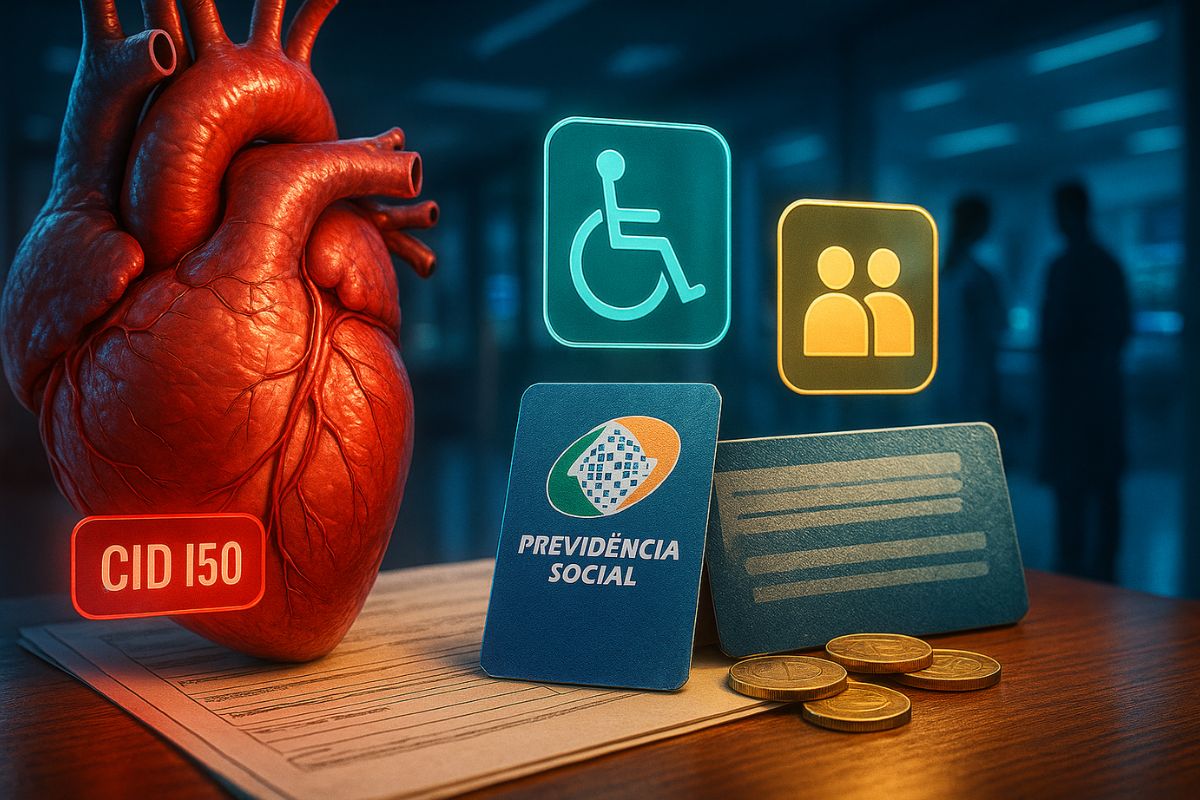
CID I50 Cardiac Problems Can Guarantee Retirement or Sick Leave at INSS When Heart Failure Causes Proven Disability in Medical or Biopsychosocial Expertise.
The CID I50 cardiac problems, which classifies heart failure in the international CID-10 table, is one of the diagnoses most analyzed by INSS in 2025. The disease, considered severe in advanced stages, can ensure disability retirement, sick leave, and even full benefits, provided that the work incapacity is proven with medical documents.
According to social security lawyer Hilário Bocchi Junior, the definition of the right depends on two factors: maintaining insured status and presenting consistent medical reports. It is not enough to have a diagnosis; it is necessary to demonstrate that heart failure permanently or temporarily compromises the ability to work.
What CID I50 Really Means
The CID I50 cardiac problems encompasses three main classifications: congestive heart failure (I50.0), left heart failure (I50.1), and unspecified heart failure (I50.9).
-
The noise law will no longer be in effect at 10 PM starting in June with a new rule valid during the 2026 World Cup.

-
The Chamber opens a debate on driver’s licenses at 16 years old as part of a reform that includes around 270 proposals to change the Brazilian Traffic Code and may redesign rules for licensing, enforcement, and circulation in the country.

-
The new Civil Code could revolutionize marriages in Brazil with “express divorce” and changes that could exclude spouses from inheritance.

-
Banco do Brasil sues famous influencer for million-dollar debt and intensifies debate on delinquency, risks of seizure, and direct impact on Gkay’s credibility.


These codes are used in medical certificates and analyzed in INSS assessments.
During the evaluation, the expert considers symptoms such as constant shortness of breath, intense fatigue, swelling in the legs, and recurrent hospitalizations.
When these signs indicate total and permanent incapacity, the insured may be entitled to full disability retirement.
In temporary cases, sick leave is the recognized alternative.
When Heart Failure Gives Right to Retirement
Experts divide the evolution of CID I50 into three main stages: acute, chronic, and terminal heart diseases.
In advanced stages, physical limitations hinder the continuation of work activities, especially in professions that require physical effort or exposure to risky environments.
In these situations, INSS can grant permanent incapacity retirement, provided that the insured maintains their insured status and has fulfilled the minimum contribution requirement of 12 contributions, except in cases of severe illnesses recognized by law.
Benefits Beyond Retirement
The recognition of CID I50 cardiac problems is not limited to disability retirement. The insured may have access to:
Sick leave in temporary cases when there is an expectation of partial recovery.
Disability retirement in situations where heart failure is considered a long-term disability.
Full death pension for dependents when the surviving spouse is a person with a disability.
Additionally, when heart failure is work-related — as in cases of Chagas disease acquired in a rural environment — the benefit can be classified as accident-related, ensuring additional protection.
The Role of Justice in Denial Cases


Even with consistent medical documentation, it is common for INSS to deny retirement or sick leave requests related to CID I50 cardiac problems.
In such situations, the judicial route becomes a necessary alternative.
According to Hilário Bocchi Junior, legal actions can reverse administrative denials, as they allow for independent assessments and a more thorough analysis of the insured’s clinical history.
This step ensures that decisions are not made solely based on simplified reports.
The CID I50 cardiac problems does not automatically guarantee benefits, but can ensure disability retirement, sick leave, and even full pension for dependents when incapacity is proven.
The insured must maintain insured status, fulfill the contribution requirement, and present robust medical reports to avoid denials from INSS.
Do you believe that INSS should have clearer criteria for automatically recognizing severe diseases such as heart failure? Have you faced difficulties with assessments? Leave your comment and share your experience.










-

-

4 pessoas reagiram a isso.