





 Portuguese
  English
  Spanish
 4 min of reading
  0 comments


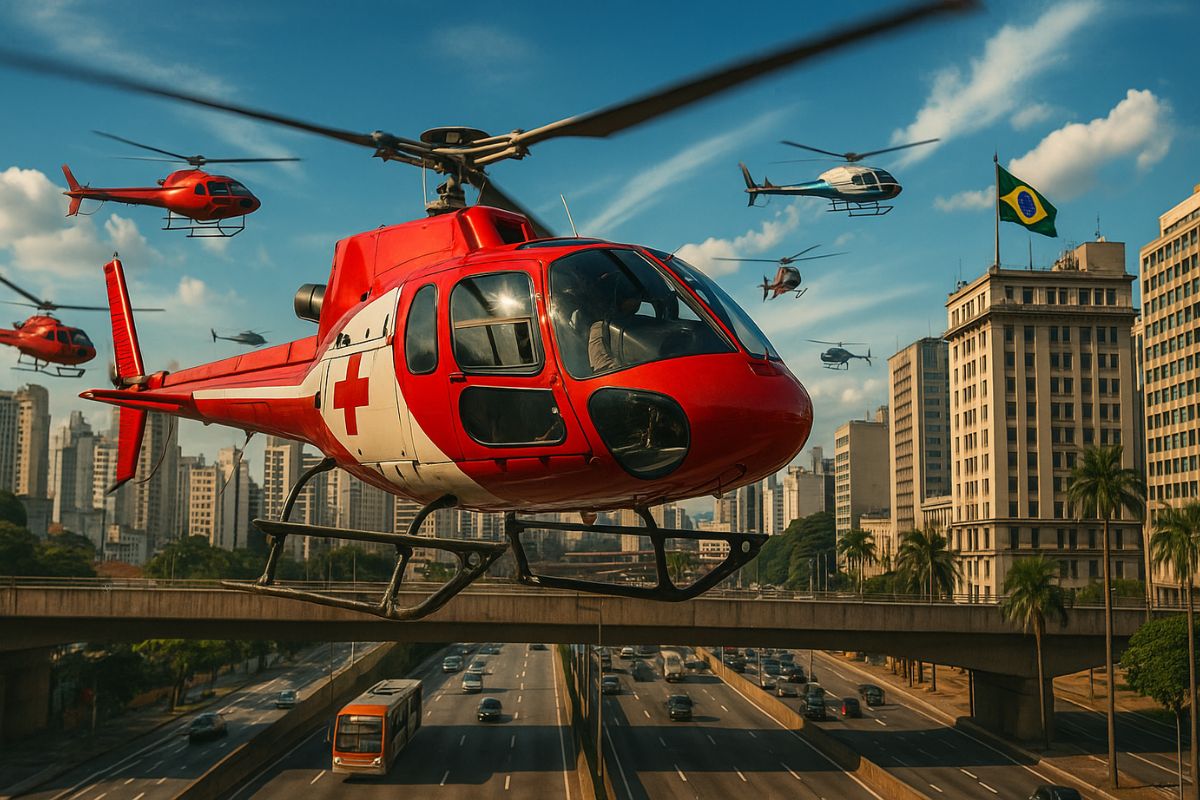
The Largest Helicopter Fleet on the Planet Operates in São Paulo with Over 400 Aircraft, 260 Helipoints, and a Flow That Reaches One Landing Every 45 Seconds During Peak Times
The largest helicopter fleet on the planet is not in New York or Tokyo. It is in São Paulo, where over 400 aircraft cross the sky daily, supported by 260 helipoints and a flow that, during peak times, can reach one landing every 45 seconds. It is the portrait of a metropolis that has transformed the air into a real alternative to surface traffic.
In the country’s financial capital, the helicopter has become a time tool. Between business appointments, trips to airports, and connections to the coast, the city has developed a unique infrastructure, backed by dedicated air traffic control and a maintenance ecosystem, air taxi, and operations that few metropolises can replicate.
Who Flies, How Much They Fly, Where They Fly
The question of who starts with executives, healthcare professionals, press teams, visitors, and high-value logistics operators.
-
Spain surprises the world by erecting 62 artificial dunes, mixing sand with natural remains of posidonia, and causing the structure to lose only 1.4% of its volume in 1 year.

-
With 16 Bulava missiles, improvements in acoustic stealth, and a design focused on silent patrols, Russia’s nuclear submarine was born to ensure Moscow’s invisible retaliation and has become one of the pillars of its maritime strength.

-
‘Populous’ city in Rio among the worst in Brazil in national ranking and exposes silent development crisis.
-
Couple buys house in the South Zone of São Paulo, opens a hidden door in the garage, and finds a secret wine cellar with dozens of old wines forgotten since the 1970s.


It’s not just a status symbol. It is an operational solution to gain predictability in strategic movements.
How much they fly is measurable. It is estimated that there are about 2,200 daily landings and takeoffs in the metropolitan region, with peaks of one movement every 45 seconds.
Where they fly covers nearly all of the city’s business network.
The 260 helipoints are distributed across the tops of corporate buildings, hospitals, hotels, terminals, and private structures that shorten critical routes.
Why São Paulo Leads the World
São Paulo combines economic power, dense corporate network, and chronic congestion that increase the cost of every minute lost.
In this scenario, the helicopter has become a bridge over road inefficiencies, connecting hubs like Faria Lima, Paulista, Marginal, Alphaville, airports, and the coast with a clock that does not depend on traffic.
There is also an uncommon support infrastructure. Specialized workshops, hangars, air taxi operators, and maintenance teams form a cluster that provides connectivity to operations.
When there is scale, unit costs are better organized, and the market matures.
How Air Traffic Control Works
The city operates with an exclusive traffic system for helicopters, known as HELICONTROL, created to organize routes, altitudes, and minimum separations in an extremely active airspace.
It is an operational differentiator that increases safety, reduces go-arounds, and adds fluidity to an air network over densely populated areas.
This arrangement separates the flow of helicopters from other traffic, organizes the entries and exits of helipoints, and standardizes communications and procedures.
The result is a predictability pattern that supports the high frequency of operations observed during peaks.
Comparisons That Help Dimension
In terms of number of aircraft, the largest helicopter fleet on the planet in São Paulo surpasses New York and Tokyo.
Noise restrictions and usage in other metropolises limit the scale that the São Paulo capital has reached.
The daily volume of operations is unparalleled when we look at cities with similar density.
Also in infrastructure, the number of helipoints integrated into the corporate and hospital fabric is an outlier.
Few metropolises offer so many landing windows close to where the passenger really needs to be, which multiplies the modality’s utility.
Urban, Social, and Environmental Impacts
Noise is a fact. Residents of areas with a high density of helipoints live with frequent noise.
Local regulations and approach procedures try to mitigate disturbances, but noise pollution remains at the center of the debate.
On the social front, the fleet exposes inequality of access. While part of the city crosses the sky in minutes, most remain stuck on the asphalt.
The issue is public policy: how to transform productivity gains into broader benefits by investing in mass transport and the integration of modalities.
Executive Aviation and Services Economy
The São Paulo ecosystem supports air taxi companies, maintenance centers, pilot training, and parts supply.
It is a value chain that generates skilled jobs and positions São Paulo as a Latin American hub for helicopter operations.
For the corporate user, the calculation is straightforward.
Time saved is cost avoided.
Connections as a financial center to airports or the coast become predictable and repeatable, which boosts schedules, reduces delays, and enables business that depend on punctuality.
What Lies Ahead in Air Mobility
In future studies, the infrastructure of 260 helipoints is seen as a lever for new technologies, with electric vertical takeoff and landing aircraft on the medium-term horizon.
Electrification promises to reduce noise and emissions, a sensitive subject in dense environments like São Paulo.
The strategic lesson is clear. Where there is already operation, standard, and scale, technological adoption happens faster.
This could reposition the city at the forefront of urban air mobility, provided that regulation, safety, and social acceptance move forward together.
São Paulo has solidified its position as the largest helicopter fleet on the planet by transforming time into infrastructure and creating an ecosystem that operates at an industrial pace.
The next step is to reduce social and environmental costs and spread efficiency to those who remain on the ground.
Have you felt the impact of helicopter traffic on your routine? Does the noise bother you, has the service facilitated your work, or do you see room for a cleaner and more accessible version of this modality? Share in the comments how this reality appears in your neighborhood and what should change first.







-

-

-

-

-

-

207 pessoas reagiram a isso.