





 Portuguese
  English
  Spanish
 7 min of reading
  0 comments


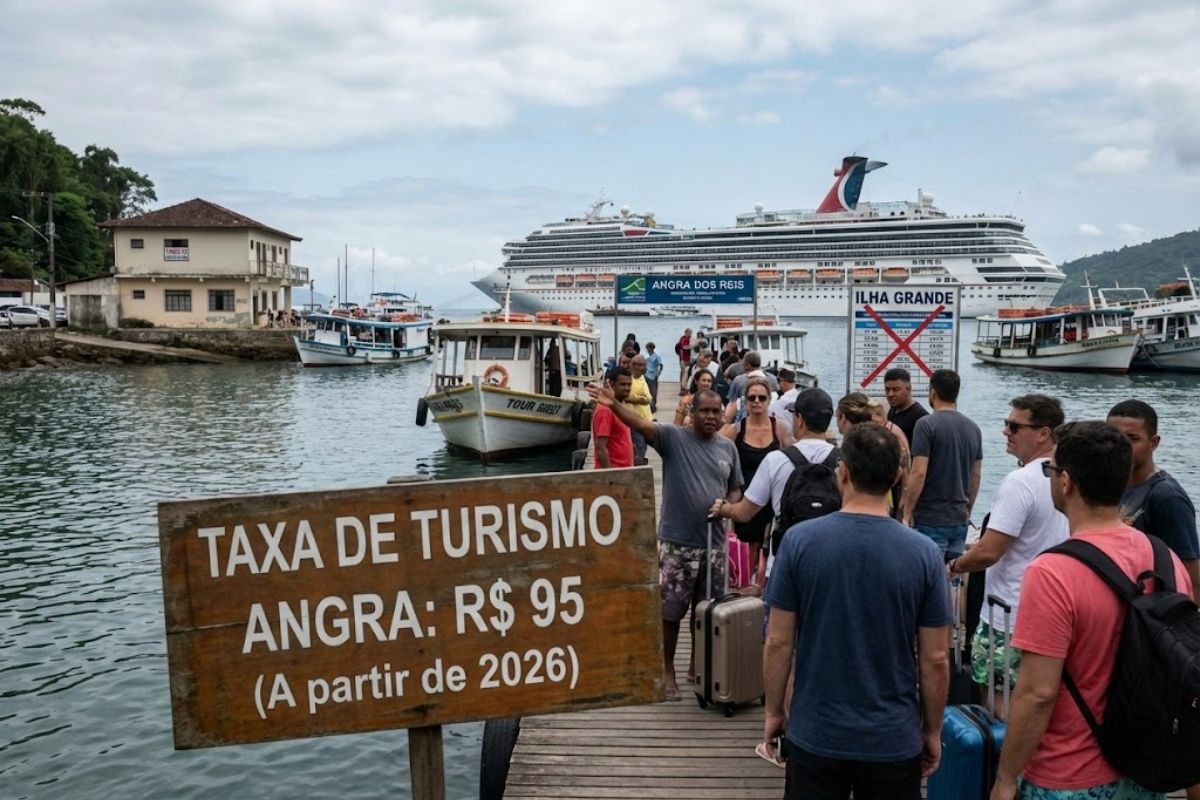
Brazilian Coastal City Approves Tourism Fee Of Up To 95 Reais Starting In January 2026, Charging Visitors From The Mainland And Ilha Grande, Irritating Residents, Worrying Hotels, Raising Cruise Costs And Raising Questions About Economic Impact And Environmental Preservation In The Carioca Paradise While Businesses Fear A Drop In Annual Traffic
On November 13, 2025, a Brazilian coastal city in the south of Rio de Janeiro approved a law creating the so-called sustainable tourism fee, which will take effect starting in January 2026 for those visiting the municipality and the islands in the region for up to seven days. The measure directly impacts Ilha Grande, one of the main postcards of the Fluminense coast, and places the Brazilian coastal city at the center of the debate about the cost of visiting a tourist paradise in the midst of a cruise boom.
Since the publication of the law, residents, merchants, and hospitality business owners have begun criticizing the project, citing a lack of dialogue and the risk of depleting the destination. Hotels, inns, and tour operators fear that the new fee will deter price-sensitive visitors and turn the Brazilian coastal city into a destination deemed too expensive, even for tourists arriving by ship.
How The Tourism Fee Will Work In The Brazilian Coastal City

The law uses the UFIR-RJ as a calculation basis. In 2025, each reference unit is equivalent to 4.75 reais.
-
A new Brazilian shopping center worth R$ 400 million will be built in an area equivalent to more than 4 football fields, featuring 90 stores, 5 cinemas, a supermarket, a college, and parking for 1,700 cars, potentially generating 3,000 jobs.

-
Larger than entire cities in Brazil: BYD is building a 4.6 km² complex in Bahia with a capacity for 600,000 vehicles per year, but the discovery of 163 workers in conditions analogous to slavery has shaken the entire project.

-
With an investment of R$ 612 million, a capacity to process 1.2 million liters of milk per day, Piracanjuba inaugurates a mega cheese factory that increases national production, reduces dependence on imports, and repositions Brazil on the global dairy map.

-
Brazilian city gains industrial hub for 85 companies that is equivalent to 55 football fields.


The island fee has been set at 20 UFIR-RJ, which corresponds to 95 reais for those staying in Ilha Grande for up to seven days, while the mainland fee is set at 10 UFIR-RJ, or 47.50 reais, for visitors staying on the mainland of the Brazilian coastal city for the same period.
For those exceeding a week of stay, an additional 1 UFIR-RJ will be charged per day. If the tourist only purchases the mainland fee and then decides to cross to the island, they will only pay the difference between the two amounts.
The management and collection will be concentrated in a Digital Tourism System, with issuance of receipts and integration with the city’s vessel and accommodation control.
The legislation also provides for progressive discounts in the initial phase.
In 2026, the year the fee is initiated, it will be applied at a 50 percent reduction from the full value, and in 2027, the discount may reach 25 percent.
Travel packages purchased by December 31, 2025, with boarding or accommodation until July 31, 2026, will also be exempt, which attempts to ease the impact on already contracted bookings.
Who Pays, Who Is Exempt And How Cruises Are Affected
According to the rules of the law, residents of the Brazilian coastal city, both from the mainland and Ilha Grande, will be exempt from payment, as well as relatives up to the second degree who are registered.
Children up to 12 years old and people over 60 years old will also not need to pay the fee, as long as they prove their condition at the time of registration.
The maritime cruises, which account for an increasing flow of tourists in the region, will have special treatment.
The law authorizes the city hall to grant discounts between 10 and 90 percent off the full amount per passenger, to be defined by decree.
In practice, the government aims to balance revenue collection with maintaining ship docking schedules, while operators fear that the Brazilian coastal city will become less competitive compared to other Brazilian tourist ports.
The law also gives the Executive the capability to establish limits on vessels and visitors per attraction, based on load capacity studies.
The idea is to use the fee not only as a source of revenue but also as a tool for organizing tourist flow, although the sector questions whether the current design fulfills this promise.
Criticisms From Residents And Hotels In Ilha Grande
In Ilha Grande, where the fee will be higher, the news was met with strong resistance.
Inns associations, small entrepreneurs, and residents claim that the decision was made under urgency in the Chamber, without adequate consultation with the community.
Business owners report that they were only called to discuss after the law was enacted, and that many of the suggestions presented were not incorporated into the final text.
One of the main complaints is the difference between the approved amount and previous technical estimates regarding what would be sustainable.
Load capacity studies previously conducted for the region indicated lower values for charging per visitor, focusing on control by attraction and direct allocation of resources to a specific fund linked to the island.
However, the law adopted a significantly higher fixed fee, without detailing the allocation for local environmental management instruments.
A lodge owner in Ilha Grande, representing accommodations and a resident of the area, also pointed out a problem of equality.
According to these criticisms, a tourist staying at a small inn on the island, managed by local families, will pay double the fee compared to someone staying at a large resort on the mainland and visiting the same beaches by boat.
For the sector, this difference disrupts competition and penalizes local-based tourism, which already operates with reduced margins.
Risk Of Inflating The Destination And Emptying The Carioca Paradise
In addition to the nominal value, business owners highlight the impact of the fee on the total cost of the trip.
Those leaving from other cities need to cover land transportation, maritime crossing, accommodation, boat tours, and food.
In many cases, the inclusion of up to 95 reais per person can be decisive for middle-income families comparing the final price with other destinations.
The concern is that the Brazilian coastal city may end up being seen as too expensive, especially during peak seasons when accommodation and ticket prices are already rising.
Operators fear that part of the public will migrate to competing beaches without similar fees, which may reduce occupancy in smaller inns in Ilha Grande and shorten the average length of stay for those who decide to maintain the itinerary.
The cruise sector is also observing the measure with caution.
If the additional cost per passenger approaches the full fee, companies may reassess itineraries or length of stay in port, which would affect restaurants, bars, vendors, and guides who depend on the circulation of ships.
In the opinion of many business owners, the risk is to turn a carioca paradise into a destination that’s too pricey just when the recovery of tourism was starting to gain momentum.
Lack Of Dialogue, Studies Ignored And Political Pressure
The manner in which the project was approved created additional discomfort.
The fast-tracked process, without a broad public hearing, reinforced the perception that the Brazilian coastal city made a structural decision about tourism without sufficiently listening to those who depend on it.
Local entities cite expensive studies commissioned over the years, with specific recommendations regarding visitation control by area and lower values, which would have been underutilized in the final drafting of the law.
The topic has also reached state agencies.
Parliament members requested the opening of a civil inquiry to assess any irregularities, but the Public Ministry indicated that it is not up to the agency to contest the validity of a law already approved by the Chamber and sanctioned by the Executive.
The State Court of Auditors has been notified to monitor implementation, especially regarding the use of collected resources and the contracting of the charging system.
For part of the critics, the combination of accelerated voting, lack of broad consultation, and disconnection from previous studies creates a scenario of legal and operational insecurity.
They argue that a review of the law, with parameters closer to the actual payment capacity of tourists and the impacts on businesses, would be necessary before the Brazilian coastal city establishes a new charging model.
What The City Hall Says And What Projects Should Be Funded
The city hall argues that the so-called Angra Viva, the name given to the sustainable tourism fee, aims to finance environmental preservation actions, sanitation, tourist infrastructure, and security, benefiting residents and visitors.
In an official statement, the municipal administration states that the fee follows examples from destinations like Fernando de Noronha and Jericoacoara, where visitation taxes help fund trail maintenance, beaches, waste collection, and public services related to tourism.
The municipality also reports that it is preparing the bidding process to hire the company responsible for the digital collection system and that it will publish a detailed manual with rules for payment, inspection, and sanctions for those who violate the norm.
By insisting that there will be discounts in the implementation phase and exemptions for residents, the city hall tries to frame the fee as a tool for balancing tourist growth and local quality of life, rather than as a barrier for visitors.
Still, the central question for those who live off tourism remains: what will be, in practice, the destination of the funds raised, how much will be specifically invested in Ilha Grande, and whether there will be transparent mechanisms for social oversight.
Without these answers, residents fear that the Brazilian coastal city will collect more but not deliver corresponding visible improvements on beaches, trails, sanitation, and transportation.
In your opinion, should a Brazilian coastal city charge a tourism fee at this level to finance environmental preservation or does the risk of emptying Ilha Grande and permanently inflating the carioca paradise speak louder?









Seja o primeiro a reagir!