





 Portuguese
  English
  Spanish
 5 min of reading
  0 comments


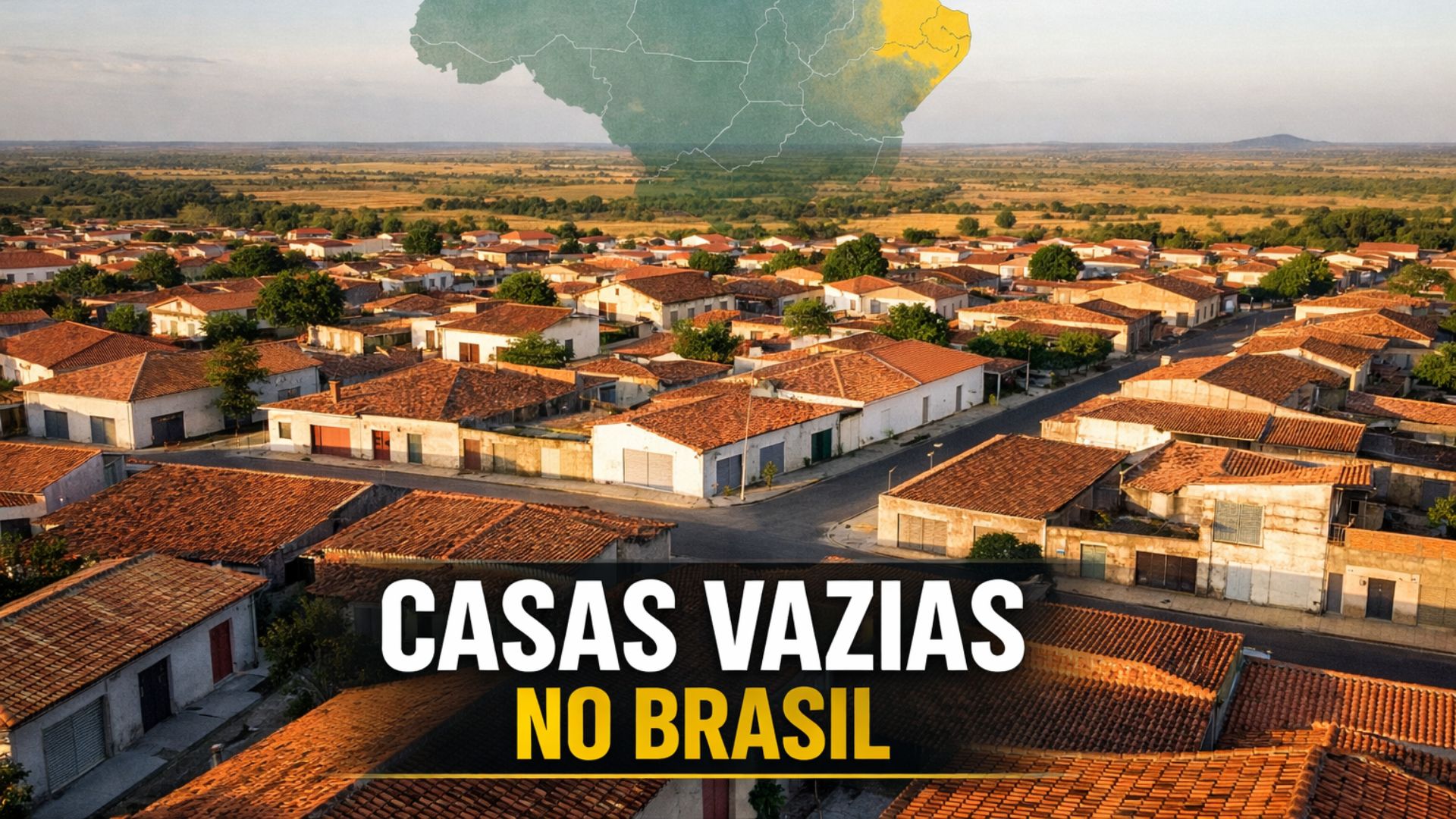
Lesser-Known Municipality in Ceará’s Interior Ranks Top in National Snapshot on Housing Released by IBGE, Reporting the Highest Proportion of Vacant Dwellings in the Country. Technical Data, Based on Official Census Criteria, Exposes Contrast Between Reduced Population and Volume of Unoccupied Properties.
A lesser-known municipality outside Ceará’s interior ranks top in a national snapshot on housing released by the Brazilian Institute of Geography and Statistics (IBGE): São João do Jaguaribe.
According to the data, the city records the highest percentage of vacant permanent private households in the country, with 29.1% of residences in this condition, a result that draws attention for placing a small municipality ahead of thousands of other Brazilian locations.
The indicator does not measure wealth or the size of the local economy.
-
Friends have been building a small “town” for 30 years to grow old together, with compact houses, a common area, nature surrounding it, and a collective life project designed for friendship, coexistence, and simplicity.

-
This small town in Germany created its own currency 24 years ago, today it circulates millions per year, is accepted in over 300 stores, and the German government allowed all of this to happen under one condition.

-
Curitiba is shrinking and is expected to lose 97,000 residents by 2050, while inland cities in Paraná such as Sarandi, Araucária, and Toledo are experiencing accelerated growth that is changing the entire state’s map.

-
Tourists were poisoned on Everest in a million-dollar fraud scheme involving helicopters that diverted over $19 million and shocked international authorities.


The data refers exclusively to the proportion of houses and apartments classified as “vacant” among permanent private households, a category used by IBGE to depict properties intended for residence that, at the time of the survey, had no one living in them.
Population and Territory of São João do Jaguaribe
São João do Jaguaribe is a municipality with a small population.
According to the IBGE Cities and States page, the city had 5,855 inhabitants in the last census, spread over an area of 279.451 km², with a population density of 20.95 inhabitants per km².
The combination of a large territory, small population, and a high percentage of unoccupied properties reinforces the contrast that made the municipality’s name stand out in the survey.

What IBGE Considers “Vacant Dwellings”
The snapshot that places the city in the lead appears in an IBGE release about the portrait of households in Brazil.
In the same material, the institute reports that the country reached 90.7 million households and that the comparison with the 2010 Census shows a growth of 34% in the total number of residences.
Within this set, IBGE points out that vacant permanent private households increased by 87%, reaching 11.4 million, while households of occasional use grew by 70%, totaling 6.7 million.
The publication explains that “vacant dwellings” are those in which no one is living.
Households of occasional use, also counted by the census, are those occupied only part-time, as occurs with vacation properties.
With these categories separated, the results allow observing not only where there are more houses, but where the presence of unoccupied properties grows in relation to the total number of residences.
National Ranking of Vacant Dwellings: CE, PI, and PB at the Top
In the ranking by percentage of vacant households, IBGE highlights that the top three are municipalities in the Northeast.
After São João do Jaguaribe (CE), appear Canavieira (PI), with 28.1%, and Bom Sucesso (PB), with 27.2%.
The list highlights that, in this specific snapshot, small towns can stand out with high rates, because the indicator is proportional and does not depend on the absolute number of properties.

City in Ceará’s Interior Leads IBGE Ranking with the Highest Percentage of Vacant Houses in Brazil, According to Official Census Data. Difference Between Percentage and Quantity of Vacant Properties
To understand what this number means in practice, it is important to differentiate “percentage” from “quantity”.
A metropolis may have more vacant residences in absolute numbers but present a smaller proportion when compared to the total number of properties.
In municipalities with few households, smaller variations in occupancy can more intensely alter the percentage of vacant properties, without that necessarily indicating a gigantic volume of constructions.
Growth of Households and Change in Family Size
IBGE’s release also contextualizes the growth of households in the country with changes in family arrangements.
The institute records that the average number of residents per household fell from 3.31, in 2010, to 2.79 in the most recent survey cited in the publication.
This movement, associated with demographic transformations and homes with fewer people, helps explain why the number of residences may advance more rapidly than the population in some regions.
Population Density and Different Housing Realities
The national snapshot also shows that Brazil has an unequal distribution of population density and land occupation.
IBGE records that, in the country, the density reached 23.9 inhabitants per km², with marked differences between regions, which reinforces the diversity of urban and rural realities.
Within this scenario, high percentages of vacant households can appear in very distinct contexts, from areas with low density in the interior to locations that concentrate unoccupied properties for part of the year.
When a Technical Data Point Becomes a National Curiosity


In the case of São João do Jaguaribe, the ranking highlight turns a technical datum into a national curiosity, as it places the city as a reference in an indicator that affects daily life: presence of closed properties, streets with houses without permanent occupancy, and areas with low residential movement.
As the classification “vacant” is limited to recording the absence of residents, the number serves as a starting point to observe the housing profile of the municipality within the national context.
The Official Portrait of the Country and the Extremes of the Survey
The result also draws attention for appearing in the same survey that gathered other data about households and population, like the interview rate conducted by the census and the expansion of the total number of residences compared to 2010.
By crossing the national snapshot with extreme cases, such as São João do Jaguaribe, the survey helps to show how the reality of housing can vary profoundly between municipalities, even when they have similar populations.
What the Proportion of Vacant Houses Suggests for Local Routine
In a small city, where much of the routine tends to concentrate in a few neighborhoods and short distances, the proportion of houses without residents can be perceived directly by those who walk the streets and engage with the neighborhood.
The IBGE data, therefore, tends to gain repercussion not only for being in a ranking but for provoking a simple question: what leads a municipality with few inhabitants to record such a high slice of vacant properties in the official portrait of the country?
In your region, is the presence of vacant houses and properties something that stands out in daily life—and what kind of reality does this reveal about the city where you live?







Seja o primeiro a reagir!