





 Portuguese
  English
  Spanish
  4 min of reading
  0 comments


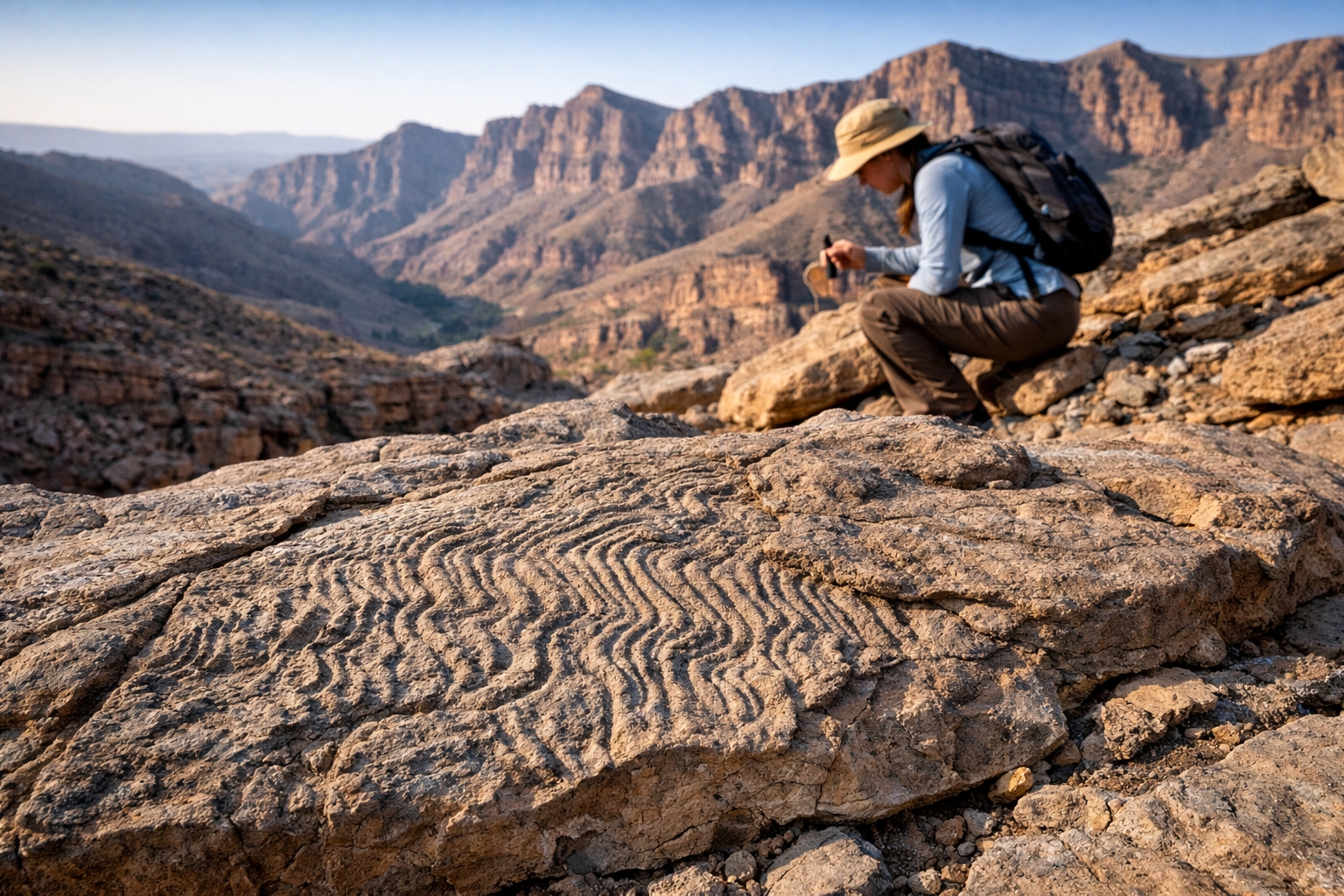
A Identification of Fossil Marks of Microbial Colonies in Morocco Triggered a Shift in the Search for Signs of the Oldest Life and Caught the Attention of Researchers Worldwide.
The scene seems simple but changed the search for the first life on Earth: a researcher walking on rocks in the Dades Valley, Morocco, noticing “wrinkles” that resembled small ripples on the ground. However, the visual detail did not match the location where it appeared.
What caught attention was the contrast: these marks are usually associated with microbial mats that grow in shallow waters, where light still nourishes photosynthetic bacteria. But the rocks from the find came from a much deeper environment.
And here comes the impact: if these records were indeed generated by life, the “hunting zone” for the oldest signs could be larger than many people imagined, including deep and unstable areas of the ancient ocean.
-
Motorola launched the Signature with a gold seal from DxOMark, tying with the iPhone 17 Pro in camera performance, Snapdragon 8 Gen 5 that surpassed 3 million in benchmarks, and a zoom that impresses even at night.

-
Satellites reveal beneath the Sahara a giant river buried for thousands of kilometers: study shows that the largest hot desert on the planet was once traversed by a river system comparable to the largest on Earth.

-
Scientists have captured something never seen in space: newly born stars are creating gigantic rings of light a thousand times larger than the distance between the Earth and the Sun, and this changes everything we knew about stellar birth.

-
Geologists find traces of a continent that disappeared 155 million years ago after separating from Australia and reveal that it did not sink, but broke into fragments scattered across Southeast Asia.

What Appeared in the Atlas Mountains and Why This Became a Topic
The wrinkled structures were found in the Central High Atlas region of Morocco. The important detail is the type of rock: turbidites, deposits formed by underwater landslides, those flows of debris that tumble down from continental areas to the deep ocean.
Researchers were surprised because this “design” is usually associated with microbial mats in quieter and more illuminated locations. Here, the signature appeared where, theoretically, it shouldn’t be found.
One Fact Changes Everything: 180 Meters Deep and 180 Million Years
The turbidites that hold these marks were, when deposited, at least 590 feet, about 180 meters, below the surface. And this happened approximately 180 million years ago.
This number is what turns the key of the story. In such a deep environment, practically no light would enter to sustain photosynthesis. So, if there was life there, it would have to work differently.
Why It Wasn’t Photosynthesis and What the Chemistry of the Rocks Revealed
The initial reading resembled photosynthetic microbial mats, those “mats” in layers that form in sediments of lakes and seas. However, the depth counters this hypothesis.
The clue came from chemistry: analyses indicated high levels of carbon in the layers where the wrinkles appear. This is a sign associated with biological activity, reinforcing that the structures were shaped by life, not just physics and sediment.
Researchers pointed out that this community was probably chemosynthetic, meaning it obtained energy through chemical reactions rather than light, possibly using sulfur or other compounds available in the environment.
The Role of Underwater Landslides in the “Cycle” that Fed the Microbes
Here comes the mechanism that makes everything more interesting. The landslides that flowed from the continent to the sea floor pulled organic matter down. This matter decomposed and generated compounds like methane or hydrogen sulfide, a veritable feast for chemosynthetic life.
Between one landslide and another, the microbial mats managed to grow. At times, a new flow of debris could wipe everything out. At other times, the marks would be preserved in the rock record, like a stamp of what lived there.
What Changes in the Search for the Oldest Life and What Can Happen Now
The message from the find is clear: wrinkled structures do not need to be restricted to shallow formations. The recommendation is to expand the search for rocks that formed in deep waters, including unstable environments linked to turbidites.
In practice, this opens a window to better understand ancient chemosynthetic organisms and how they might have established themselves in scenarios where light has no say.
In the end, the whole story goes back to a simple phrase: these wrinkled structures become important evidence to discuss the first steps of the evolution of life.
This find in Morocco draws attention because it combines three things that are difficult to see in the same place: depth, instability, and a delicate fossil record that, despite that, remained marked. And when a detail that “shouldn’t be there” appears, it forces science to recalibrate the map where it seeks answers.
This clue makes more sense as a rare exception preserved by chance, or as a sign that there are still many records hidden in deep-water rocks? Tell us what you think seems more likely.








-

-

-

5 pessoas reagiram a isso.