





 Portuguese
  English
  Spanish
  3 min of reading
  0 comments


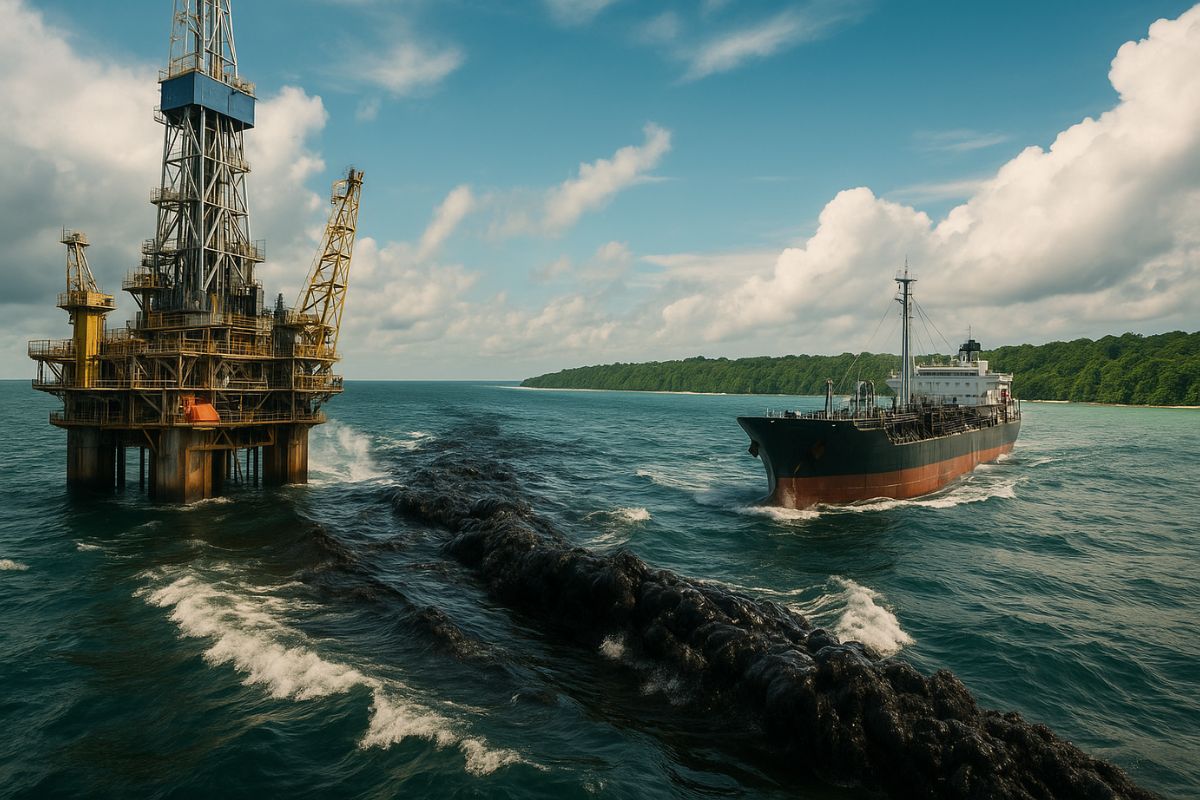
Studies Indicate Unprecedented Risks for the Amazon, Marine Fauna, and Traditional Communities If Exploration Advances Without Environmental Guarantees.
A oil spill in the Equatorial Margin could have more severe impacts than the Deepwater Horizon disaster, which occurred in 2010 in the Gulf of Mexico, when over 3 million barrels of oil were dumped into the sea. This is the conclusion of an article authored by researchers from Brazil and Spain, which compiles scientific evidence about the risks of exploration in the region.
According to a report by O Globo, the study, published in the journal Nature Sustainability, highlights that the combination of complex ocean currents, well depth, and ecological fragility of the Amazon creates a scenario of high destructive potential in the event of an accident.
Currents and Depth Increase Risks
Experts point to a critical factor: the depth of the wells in the Equatorial Margin reaches 2.88 km, almost double that of the Deepwater Horizon accident site.
-
Offshore industrial demand in Macaé skyrockets with the recovery of oil and gas and could grow by up to 396% by 2026 in the Campos Basin.
-
Offshore industrial demand in Macaé surges with the recovery of oil and gas and could grow by up to 396% by 2026 in the Campos Basin.
-
Brazilian giant expands borders in the Southeast: Petrobras confirms new oil discovery in ultra-deep waters in the pre-salt of the Campos Basin.

-
Alert in the global energy market: Severe tropical cyclone hits the coast and disrupts gas production at major plants in Australia, threatening global supply.


This, combined with strong and cross currents, would make any containment attempt much more difficult and time-consuming.
Mathematical models indicate that oil plumes could extend up to 132 km in just 72 hours, reaching coastal areas, environmental reserves, and communities dependent on fishing.
This rapid dispersion would compromise not only marine biodiversity but also the water supply in urban areas.
Amazon and Biodiversity in Danger
The impact would not be limited to the sea. Researchers point out that the terrestrial food chain would also suffer direct consequences.
Animals such as the jaguars on the islands of Maracá and Jipioca, on the coast of Amapá, have their diet heavily linked to fish, dolphins, and seabirds, which could be decimated by a spill.
Furthermore, according to the study cited by O Globo, rising sea levels and changes in water acidity—processes potentially accelerated by oil exploration—could affect açaí production in the Amazon floodplain, a sector that generated over R$ 6 billion in 2023.
Traditional Communities and Local Economy
With around 700,000 inhabitants, Amapá has a large part of its population formed by indigenous, quilombola, and riverside communities who depend on fishing and extraction. An environmental accident would compromise not only food security but also the economic foundation of these communities.
Scientists warn that oil royalties would hardly compensate for long-term losses, whether in biodiversity or in the sustainable economy of the region.
As Philip Fearnside from Inpa noted, “the economic benefits would be temporary, while environmental damage could be permanent.”
Lack of Consensus Among Experts
Not all the scientific community presents a unified position. While the article published in Nature Sustainability advocates for the application of the precautionary principle, a recent report from the Brazilian Academy of Sciences suggests that the impacts can be mitigated with appropriate measures.
This divergence, however, reveals the scarcity of systematic and peer-reviewed studies on the region. For the authors of the new article, the absence of robust data should reinforce caution before making decisions.
The debate about the Equatorial Margin goes beyond the promise of royalties. It involves concrete risks of environmental devastation, loss of biodiversity, and profound social impacts for the Amazon and the Brazilian coast.
And you, do you believe that Brazil should proceed with exploration in the Equatorial Margin even in light of scientists’ warnings, or is the risk of an oil spill too high to ignore? Leave your opinion in the comments.







-

Uma pessoa reagiu a isso.