





 Portuguese
  English
  Spanish
  6 min of reading
  2 comments


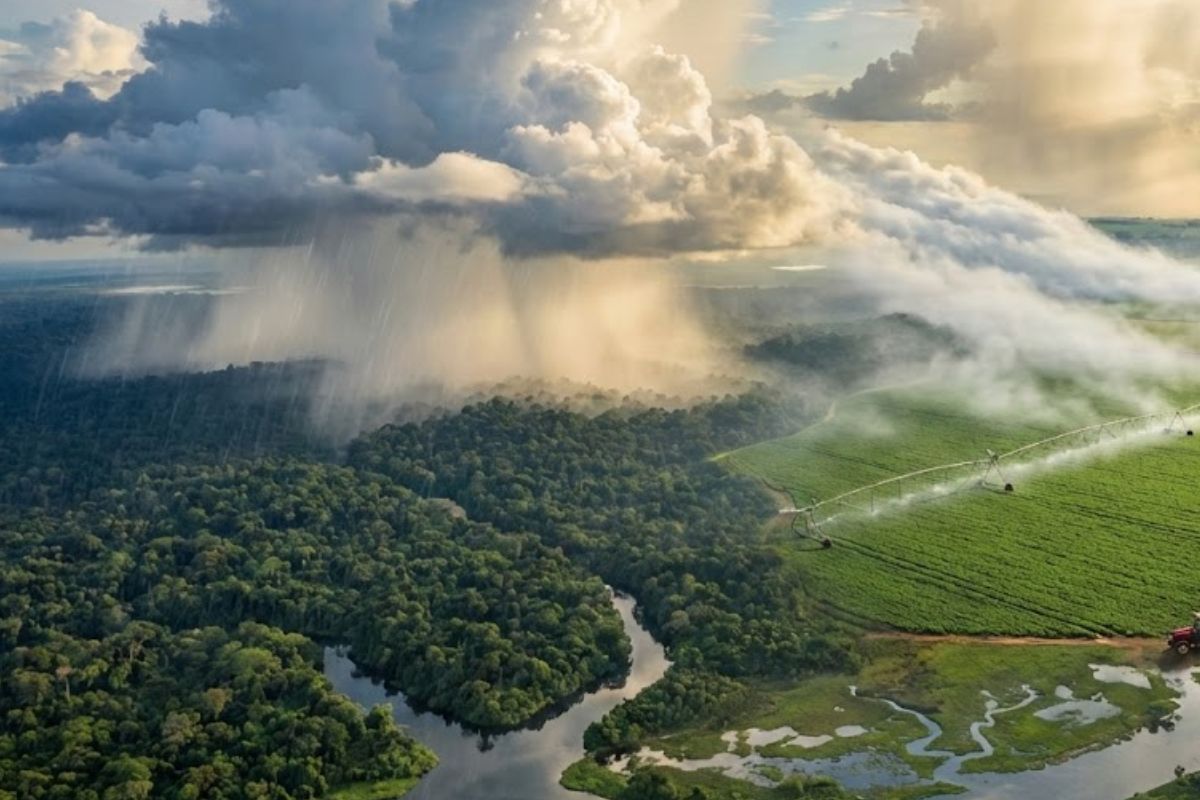


Study in Communications Earth & Environment Estimates That the Amazon Generates Rain Valued at Approximately US$ 20 Billion Annually, Almost R$ 104 Billion. Using Satellites and Climate Models, Researchers Calculate 2.4 Million Liters per Preserved Hectare, Based on 85% of Agriculture Dependent on Precipitation in Brazil.
The Amazon has returned to the center of an old discussion with new data: researchers calculated how much the rain produced by the forest is worth to society and the economy. The estimate points to an annual value of approximately US$ 20 billion, equivalent to about R$ 104 billion, translating an environmental service that is often treated merely as an idea into numbers.
What changes is not just the size of the figure, but the logic: there is a direct connection between standing forest, water in the sky, and productivity on the ground. And this link appears precisely where autonomy is often imagined in agriculture that depends on precipitation to function.
How the Amazon “Manufactures” Rain Without Appearing to Do So

The physical basis of the phenomenon involves a process that is little visible in daily life: evapotranspiration. In simple terms, the water that enters the system through rain and soil returns to the atmosphere not only through evaporation but also through the release of moisture by leaves.
-
Motorola launched the Signature with a gold seal from DxOMark, tying with the iPhone 17 Pro in camera performance, Snapdragon 8 Gen 5 that surpassed 3 million in benchmarks, and a zoom that impresses even at night.

-
Satellites reveal beneath the Sahara a giant river buried for thousands of kilometers: study shows that the largest hot desert on the planet was once traversed by a river system comparable to the largest on Earth.

-
Scientists have captured something never seen in space: newly born stars are creating gigantic rings of light a thousand times larger than the distance between the Earth and the Sun, and this changes everything we knew about stellar birth.

-
Geologists find traces of a continent that disappeared 155 million years ago after separating from Australia and reveal that it did not sink, but broke into fragments scattered across Southeast Asia.

The forest does not “create” water out of nowhere; it recirculates and reorganizes moisture, sustaining cloud formation and, later, new precipitation.
It is along this path that the concept of “flying rivers” gained strength, developed in Brazil to describe the immense flows of water vapor that come from the forest and are carried by winds, often accompanied by clouds.
In practice, the Amazon functions as a continental moisture engine, and the effect is not restricted to a specific point on the map: it spreads as atmospheric circulation distributes this vapor.
What the Study Did to Transform Rain into Monetary Value
The work was led by Jess Baker, a researcher at the School of Earth Sciences, Environment and Sustainability at the University of Leeds, in the UK. The proposal was to combine two pieces that rarely appear side by side with the same strength: satellite observations and simulations with state-of-the-art climate models.
The logic is to observe what happens and, at the same time, test in models how the system behaves, reducing the space for loose interpretations.
From this, the authors calculated a monetary value for the rain “produced” by tropical forests, connecting precipitation to what it represents for the economy and for everyday life.
The central interpretation is that if rain is essential for activities such as agriculture, then it has a measurable value not as a simple market price, but as a material benefit that supports productive chains and land use decisions.
How Much Each Preserved Piece Yields and Why “Millions of Liters” Matter
The most striking result of the study is the estimate per area: each preserved hectare of forest would generate 2.4 million liters of rain per year.
On another scale, the work also indicates that across the tropical region, each square meter of standing forest contributes about 240 liters of rain annually, and this number rises to about 300 liters in the Amazon.
When the account comes down to the square meter, the forest stops being “distant landscape” and becomes a concrete unit of water.
These values serve as a translator between ecology and planning. A preserved hectare is not just “an area that has not been cleared”; it becomes a measurable reference of water contribution.
And by scaling the service, the research attempts to show why the loss of forest cover is not an abstract discussion: it affects a resource that does not have an easy substitute, especially in rain-dependent agricultural systems.
Where the Rain from the Amazon Touches Agriculture and Why 85% Matters
The authors remind us that 85% of Brazilian agriculture depends on rainfall. This data shifts the weight of the debate because it moves the Amazon from the symbolic realm to the operational realm: without sufficient and well-distributed precipitation, the risk is not “the forest,” but production, supply, and income in the field.
The sensitive point is that this dependence coexists with pressures for expansion of areas, often associated with deforestation.
The study uses a direct example to illustrate the logic of “water balance per area”: cotton can demand 607 liters of moisture per square meter, which would equate to the amount of water produced by two square meters of intact forest.
The comparison does not aim to simplify agriculture to a single variable, but it leaves an uncomfortable message: certain crops may require more water than the area occupied “would return” to the system if it were covered by forest. This is where the tension between conservation and production stops being ideological and becomes a physical account.
What Deforestation Has to Do with “Rainfall” Throughout the Year
The work highlights a scenario that has been repeating despite international efforts: tropical deforestation continues to advance. Showing the financial benefit can “unlock investments” and strengthen arguments for forest protection.
The logic is pragmatic: when the environmental service appears as value, it gains more weight in financing, governance, and priority decisions.
The researchers also cite a previous study, published in 2023 by some of the same scientists, which warned about the impacts of deforestation on precipitation in tropical forests of South America (Amazon), Congo, and Southeast Asia.
The central message was that the loss of tree cover can reduce rainfall throughout the year, including in the rainy season, and that the larger the area destroyed, the greater the decrease in rainfall. In terms of risk, this means that the problem is not just “less forest,” but a more unstable water system.
Why Placing a Price on Amazon Rain Does Not End the Debate, but Changes the Question
Transforming rain into figures does not solve, by itself, dilemmas of development, regularization, production, and conservation.
But it changes the type of conversation possible: instead of discussing only “preservation because it is important,” the discussion enters “preservation because it supports an economic asset that is already functioning.” The Amazon appears as natural infrastructure, with recurring delivery and impact distributed across sectors that do not always see themselves as part of the same system.
The study itself suggests a political and social consequence: recognizing the crucial connection between tropical forests, rain, and agriculture could ease tensions between agricultural and conservation interests and broaden support for forest protection.
This proposal does not romanticize the conflict; it tries to reorganize it around a shared dependence.
When the water that falls from the sky is treated as a result of a territorial process, the question shifts from “who benefits from clearing?” to “who pays the bill when the rain fails?”.
By estimating that the rain generated by the Amazon is worth more than R$ 100 billion per year and detailing the contribution per preserved hectare, the study attempts to make visible an environmental service that sustains the water base for much of the country, especially for an agriculture largely dependent on precipitation.
The message is not a slogan; it is a mechanism: standing forest, moisture in circulation, more likely rain, less vulnerable production.
And now I want to hear from you in a very concrete way: in your region, do you feel that the rain has become more irregular in recent years? If the Amazon delivers a “service” that sustains agriculture, what would be, in your opinion, the fairest way to finance preservation and who should pay for it: the government, the productive sector, consumers, or everyone together?








Galera não acreditem em tudo que essa mídia nos diz … Não espalhem coisas por aí … Tudo isso por partir de uma manipulação ….podem ser dados e informações que não significam nada agora mas depôs de uns anos juntando o quebra cabeça a coisa se encaixa
Eita texto sem dados, sem argumentos e sem lógica.
A floresta e importante… Mas querer “mensurar valor da água da chuva”… Aí já é burrice ideológica demais.
Acabou a narrativa do “aquecimento global”… Agora a floresta é responsável pela chuva mundial… Inclusive de países distantes da floresta.
A agricultura brasiliera, que é a mais tecnológica e mais ecológica do mundo, ficou tão ineficaz, que depende de chuva para produzir… Kkk
“Meu bem”, você está confundindo o “agro” com “agricultura familiar”.
Os grandes produtores, não dependem de chuva. Eles têm sistemas de pulverização. A maior parte da agricultura brasiliera é controlada artificialmente… Não precisamos de fenômenos naturais.
Na verdade, as chuvas também atrapalham… Dependendo da plantação, muita chuva forte “afoga” a plantação.
A Amazônia gerou em “créditos de carbono” mais de 30 bilhões de dólares… Que deveria ser pago por países que poluem muito.
O Brasil preservou… Gerou os créditos… Cadê o dinheiro??? A Europa prometeu comprar os créditos… Cadê???
Comparar os valores… 30 bilhões de dólares… Com 100 milhões de reais.
Conversa para “****” dormir.