





 Portuguese
  English
  Spanish
  3 min of reading
  0 comments


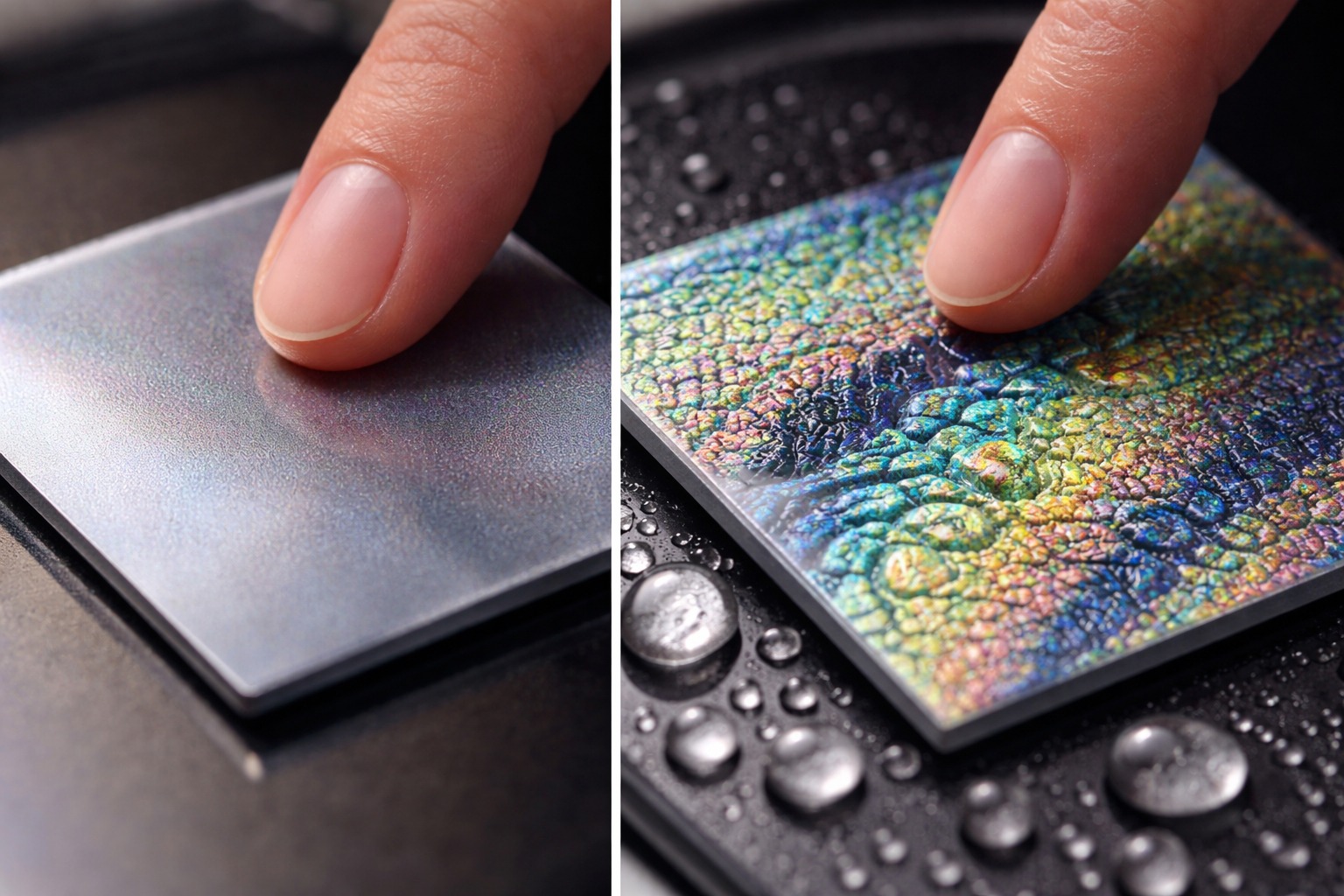
Scientists Create Material Inspired by Octopuses That Changes Color and Texture in Seconds with Liquids, Opening the Way for Advanced Camouflage and Robotics Technologies
Researchers from Stanford University and other institutions in the United States have developed a “synthetic skin” inspired by the camouflage of octopuses, capable of changing color and texture in seconds when in contact with liquids such as water or alcohol.
Inspiration in the Camouflage of Octopuses
The research was motivated by a simple question: how to artificially reproduce an octopus’s ability to change appearance almost instantaneously on the ocean floor.
Scientists aimed to create a surface that could alternate between flat and rough states and also quickly modify its coloration, mimicking the natural camouflage system observed in cephalopods.
-
NASA has set a date for the beginning of the end of Earth, and it won’t be an asteroid or an explosion: the planet will slowly lose its oxygen over the course of 1 billion years because the Sun is getting hotter every day.

-
Archaeologists have discovered a colossal submerged wall in the Atlantic, dating back 7,000 years and weighing 3,300 tons, regarded as the largest prehistoric submerged structure ever found in France.
-
Scientists have discovered a gigantic magnetic anomaly hidden beneath the soil of Australia that mirrors the shape of the entire continent and holds geological records of two and a half billion years that could change what we know about the Earth.
-
The heatwave that has been affecting Brazil in recent weeks is coming to an end: a cyclonic vortex is moving in during Holy Week with heavy rains, and a cold air mass is already threatening to lower temperatures in the South starting in April.


The results of the study were published in the journal Nature recently. The work describes a platform capable of producing reversible and programmable patterns that activate rapidly when they come into contact with liquids.
Previous attempts had managed to modify color or texture individually. However, the researchers point out that this research was able to integrate both functions simultaneously in the same material.

How the Developed Material Works
The study was conducted by Siddharth Doshi and colleagues from Stanford University, Paderborn University, and the Chan Zuckerberg Biohub in San Francisco.
The team used the polymer PEDOT:PSS, a material already applied in solar technologies and electronic sensors.
This compound has a specific characteristic: it swells when in contact with water and shrinks when exposed to alcohol.
This property allows for changing the topography of the surface. To create the patterns, the scientists deposited a thin layer of polymer on a substrate and applied an electron beam.
This process controls how different regions of the material respond to the liquids, allowing the formation of microscopic reliefs and three-dimensional surfaces capable of reproducing detailed structures.
Complex Patterns and Color Change of the “Synthetic Skin”
With this technique, the researchers were able to imprint complex patterns, including a replica of the topography of El Capitan, a rock formation located in California.
Another example produced by the team was the shield of Stanford University. According to the authors, the structure remains flat and hidden in isopropyl alcohol but transforms into relief when exposed to water.
In addition to texture changes, the system also allows for controlling the color of the material. To achieve this, the scientists combined the polymer with metallic layers capable of forming optical cavities.
These cavities remain colorless when the material is dry. When the polymer expands, colorful patterns appear due to light scattering.
Results and Possible Applications
According to the researchers, the change in texture and color of the “synthetic skin” occurs in less than ten seconds. The behavior can also be adjusted according to the thickness of the material and how light disperses.
Tests conducted during the study indicated that the system maintains its efficiency after 250 cycles of expansion and contraction.
This result suggests potential applications in smart coatings, wearable devices, flexible robotics, and dynamic camouflage surfaces.
Despite the advancements, the study also points out limitations of the technology. The system depends on the presence of liquids for activation and can only display one geometric pattern at a time.
Still, the researchers indicate that future versions may incorporate electrical signals and computer vision algorithms.
According to Doshi, simultaneously controlling texture and optical properties at a microscopic scale may open new possibilities in areas such as nanophotonics, advanced electronics, and camouflage technologies aimed at humans and robots.
With information from O Globo.






-

Uma pessoa reagiu a isso.