





 Portuguese
  English
  Spanish
  4 min of reading
  0 comments


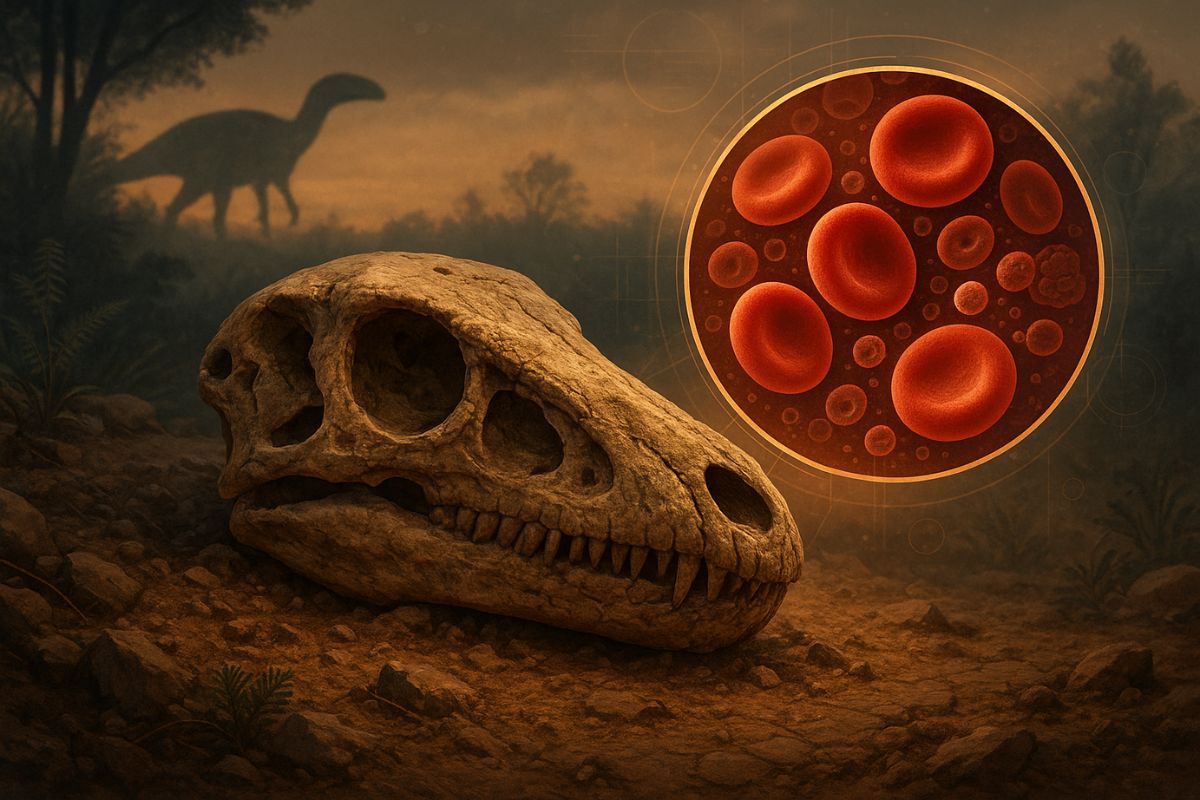
British researchers identified blood cell-like structures preserved in a dinosaur fossil around 70 million years old. The finding, conducted by teams from Anglia Ruskin University (ARU) and Imperial College London, published by The Independent, suggests new possibilities in understanding cancer, potentially transforming the development of future treatments for humans.
A Surprising Discovery And An Unprecedented Investigation
The study, recently published in the journal Biology, revealed that the analyzed fossil belonged to a Telmatosaurus transsylvanicus, a herbivorous species that inhabited present-day Romania around 66 to 70 million years ago. The scientists were particularly interested in identifying blood cell-like structures preserved in the fossil, paving the way for deeper investigations.
The research began after the initial discovery in 2016 of a benign tumor known as ameloblastoma in the dinosaur’s jaw. This type of tumor also occurs in humans, which increased the scientists’ interest in investigating possible parallels and better understanding the formation of these conditions in the distant past.
-
Samsung launches cordless vertical vacuum cleaner with up to 400W of suction and relies on AI to automatically recognize corners, carpets, and different surfaces.

-
The lost continent beneath Europe: separated from North Africa about 240 million years ago, comparable in size to Greenland, Greater Adria was crushed over 40 million years and left geological marks from the Alps to the Balkans.

-
A cold front advances through the South this Saturday and reaches the Southeast on Easter Sunday with heavy rain and a drop in temperature, while the North and Northeast face the risk of storms and flooding throughout the holiday.

-
Brazil is about to inaugurate the largest maritime surveillance system in its history, with radars, infrared cameras, and autonomous sensors installed on Ilha Grande to monitor the entire Brazilian coast in real time.


The team, led by Professor Justin Stebbing and Dr. Biancastella Cereser, traveled to Romania to obtain samples of the fossil. Using sophisticated electron microscopy techniques, they clearly identified cellular structures resembling modern red blood cells, an unexpected and highly significant result for biomedical studies.
These preserved cells indicate that soft tissues, considered extremely fragile, can survive for much longer periods than previously believed. This represents a paradigm shift in how fossils can be used to study ancient diseases, particularly tumors.
The researchers emphasized that while DNA cannot be recovered from these fossils due to degradation over time, proteins and other molecular structures can be studied in detail. This approach offers a unique insight into the evolution of diseases, including cancer, and the influence of environmental factors.
The innovation of this discovery lies in the unprecedented opportunity to directly investigate the molecular composition of prehistoric tumors, something previously unthinkable. This advancement opens doors to understanding how cancer evolved and manifested in different geological periods, potentially aiding in modern treatments.
How Cancer Can Be Studied In Ancient Fossils
The tumor present in the Telmatosaurus was analyzed using scanning electron microscopy (SEM), revealing forms very similar to current red blood cells. This technique allowed for an unprecedented analysis of cells and tissues from such an ancient organism, suggesting great potential for similar studies on other fossils.
Professor Stebbing highlighted that the study of fossils had previously been restricted to hard parts like bones and shells. Now, however, it is possible to analyze preserved soft tissues as well, providing a window into the biological past that can clarify how current human diseases emerged and evolved.
The focus on molecular structures like proteins could bring critical information about how different environmental factors influenced the emergence and development of cancer throughout evolutionary history. Better understanding this could lead to more effective personalized treatments.
The involved scientists also emphasize that this approach does not seek to revive extinct organisms but to deeply understand the basic biological processes governing life and diseases, especially cancer, which remains one of humanity’s greatest medical challenges.
The potential of this research extends beyond cancer, possibly offering insights into other modern diseases. The possibility of comparing prehistoric tumors with current human tumors is particularly exciting, providing a much broader understanding of the behavior of these diseases.
The study proves that the traditional boundaries of paleontology are being expanded, integrating fields such as oncology and molecular biology, creating an innovative and highly interdisciplinary research field.
Next Steps And The Future Of Cancer And Fossil Research
The scientists plan to expand their studies to other fossils that may contain preserved tissues, further deepening the understanding of cancer over time. This will help establish robust evolutionary models that explain how and why certain tumors developed.
Another central objective will be to determine which specific proteins and molecules can be isolated from these fossils, providing valuable comparative data with contemporary samples. This will allow for a more precise and efficient approach in the search for new cancer treatments and medications.
The practical result of this research could revolutionize how diseases are treated, with therapies based on a more solid evolutionary understanding of cancer mechanisms. In this way, patients will benefit from more targeted and effective therapies.
International collaborations will also be strengthened, integrating paleontologists, oncologists, and molecular biologists in joint projects, ensuring a holistic and comprehensive view of cancer.
Finally, researchers emphasize that this discovery should motivate more investments in interdisciplinary research that, until recently, would have been considered unlikely, but now represents a new frontier in evolutionary medicine.
By revealing the unexpected potential of fossils in the fight against cancer, this study promises to redefine how ancient diseases are understood, opening unprecedented possibilities for human health in the present and future.







Seja o primeiro a reagir!