





 Portuguese
  English
  Spanish
  4 min of reading
  2 comments


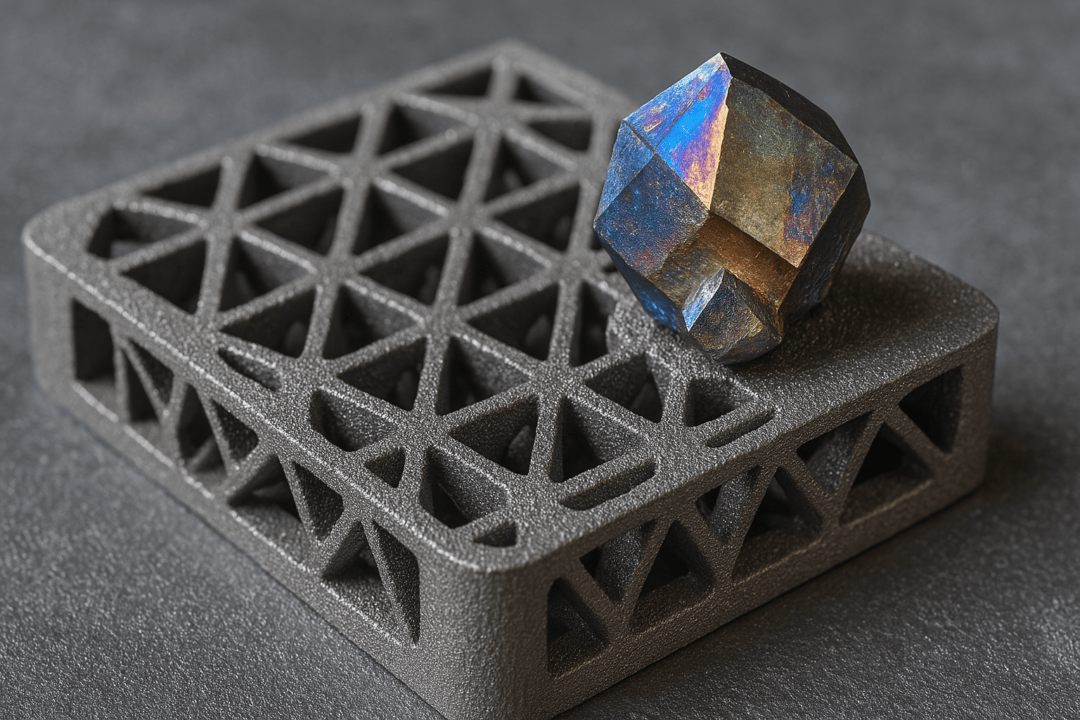


Researchers Have Identified An Unusual Crystal Structure In Metals Produced By 3D Printing, Capable Of Significantly Increasing The Material’s Strength. The Discovery Could Represent A Technological Leap In The Manufacture Of Parts For Sectors Such As Aerospace, Automotive, And Industrial
A group of scientists has discovered a rare form of crystal that could revolutionize 3D printed metal manufacturing.
During a routine analysis under the microscope, engineer Andrew Iams from NIST (National Institute of Standards and Technology) came across something unusual.
While observing a new aluminum alloy at the atomic scale, he noticed a strange pattern. An arrangement of atoms that did not follow normal crystallization rules. That’s when he realized: he could be looking at a quasicrystal.
-
China has launched the world’s first floating artificial island, a scientific structure designed to face open seas, test equipment weighing hundreds of tons, and reach depths of 10,000 meters.

-
China accelerates global science and may surpass the United States in 2 years with increased public investment, continuous growth, and direct impact on the global technological competition.

-
Scientific studies indicate that drought may be strengthening a much greater silent threat: more resistant superbugs.

-
Man builds functional 5-meter submarine in his garage using gas cylinders, PVC pipes, and a refrigerator motor, and navigates with the vessel on a lake in Colombia.

This discovery, made together with other researchers, not only confirmed the presence of quasicrystals in the alloy but revealed something even more important: they increased the material’s strength.
The research was published in the Journal of Alloys and Compounds and could change the way aluminum is used in 3D printers.
What Are Quasicrystals?
Quasicrystals are unusual atomic structures. Unlike traditional crystals, which repeat in regular patterns, quasicrystals form patterns that never repeat — even while occupying all the space.
In a common crystal, like table salt, the atoms form cubes that repeat throughout the structure. There are only 230 possible forms of regular crystalline patterns. Quasicrystals do not fit any of them.
This type of structure was discovered by Dan Shechtman, also at NIST, in the 1980s.
His discovery was so unusual that many scientists at the time doubted it. Nevertheless, Shechtman insisted. And he proved that quasicrystals existed, winning the Nobel Prize in Chemistry in 2011.
Decades later, in the same building, Andrew Iams found quasicrystals in a 3D printed aluminum alloy.
3D Metal Printing: How It Works?
The technique used to create this alloy was 3D printed metal. More specifically, powder bed fusion.
In this process, the metal powder is spread in thin layers. A laser passes over it, melting the powder and creating a solid piece, layer by layer.
This technology enables the manufacture of objects with complex shapes that could not be made otherwise. One example is the fuel nozzle developed by GE in 2015.
It was composed of 20 separate pieces but became a single, lightweight, and efficient piece. GE has successfully produced tens of thousands of these parts.
Even with this advancement, printing high-strength aluminum remained a challenge.
Why Is It Difficult To Print Aluminum?
Aluminum melts at around 700 °C, but the lasers used in metal printing raise the temperature above 2,400 °C — beyond the boiling point of the metal. This extreme heat changes aluminum’s behavior, causing it to cool too quickly and tend to crack.
It was only in 2017 that a solution emerged. Researchers from HRL Laboratories and UC Santa Barbara created an aluminum alloy with zirconium.
This material managed to withstand the printing process without breaking. And more: it maintained high strength.
The NIST team decided to study this alloy in detail, at the atomic scale. They wanted to understand why it was so strong.
The Role Of Quasicrystals
What they discovered surprised even the experts: quasicrystals were one of the reasons for the alloy’s strength.
Perfect crystals, in metals, can be weak. This is because atoms easily slide over each other, causing the metal to bend or even break.
Quasicrystals, on the other hand, disrupt this sliding. They create structural defects that, paradoxically, make the material more resistant.
Andrew Iams noticed the presence of quasicrystals by observing unusual symmetries under the microscope. One of the signs was the fivefold rotational symmetry — something very rare.
To confirm, he had to rotate the crystals and also find triple and double symmetries from different angles.
Only then could he be certain that the quasicrystals were indeed there.
New Possibilities For Metal Alloys
Fan Zhang, a physicist at NIST and co-author of the study, explained the importance of the discovery. According to him, to trust this new type of aluminum in critical components, such as airplane parts, it is necessary to understand exactly how the atoms are organized.
Now, with the confirmation of quasicrystal presence, researchers believe it’s possible to create even better alloys. The idea is to use these crystals not just by chance, but intentionally during metal manufacturing.
Zhang believes this discovery could change how alloys are developed in the future. “We have shown that quasicrystals can make aluminum stronger,” he said. “Now, people can try to create them deliberately.”
A New Path For 3D Printed Metal Science
3D metal printing has already proven useful and viable in industrial applications. But it still faces limitations, especially with stronger and lighter alloys like high-strength aluminum.
The discovery that quasicrystals help prevent structural failures and increase material strength opens a new path for research.
It’s not just about understanding a rare phenomenon, but about using this knowledge to create more efficient, safe, and durable metals.
With this, sectors like aerospace, automotive, and energy could benefit from lighter and stronger materials — all thanks to an atomic structure that, until recently, was considered impossible.
This discovery, made in a laboratory that has already made history with quasicrystals, could now initiate a new revolution in materials science.







Anúncio esconde a reportagem dificultando a leitura da mesmo impedindo o contesto da pagina
Sensacional