





 Portuguese
  English
  Spanish
  4 min of reading
  0 comments


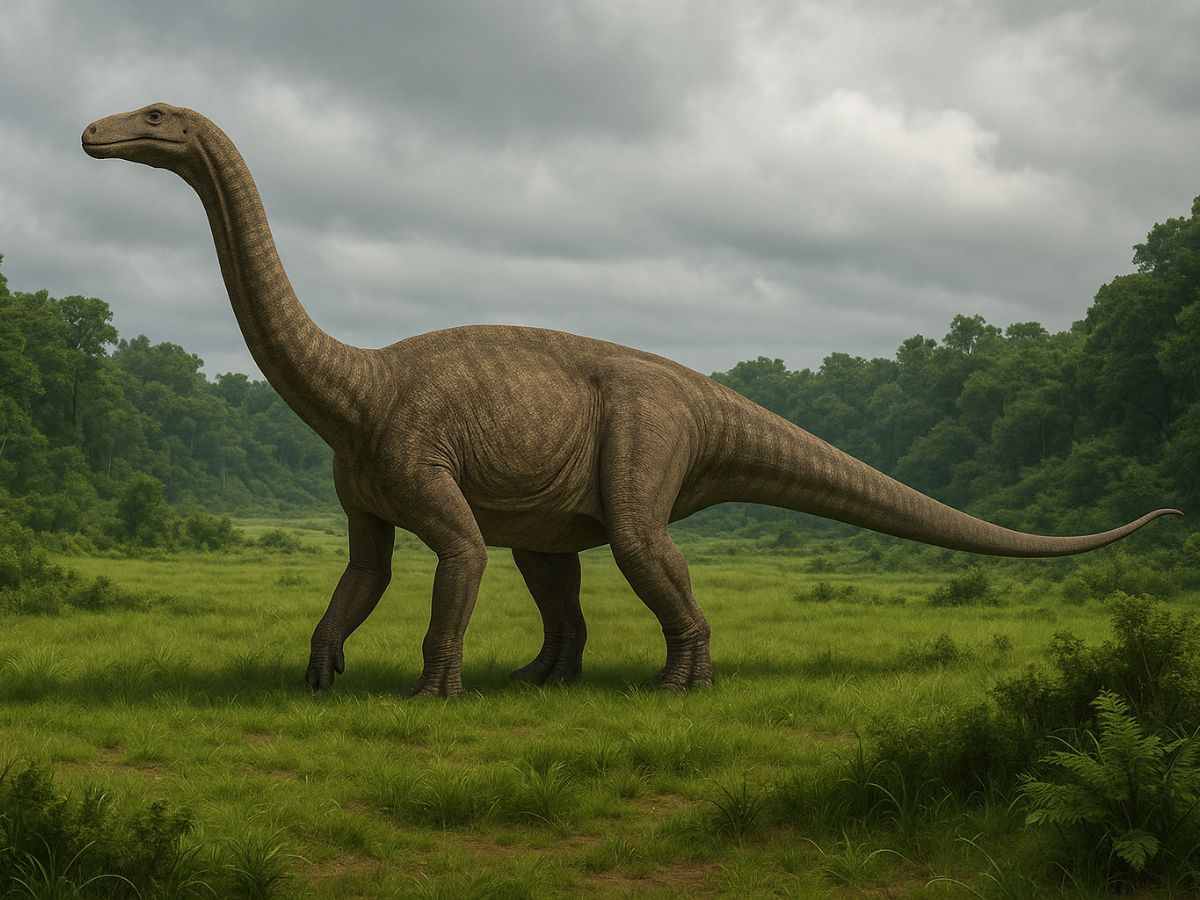
A new giant dinosaur approximately 10 meters long has been discovered in the Lufeng Formation in southwestern China by scientists from the Institute of Vertebrate Paleontology and Paleoanthropology, revealing a rare fossil from the Jurassic period with anatomical features that expand the understanding of the evolution of sauropodomorphs.
Surprising Discovery at Paleontological Site in China
The excavation was led by paleontologist Dr. Xiang-Yuan Chen in collaboration with the University of the Chinese Academy of Sciences. The fossil was found in the Lufeng region of Yunnan Province, one of the richest sites for dinosaur fossils on the planet. The new species has been named Xingxiulong yueorum, becoming the second known member of the genus Xingxiulong.
According to information released by the portal Earth.com and confirmed in a publication in the scientific journal Historical Biology, the species is about 10 meters long and is considered to be twice the size of its closest known relative. This proportion reinforces the morphological diversity that already existed among herbivorous dinosaurs in the early Jurassic.
-
He found the largest gold shipwreck in the United States with tons of the precious metal at a depth of 2,400 meters in the Atlantic and recovered a treasure that no one thought possible to reach, but 500 gold coins disappeared without explanation.

-
The United States has a serious problem with its F-35s: China is already producing fighters at a pace that exceeds American capacity and could manufacture up to 300 aircraft per year before the end of the decade, shifting the global military balance.

-
A retired IT professional built a 22-meter boat in his backyard in Oklahoma with a school bus engine, light pole masts, and handmade watertight doors to become the redneck version of Jacques Cousteau.

-
China is building a city in Brazil: a complex with an investment of R$ 5.5 billion comes to light, but allegations involving workers draw attention.


The fossil includes fused sacral vertebrae, robust limb bones, and a series of bony details that reference an early evolutionary transition between bipedal and quadrupedal forms, indicating a progressive adaptation to larger bodies and distinct lifestyles.
A Fossil That Rewrites Part of the History of Sauropodomorphs
Sauropodomorphs are a group of long-necked herbivorous dinosaurs that preceded the famous sauropods like Diplodocus and Brachiosaurus. Xingxiulong yueorum belongs to the Massopoda lineage, which emerged at the end of the Triassic period and played a key role in the transition to the giant quadrupeds of the Late Jurassic.
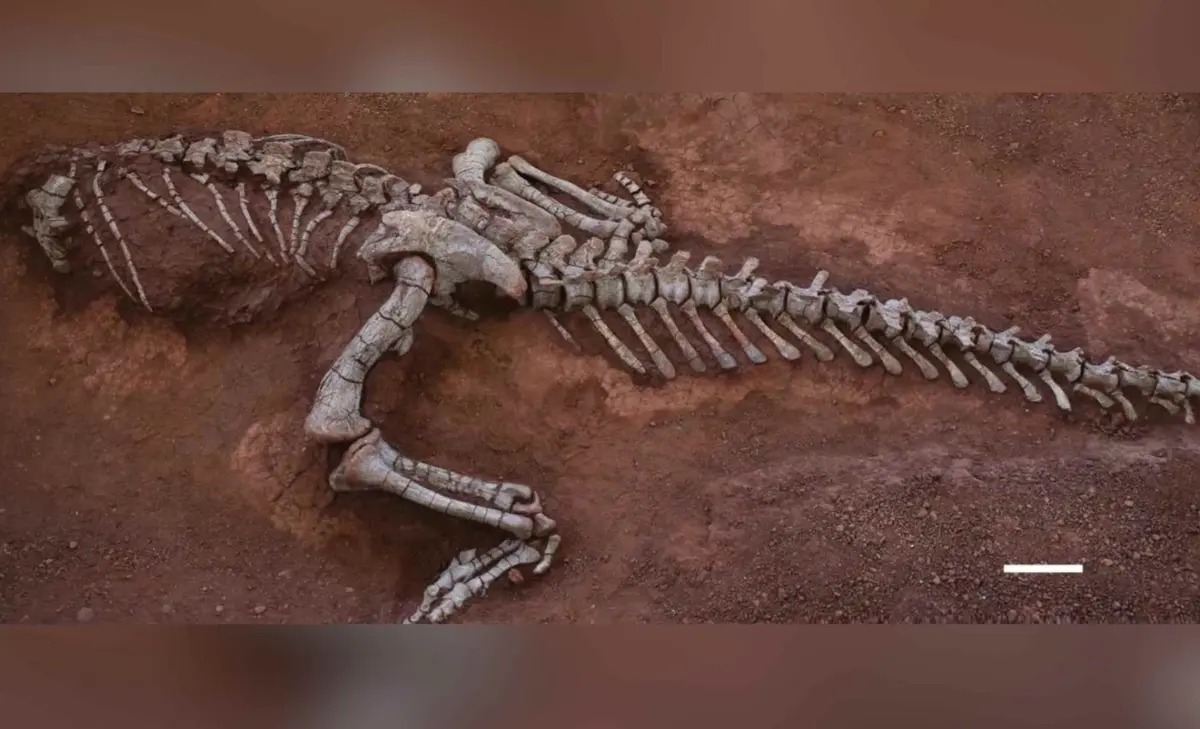
According to researchers, the new species has a fourth trochanter in a pendulous shape — a bony protrusion on the femur — and other unique characteristics, such as the presence of two phalanges in the fifth toe. Such traits indicate an intermediate anatomical stage with mixed locomotor capabilities, suitable for both rapid movement and weight-bearing.
These findings support the hypothesis that modifications in the pelvis, limbs, and vertebral column occurred much earlier than previously thought. The fossil confirms that some of these transformations were already underway 190 million years ago, revealing the complexity of giant herbivore evolution.
Xingxiulong and Its Role in the Jurassic Evolutionary Line
Xingxiulong yueorum now joins Xingxiulong chengi as part of a genus that represents a bridge between primitive dinosaurs and gigantic sauropods. Both share the presence of four sacral vertebrae, a feature that would only become common among the more advanced groups of the lineage.
As noted in the published research, this solid bony structure was essential for supporting the growing weight of the animals, especially as they transitioned from a bipedal to a quadrupedal posture. The discovery reinforces that locomotor adaptations did not occur abruptly, but rather in stages, with intermediate groups testing different anatomical arrangements.
The Lufeng Formation, from which the fossil was extracted, continues to provide valuable data on the diversification of dinosaurs during the Early Jurassic. Fossil tracks, teeth, bone fragments, and other species identified at the site indicate a forested, humid environment with a wide variety of ecological niches and competition for plant resources.
A Portrait of the Jurassic Environment in Southwestern China
During the early Jurassic period, about 190 million years ago, the area now known as Yunnan Province was home to extensive rivers, swamps, and lush vegetation. This setting allowed for the proliferation of various species of herbivorous dinosaurs, each exploring different ecological niches.
According to the article published by Chen’s team, the fossil records in the Lufeng Formation help explain how these animals spread across different continents and adapted to various environmental conditions. There is evidence that sauropodomorphs were present in nearly all regions of the planet throughout the Mesozoic.
The discovery of Xingxiulong yueorum reinforces this narrative of evolutionary success. In addition to indicating a new level of body size among early sauropodomorphs, the fossil shows how the earliest giants developed unique adaptations to feed on tall vegetation and withstand predators in a competitive environment.
Scientific Impact and New Research Possibilities
For experts, the finding represents an opportunity to refine the understanding of the dinosaur family tree. With more details on bone morphology, scientists will be able to compare similar species found in other parts of Asia, Africa, and South America.
Future excavations in the Lufeng region are already underway with the goal of locating more complete skeletons and assessing anatomical variation among different populations of sauropodomorphs.
“The discovery of Xingxiulong yueorum significantly expands the known diversity of herbivorous dinosaurs in the Lufeng Formation and provides fundamental evidence for understanding the early evolution of large long-necked dinosaurs,” concluded the team in an interview with EarthSnap.








Seja o primeiro a reagir!