





 Portuguese
  English
  Spanish
  4 min of reading
  0 comments


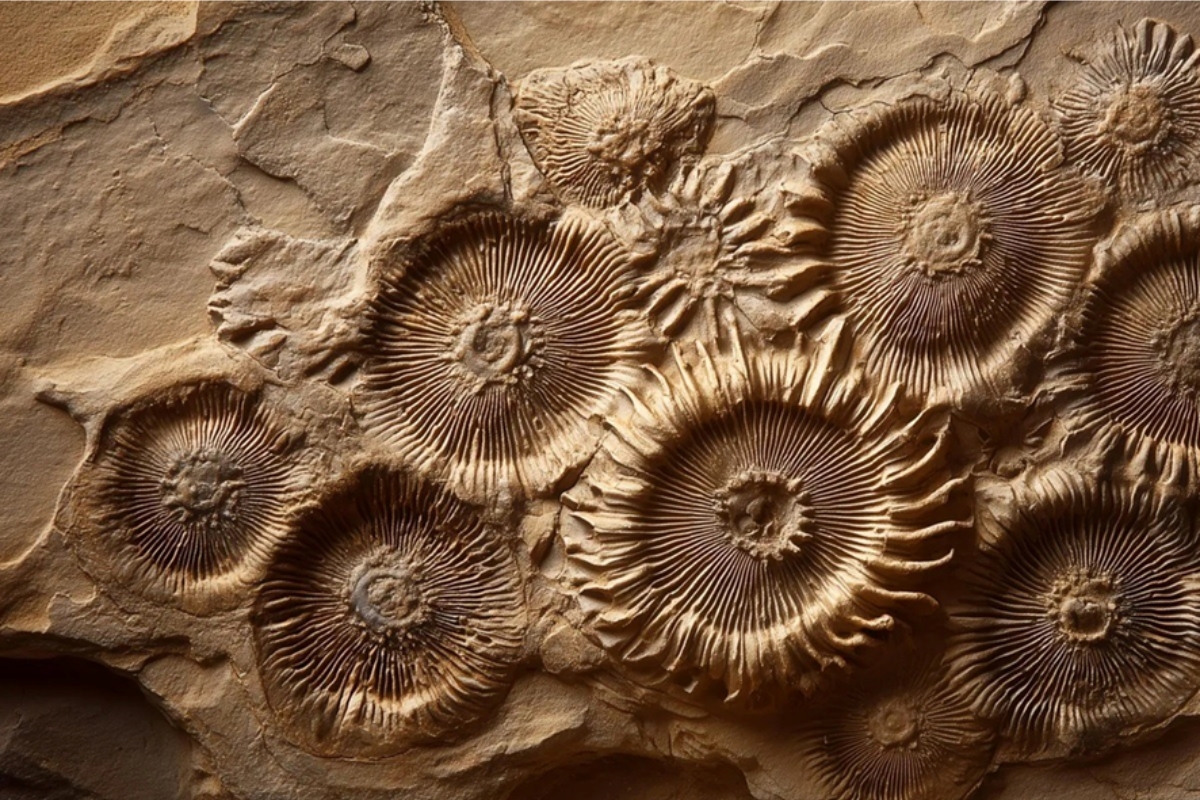
In Newfoundland and Northwestern Canada, Scientists Analyzed Fossils Around 570 Million Years Old Using Lithium Isotopes to Understand Fossilization in Sandstone, Revealing a Rare Chemical Process That Preserved Soft Organisms and Caught the Attention of the Scientific Community.
For decades, the fossils of the so-called Ediacaran Biota have been considered some of the strangest ever found on Earth. These organisms lived about 570 million years ago, long before the emergence of the first known complex animals.
What intrigued researchers the most was the fact that creatures without bones, shells, or rigid structures were preserved with a high level of detail. Under normal conditions, soft-bodied organisms quickly disappear and rarely leave fossil records.
The recent discovery showed that the explanation lies in the ancient oceans, which functioned as a true natural fossilization machine. The unusual chemistry of seawater allowed for the preservation of delicate forms that would typically never survive the test of time.
-
Motorola launched the Signature with a gold seal from DxOMark, tying with the iPhone 17 Pro in camera performance, Snapdragon 8 Gen 5 that surpassed 3 million in benchmarks, and a zoom that impresses even at night.

-
Satellites reveal beneath the Sahara a giant river buried for thousands of kilometers: study shows that the largest hot desert on the planet was once traversed by a river system comparable to the largest on Earth.

-
Scientists have captured something never seen in space: newly born stars are creating gigantic rings of light a thousand times larger than the distance between the Earth and the Sun, and this changes everything we knew about stellar birth.

-
Geologists find traces of a continent that disappeared 155 million years ago after separating from Australia and reveal that it did not sink, but broke into fragments scattered across Southeast Asia.

Mysterious Organisms Lived Before the Explosion of Animal Life
The Ediacaran Biota represents one of the oldest chapters of complex life on Earth. These organisms lived just a few dozen million years before the so-called Cambrian Explosion, which began around 540 million years ago.
This period marked the rapid emergence of animals with greater diversity and complexity. For a long time, it was believed that this advancement occurred suddenly.
Recent studies indicate that the development was gradual. The Ediacaran Biota appears as an important intermediate phase, showing a progressive increase in size, complexity, and ecological functions among the first macroscopic living beings.
The detail that caught the most attention was the unusual shape of these creatures. Some exhibited triradial symmetry, others had spiral arms and patterns resembling fractal structures, making it difficult to classify these organisms on the evolutionary tree.
Ancient Oceans Created the Natural Process That Preserved Rare Fossils

The preservation occurred in sandstone, a type of rock formed from coarse grains of sand. This environment is typically unfavorable for fossilization because it allows for water circulation and is subject to constant wave and storm action.
Nevertheless, the organisms were buried and preserved with great precision on the seabed during the Ediacaran period.
What seemed impossible was eventually explained by the unusual chemistry of ancient oceans. Seawater was rich in silica and iron, elements that favored the formation of special minerals.
These minerals gave rise to a type of clay that developed around the buried organisms. The process acted as a natural cement, binding the sand grains and maintaining the original contours of the bodies.
The result surprised scientists because it showed that fossilization did not occur due to the organisms’ resilience but rather because of environmental conditions.
Lithium Isotopes Revealed the Origin of the Minerals That Preserved Life
To understand the process in detail, researchers analyzed lithium isotopes present in the fossils found in Newfoundland and Northwestern Canada.
The samples included fossils preserved in both sandy and muddy sediments, allowing for the comparison of different fossilization environments.
The analysis showed that particles of detrital clay, coming from the continent, were already present in the sediment. These particles served as a basis for the growth of autigenic clays, formed directly on the seabed.
These clays grew around the buried organisms and stabilized the sediment. In practice, the process created a mineral capsule that preserved delicate details of soft tissues.
This chemical method allowed for a more accurate reconstruction of the ancient marine environment.
Discovery Changes the Explanation About the Survival of These Fossils
For years, it was believed that these organisms had special characteristics that allowed their preservation. The new interpretation indicates that the decisive factor was the chemical environment of the ancient oceans.
The survival of these fossils depended primarily on the composition of seawater and sediments, rather than the structure of the organisms.
This shift in understanding helps scientists better interpret other rare fossil deposits around the world.
The impact was immediate because the discovery provides new clues on how to assess the fidelity of the fossil record and better understand life in ancient seafloors.
Study May Reveal New Details About the Emergence of Complex Life
Researchers intend to apply the analysis of lithium isotopes to fossils from other regions and geological periods.
The goal is to discover whether similar processes occurred in different parts of the planet.
A more detailed understanding of fossilization mechanisms may help explain both the emergence and disappearance of the Ediacaran Biota.
The interval between the dominance of microbial forms of the Precambrian and the emergence of complex organisms represents one of the greatest transformations in Earth’s history. Understanding this period may clarify how modern animal life began.
The discovery drew attention because it shows that ancient chemical processes were decisive in preserving some of the most mysterious forms of life ever recorded, offering a new perspective on the early evolution of animals.
What do you think of these creatures that lived before modern animals existed? Do you believe that new fossils could still change what we know about the origin of life?








Seja o primeiro a reagir!