





 Portuguese
  English
  Spanish
  4 min of reading
  0 comments


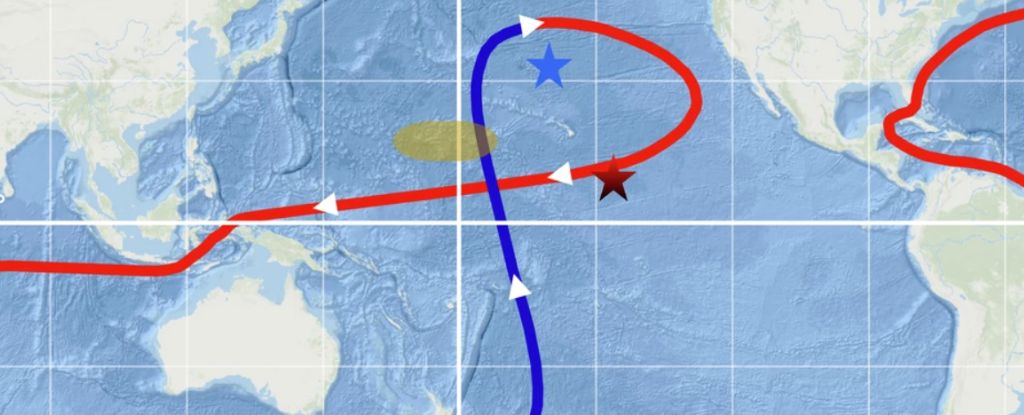
Radioactive Anomaly Discovered in the Pacific Ocean Sparks Interest from the Scientific Community, Which Seeks to Understand Its Origin and Impact on the Marine Environment.
An intriguing discovery in the Pacific Ocean has caught the attention of the scientific community: a radioactive anomaly with an origin still unknown. The phenomenon was identified by German researchers, who found unexpectedly high levels of beryllium-10, a radioactive isotope, in samples of underwater metal crusts.
The finding in the Pacific Ocean, which occurred between 9 and 12 million years ago, may indicate cosmic events or changes in ocean currents.
The study, led by physicist Dominik Koll from the Helmholtz-Zentrum Dresden-Rossendorf, revealed that the increase in beryllium-10 is not restricted to a single area.
-
Seen from space, a colossal volcano nearly 5,000 meters high in Russia has released 1,600 km of smoke over the Pacific, forming “devil’s horns” of lava and revealing the brutal force of the Ring of Fire.
-
Expedition 501: Scientists drill into the ocean floor and discover a giant reserve of fresh water hidden beneath the sea, extracting nearly 50,000 liters and revealing an invisible system that could reshape the map of water scarcity.
-
Archaeologists find an intact tomb over 2,500 years old, with more than 100 preserved objects, weapons, jewelry, and human remains never touched.

-
Volcanic lava transforms into threads as fine as human hair that travel over 30 kilometers by wind and fall like cutting rain on roofs and backyards in Hawaii and Iceland.

The samples were collected in the Central and Northern Pacific, but there are indications that the phenomenon could be global. Beryllium-10 is formed when cosmic rays interact with the Earth’s atmosphere, settling on the seafloor through precipitation. Its presence at such elevated levels challenges traditional explanations.

HZDR/blrck.de )
Hypotheses About the Origin of the Anomaly in the Pacific Ocean
Scientists are working with two main hypotheses to explain the abrupt increase of this isotope. The first suggests a major reorganization in ocean currents during the identified period. Changes of this kind can influence the deposition of various chemical elements, including beryllium-10, concentrating it in certain regions of the ocean floor.
The second hypothesis explores an astrophysical origin. Cosmic events, such as a supernova close to Earth or the passage of the Solar System through an interstellar gas cloud, may have intensified cosmic ray activity.
The resulting increase in the deposition of beryllium-10 would then be a signature of this rare and impactful event.
About 10 million years ago, nearly double the expected amount of beryllium-10 was found, according to Koll. The researcher compares this phenomenon to a marker on a geological timeline, suggesting that the detected signal may become a useful reference for dating past events on Earth.
The Role of Ferromanganese Crusts
Ferromanganese crusts are true natural archives of the planet’s geological past. They grow slowly, incorporating metals and radioactive elements over millions of years. The average growth rate of these crusts in the Pacific Ocean has been determined to be about 1.52 millimeters per million years.
This characteristic allows researchers to analyze the remote past, using the decay of beryllium-10 to estimate the age of layers. The isotope has a half-life of 1.4 million years, and its concentration at different depths indicates changes in environmental conditions over time.
These crusts can record up to 75 million years of oceanic chemistry in just a few centimeters, according to Koll. The identified increase, located about 50 millimeters deep in the analyzed samples, corresponds to a period between 10.5 and 11.8 million years ago.
Implications for Science
The discovery has significant implications for various fields, such as geology, oceanography, and astrophysics. If the anomaly has a cosmic origin, it could provide clues about Earth’s interaction with the interplanetary environment in the past. Supernova events, for example, would have influenced not only oceanic chemistry but potentially the climate and planetary biodiversity.
On the other hand, a cause related to ocean currents would indicate significant changes in the climate system of the time. Reorganizations of this kind are common during transitions between geological periods and can have relevant environmental consequences.
Next Steps
To unravel the mystery, the team plans to expand analyses by collecting samples from other oceanic regions. The expectation is to determine whether the increase in beryllium-10 occurred only in the Pacific Ocean or if it has global reach. Collaboration with other research groups is seen as essential in this process.
Only new measurements will be able to determine if the anomaly was the result of changes in ocean currents or if it has astrophysical origins, according to Koll.
The scientist emphasizes that understanding this phenomenon could help clarify cosmic events that impacted Earth in the distant past.
The study was published in the scientific journal Nature Communications and reignited interest in analyzing submarine geological records.







-

-

-

-

-

9 pessoas reagiram a isso.