





 Portuguese
  English
  Spanish
  4 min of reading
  0 comments


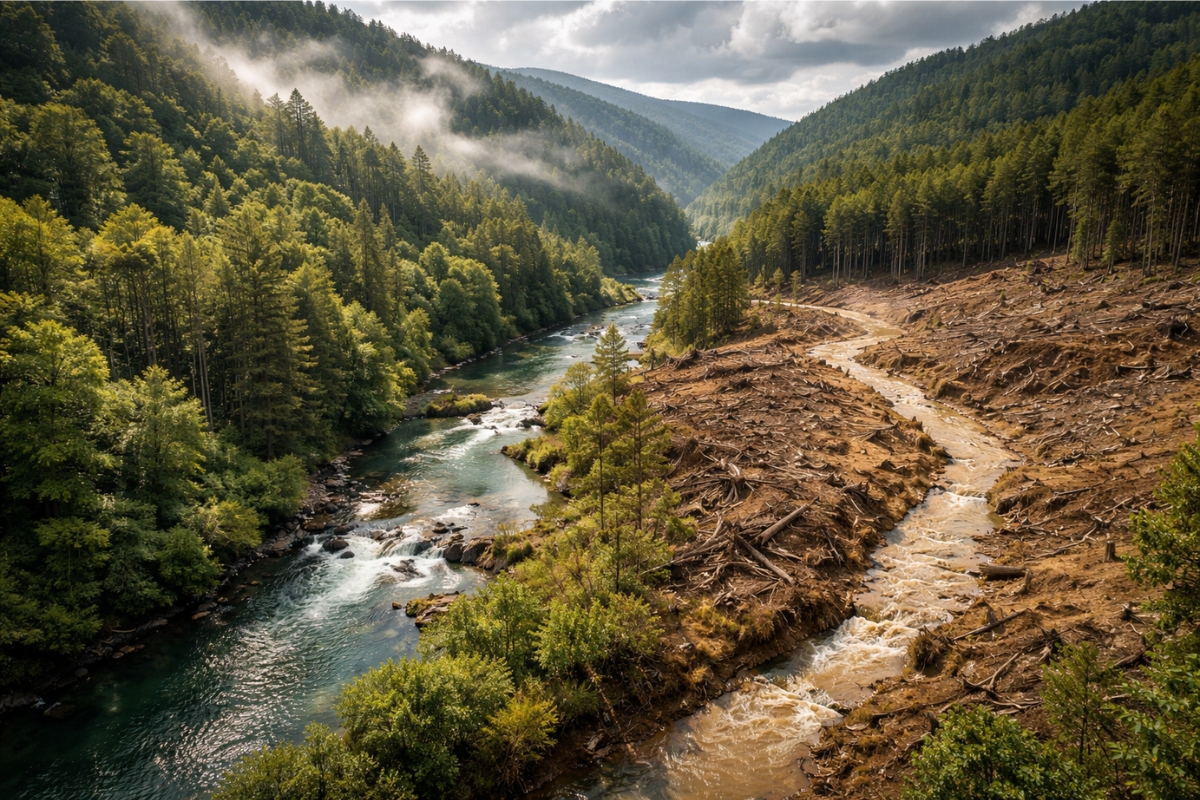
In Regions with High Rainfall Variability, Losing Forest Means Losing Buffering: The Basin Drains Quickly, Stores Little, Supports Less Flow in Drought, and Increases Dependence on Infrastructure and Fine Management of the Territory
An international study led by the University of British Columbia (UBC) concluded that the loss of forests, and their division into disconnected fragments, significantly alters the ability of watersheds to retain and release water. In other words, when tree cover decreases and the landscape becomes more fragmented, the water system starts to store less water.
The work, published in the journal Proceedings of the National Academy of Sciences (PNAS), analyzed data from 657 watersheds distributed across six continents. From this set of information, the researchers identified a consistent pattern: the reduction of forest cover is associated with an increase in what is called “young water,” that is, rainwater or meltwater that quickly passes through the system and runs off before being stored in the soil or recharging aquifers.
The Advancement of Deforestation and the Water Cycle
The research, led by Ming Qiu from UBC, presented quantitative evidence that the advancement of deforestation accelerates the dynamics of water in natural systems.
-
Motorola launched the Signature with a gold seal from DxOMark, tying with the iPhone 17 Pro in camera performance, Snapdragon 8 Gen 5 that surpassed 3 million in benchmarks, and a zoom that impresses even at night.

-
Satellites reveal beneath the Sahara a giant river buried for thousands of kilometers: study shows that the largest hot desert on the planet was once traversed by a river system comparable to the largest on Earth.

-
Scientists have captured something never seen in space: newly born stars are creating gigantic rings of light a thousand times larger than the distance between the Earth and the Sun, and this changes everything we knew about stellar birth.

-
Geologists find traces of a continent that disappeared 155 million years ago after separating from Australia and reveal that it did not sink, but broke into fragments scattered across Southeast Asia.

According to Qiu, the presence of a higher volume of young water indicates that the water resource is moving more quickly through the basin, which reduces its ability to maintain availability during dry periods.
Furthermore, dense and well-connected forests favor water retention for longer periods, while fragmentation and loss of forest mass facilitate rapid runoff.
The reduction of water storage capacity becomes particularly critical in regions where logging is an economic pillar or where there is great variability in precipitation. In these contexts, the availability of water for communities, ecosystems, and productive activities becomes more vulnerable to extreme climate events.

The Importance of Spatial Configuration in Degraded Basins
Unlike previous studies, the research from the University of British Columbia also considered the spatial configuration of the remaining forest areas.
The results indicated that in basins with forest cover equal to or less than 40% or 50%, the way in which the fragments are distributed and the presence of edges, transition zones between forest and open areas, take on a central role.
According to the study, forest edges receive greater solar radiation, exhibit lower humidity, and generate altered microclimates. This can increase evapotranspiration and influence the amount of young water, affecting the water balance of the system.
Thus, fragmentation can both aggravate and mitigate the effects of deforestation, depending on how the fragments are organized in the landscape.
According to Adam Wei, a professor at the Irving K. Barber Faculty of Science at UBC and co-author of the study, “landscape planning can be part of the solution.” He emphasized that forest management strategies need to go beyond the simple opposition between conservation and economic exploitation.
Dense Forests and Spatial Patterns
In landscapes with high forest cover, where forests remain dense and connected, the spatial pattern has less influence on the storage and distribution of water. In these conditions, microclimates tend to be more stable, and the effects of edges on water dynamics are more limited.
Qiu highlighted that the influence of spatial configuration is more relevant when forest cover is already reduced and tends to decrease above certain preservation thresholds.
The analysis showed that in basins with extensive tree cover, the microclimatic changes associated with edges are less pronounced, contributing to greater water resilience in the face of external disturbances.
The study published in PNAS also pointed out challenges for environmental management in a scenario of climate change and increasing pressure on natural resources. The authors warned that conservation and forest exploitation policies must consider not only the quantity of remaining forest but also its structure and distribution in the landscape.
In regions subjected to intensive logging, fragmentation may reduce the efficiency of basins as natural water storage systems, jeopardizing the supply for populations and ecosystems.
In areas with high forest cover, the focus should be on maintaining the connectivity and density of forests in order to preserve the stability of the hydrological cycle.
“Watersheds function as natural water storage systems,” said Qiu. The researcher recommended that territorial planning takes into account both the quantity and arrangement of forest fragments to ensure long-term water security.








-

-

-

4 pessoas reagiram a isso.