





 Portuguese
  English
  Spanish
  3 min of reading
  1 comment


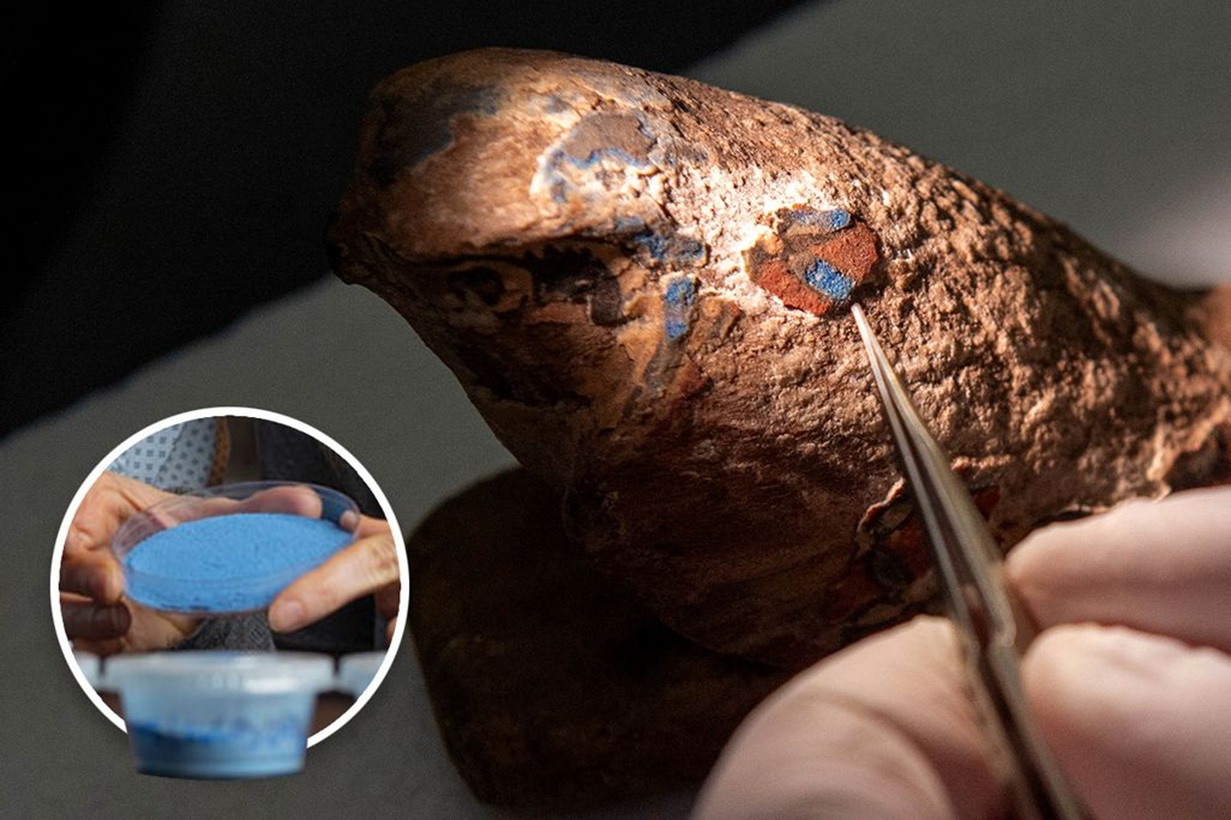


Researchers Recreate Egyptian Blue, The Oldest Synthetic Pigment In The World, Used By Pharaohs, Romans, And Renaissance Artists
Researchers from three major institutions have achieved a rare feat: recreating Egyptian blue, the oldest known synthetic pigment in the world.
Used by ancient civilizations such as the Egyptians and Romans, it disappeared for centuries and is now back based on modern studies.
The Pigment That Crossed Millennia
Egyptian blue was created over 5,000 years ago. Its oldest sample was identified in an alabaster bowl dating to 3250 B.C.
-
Motorola launched the Signature with a gold seal from DxOMark, tying with the iPhone 17 Pro in camera performance, Snapdragon 8 Gen 5 that surpassed 3 million in benchmarks, and a zoom that impresses even at night.

-
Satellites reveal beneath the Sahara a giant river buried for thousands of kilometers: study shows that the largest hot desert on the planet was once traversed by a river system comparable to the largest on Earth.

-
Scientists have captured something never seen in space: newly born stars are creating gigantic rings of light a thousand times larger than the distance between the Earth and the Sun, and this changes everything we knew about stellar birth.

-
Geologists find traces of a continent that disappeared 155 million years ago after separating from Australia and reveal that it did not sink, but broke into fragments scattered across Southeast Asia.

The pigment was common in murals, sculptures, ceramics, and coffins. Despite its name, its shade varied between blue and green, depending on the ingredients used.
After the fall of ancient Egypt, the pigment continued to be used by Romans and Renaissance artists such as Raphael. However, over time, it fell out of use. Now, a new study has revealed how to bring it back.
The Research That Revealed The Ancient Formula
The study was conducted by scientists from Washington State University, the Carnegie Museum of Natural History, and the Smithsonian Museum Conservation Institute. They published the results in the journal NPJ Heritage Science.
The team created 12 different recipes using crystalline silica, copper, calcium, and sodium carbonate. Then, these mixtures were heated to over 1,800 degrees Fahrenheit for up to 11 hours. The result was the formation of pigments with color variations.
According to researcher John McCloy, small changes in the process resulted in significant differences in the final product. All versions had one thing in common: the mineral cuprorivaite.
The Invisible Light That Reveals Egyptian Blue
Egyptian blue has a unique property. It emits infrared light when stimulated by red light.
This characteristic is used by archaeologists to detect its presence in artifacts, even if the pigment is covered by other layers of paint.
According to McCloy, this allows for the identification of areas repaired with different pigments or hidden from the naked eye. The technique was used, for example, to discover that Raphael applied Egyptian blue in a Renaissance work from 1512.
Modern Uses For An Ancient Formula
The rediscovery of the pigment opens up possibilities for current uses. By emitting invisible light, it could serve for security technologies, such as anti-counterfeiting ink or revealing fingerprints.
This connection between ancient art and modern science is what impresses scholars the most. Simon Lewis from Curtin University highlighted the importance of seeking future solutions based on ancient knowledge.
The Composition And Symbolic Value Of The Pigment
The main ingredient of the recreated pigment is cuprorivaite. However, the final shade depends on other materials used in the mixture.
The researchers tested various compositions and compared the results with real pigments found in two artifacts from ancient Egypt.
For archaeologist Moujin Matin, who did not participate in the study, the production of Egyptian blue required a sophisticated context and advanced technologies for the time. He also recalled the symbolic value of the color blue in Egyptian culture, used in religious and everyday representations.
The Return Of A Forgotten Technique
The research revealed not only the ancient technique but also its complexity. Egyptian blue, far beyond its appearance, is an example of how ancient knowledge can still provide answers and inspirations for present days.
The study marks the return of knowledge that had been forgotten for centuries and is now being studied with scientific precision.








Olhar para o passado, pode sim representar um passo adiante no futuro. Que matéria espetacular.