





 Portuguese
  English
  Spanish
  4 min of reading
  0 comments


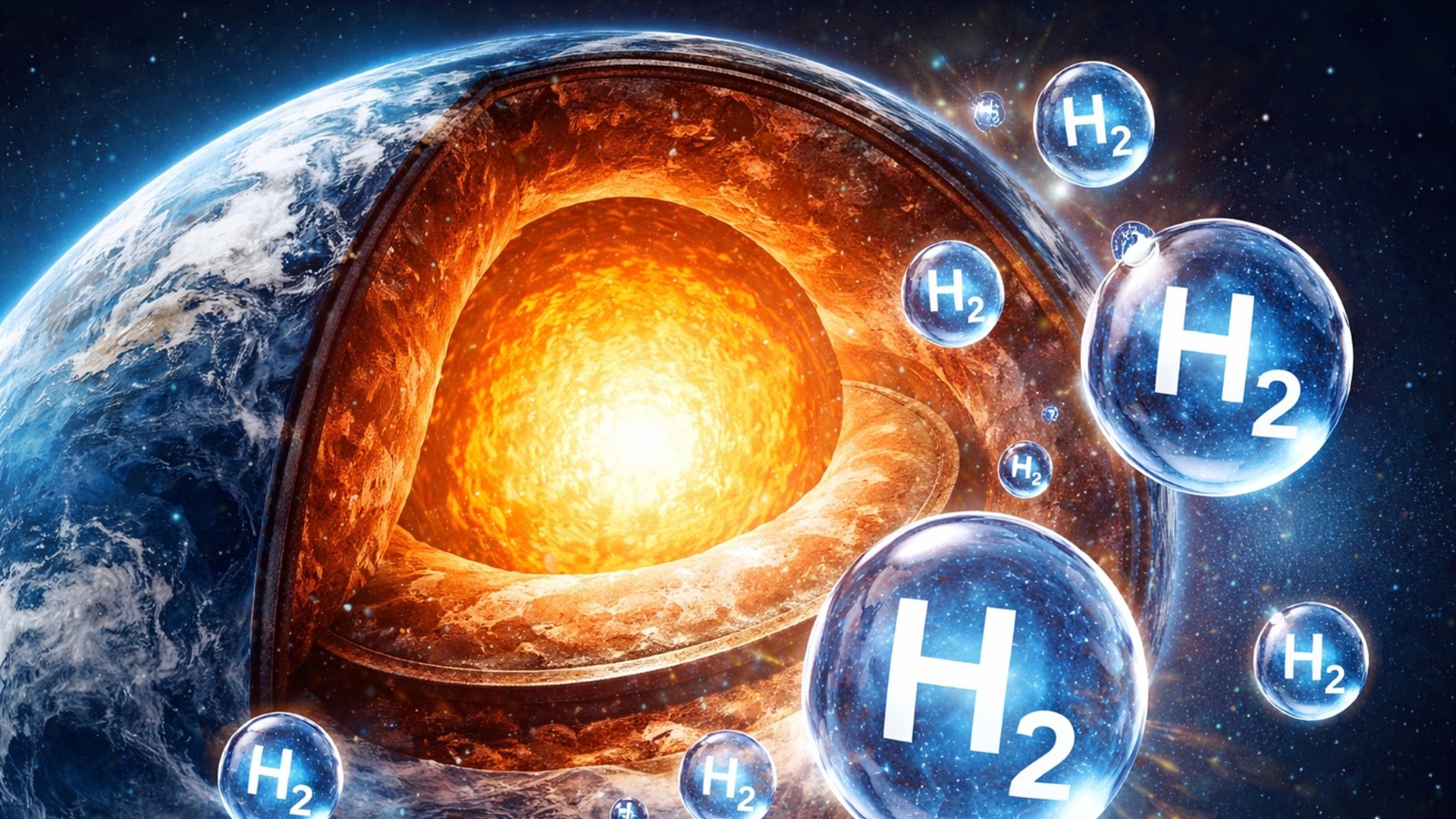
Experiments In Diamond Anvil Cells Under 111 GPa And About 5100 Kelvin Indicate That The Earth’s Core May Contain Between 0.07% And 0.36% Hydrogen By Weight, Volume Estimated Between 9 And 45 Oceans, With Direct Implications For The Origin Of Water On The Planet
Researchers reported that the Earth’s core may store hydrogen equivalent to up to 45 oceans, according to a study in Nature Communications, with estimates between 0.07% and 0.36% by weight, challenging hypotheses about the origin of water on the planet.
Earth’s Core May Contain Hydrogen Equivalent To Up To 45 Oceans
Scientists say that the Earth’s core is primarily composed of iron, but its density does not correspond to that of pure iron. This indicates the presence of lighter elements. The new study supports the hypothesis that the Earth’s core is a significant reservoir of hydrogen.
Published in Nature Communications, the work presents results suggesting the existence of hydrogen equivalent to up to 45 oceans. The conclusions also call into question the idea that most of the planet’s water was delivered by comets in the early stages.
-
Motorola launched the Signature with a gold seal from DxOMark, tying with the iPhone 17 Pro in camera performance, Snapdragon 8 Gen 5 that surpassed 3 million in benchmarks, and a zoom that impresses even at night.

-
Satellites reveal beneath the Sahara a giant river buried for thousands of kilometers: study shows that the largest hot desert on the planet was once traversed by a river system comparable to the largest on Earth.

-
Scientists have captured something never seen in space: newly born stars are creating gigantic rings of light a thousand times larger than the distance between the Earth and the Sun, and this changes everything we knew about stellar birth.

-
Geologists find traces of a continent that disappeared 155 million years ago after separating from Australia and reveal that it did not sink, but broke into fragments scattered across Southeast Asia.


Nature Communications (2026). DOI: 10.1038/s41467-026-68821-6
Challenges In Analyzing The Earth’s Core
The extreme conditions and the distance from the Earth’s core hinder direct analysis of its composition. Many techniques are inadequate for detecting hydrogen, being the lightest and smallest element.
Previous estimates used indirect methods, such as inferring the presence of hydrogen from the expansion of the crystalline network in iron hydrides. These limitations generated estimates with a variation of four orders of magnitude.
Laboratory Simulation Under 111 GPa And 5100 Kelvin
The team adopted an experimental approach with diamond anvil cells heated by lasers to simulate the conditions of the Earth’s core. The experiments reached up to 111 GPa and about 5100 Kelvin.
Iron samples similar to those in the Earth’s core and hydrated silicate glass, representing the primordial magma oceans, were used. The goal was to induce melting under conditions comparable to those found deep within the planet.
3D Tomography Identifies Silicon, Oxygen, And Hydrogen
After the experiments, the researchers applied atomic probe tomography, known as APT, to produce a three-dimensional compositional map with nanometric resolution. The technique allowed for the identification of silicon, oxygen, and hydrogen in the samples.
Nanoscale structures rich in Si-OH formed during rapid cooling were also observed. The molar ratio of silicon to hydrogen in these structures was close to 1:1, a consideration deemed central for the estimates.
Based on this relationship and the relatively known amount of silicon in the Earth’s core, scientists estimated that the hydrogen content varies between 0.07% and 0.36% by weight. This range corresponds to approximately 9 to 45 oceans of water.
Implications For The Origin Of Water And Oceans
One of the main implications of the study is the suggestion that much of the Earth’s water was acquired during the planet’s initial accretion. In this scenario, hydrogen would have interacted with oxygen during the formative stages.
This contrasts with the theory that most of the water originated from later cometary inputs. If hydrogen had been mainly delivered by comets, one would expect its concentration to be in the surface layers.
The presence of a significant reservoir in the Earth’s core indicates, according to the authors, that hydrogen was likely incorporated before the complete formation of the core. The model is compatible with interaction between the primordial atmosphere and magma ocean.
The researchers claim that the scenario is also consistent with the hypothesis that the Earth was formed predominantly from materials similar to enstatite chondrites, which contain sufficient amounts of hydrogen to supply over three oceans.
Limitations And Uncertainties Raised By The Team
The authors warn that the study has limitations. Residual hydrogen in the APT chamber may have artificially inflated the measured content. There are still uncertainties related to the silicon content in the Earth’s core.
The assumption of sufficient hydrogen during accretion also represents a relevant variable. Additionally, sample fractures may have generated errors in data collection by APT.
Despite these restrictions, the results offer a new estimate based on direct experimental simulations under high-pressure and high-temperature conditions, helping to reduce the wide variation of previous estimates.
The study emphasizes that understanding the composition of the Earth’s core is essential to explain the distribution of hydrogen and the formation of oceans. Nonetheless, the authors acknowledge that further analyses are needed to confirm the presented values and reduce the identified uncertainties.
This Article Was Based On A Study Published In The Journal Nature Communications And On Information Provided In The Base Material, Including The Analysis Conducted By The Research Team Using Diamond Anvil Cells And Atomic Probe Tomography.








Seja o primeiro a reagir!