





 Portuguese
  English
  Spanish
  4 min of reading
  0 comments


Researchers From Johns Hopkins Test Microbes Under Up to 3 Gigapascals, Reveal Unexpected Resistance and Raise Global Alert About Planetary Contamination and Origin of Life
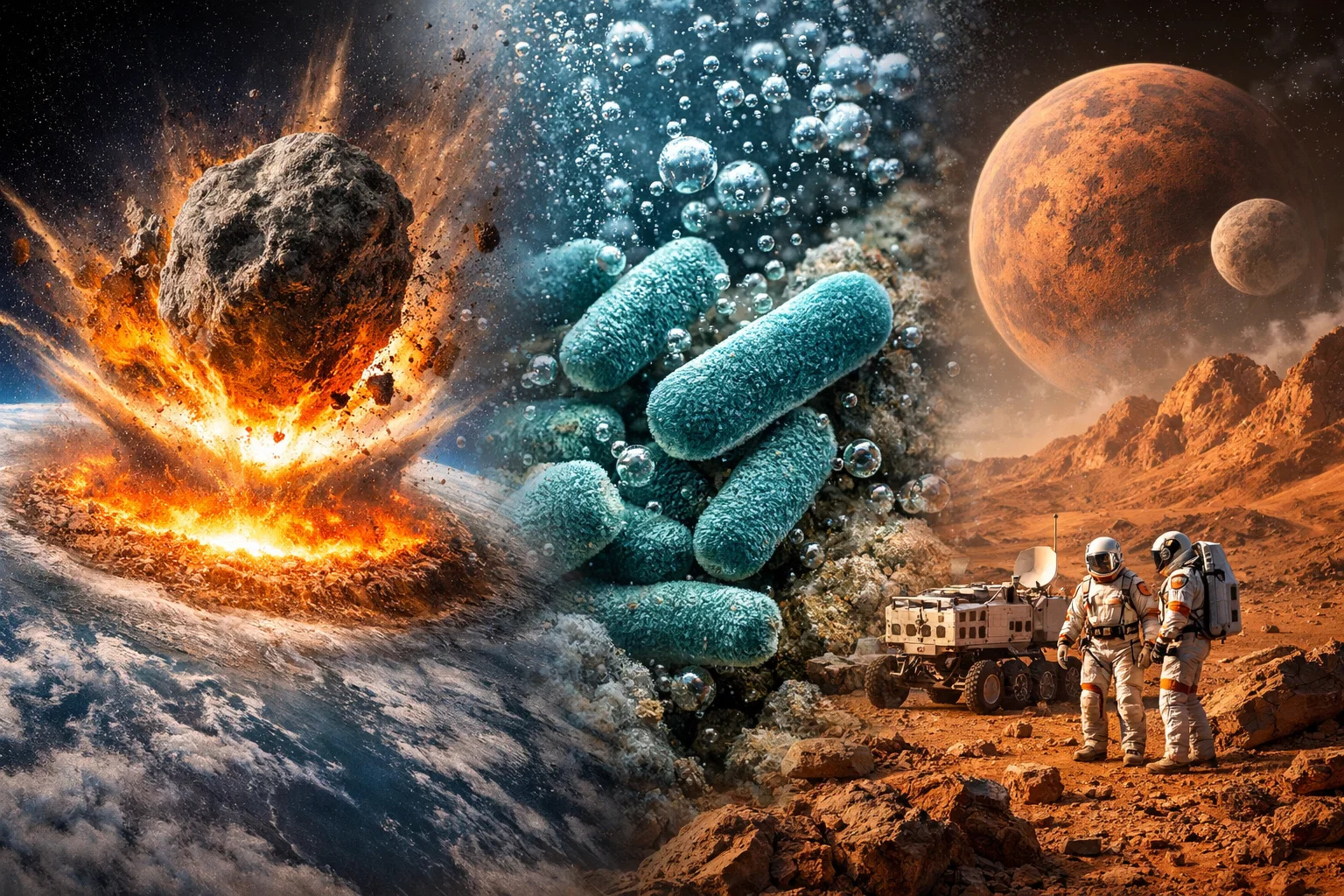
A space collision may not be the end of life. It may be the beginning of a journey. Researchers at Johns Hopkins University placed bacteria under pressures similar to those of an asteroid impact. The expectation was simple: nothing would survive. The result was different.
Some of the microbes survived. And that changes the game in the space industry.
The Impact That Seemed Impossible to Overcome and the Suspicion That Life Can Cross the Solar System
When an asteroid hits a planet like Mars, the explosion sends rock fragments into space. Some of these pieces can travel millions of kilometers.
-
With a cost per shot close to zero, the DragonFire laser could change naval warfare in 2027 and provide British ships with nearly unlimited defense against drones.

-
A British startup creates tires that generate electricity in electric vehicles when passing over potholes, speed bumps, and cracks.

-
Scientists have created robots made with living cells that have their own nervous system, swim on their own, explore the environment, and self-organize without any genetic engineering, and now they want to do the same with human cells.

-
Students create a solar-powered ambulance that operates without a plug, without fuel, and still keeps medical equipment running in remote areas.


The question has always been direct: if there is microscopic life on the impacted planet, would it withstand the brutal force of the collision?
The study shows that, at least in part, yes.
To understand the scale, scientists recreated pressures between 1 and 3 gigapascals. At the bottom of the Mariana Trench, the pressure is around 0.1 gigapascal. That means the test surpassed the most extreme environment in the oceans by more than ten times.
And yet, microbes remained alive.
The Engineering Experiment That Pitted Bacteria Against a High-Speed Gas Gun
The test was straightforward. Researchers positioned the bacteria between metal plates and fired a projectile using a gas gun.
The speed reached 480 kilometers per hour, generating a shock similar to that of a space impact.
At pressures close to 1.4 gigapascals, nearly all survived. At around 2.4 gigapascals, an average of 60 percent resisted. At higher levels, some cellular structures were damaged, but many organisms remained viable.
According to the experts involved, the initial expectation was that the bacteria would not survive even the first shot.
They did survive.
The Almost Indestructible Bacterium That May Resemble Possible Martian Life
The chosen organism was Deinococcus radiodurans, known for withstanding intense radiation, extreme cold, and dry environments.
It has a thick outer structure and an efficient internal repair system. Characteristics that, according to researchers, could be similar to those of potential life on Mars.
It is worth noting that Martian meteorites have already been found on Earth. In other words, fragments of the red planet have arrived here naturally.
The question that starts to echo is inevitable: did something come along?
The Domino Effect in the Space Industry and the Alert in Planetary Protection
The discovery does not only stir scientific curiosity. It directly impacts aerospace engineering and international protocols.
Space agencies adopt strict rules to prevent contamination when sending probes to Mars and bringing samples back. But the study suggests that nature may have already made this exchange over billions of years.
Major impacts on Mars can generate pressures close to 5 gigapascals, according to estimates. However, not all fragments experience the same intensity.
This means that some rock pieces could leave the planet carrying still viable microorganisms.
And if this has already happened, the origin of life may be less isolated than previously thought.
What This Discovery Could Change in the Space Race and Future Mars Missions
The research thus opens a delicate front.
If microbes can survive violent ejections, future missions need to pay extra attention. Contamination is not just a theoretical risk.
According to experts, it may be necessary to revise protocols when exploring Mars’ moons, such as Phobos, which may receive ejected fragments with lower pressures than those required to reach Earth.
Furthermore, researchers intend to test whether repeated impacts can select even more resistant organisms and whether other beings, like fungi, would also withstand these conditions.
The space industry, which is already in an intense competition for leadership in planetary exploration, may therefore have to recalibrate its next steps.
The idea that life may thus circulate throughout the solar system is no longer just science fiction. It now has experimental backing.
If microbes can traverse space trapped in rocks launched by cosmic collisions, the boundary between planets may be less rigid than it seemed. And, thus, this explains why the study has garnered so much attention in the field of space engineering and Mars exploration.
What do you think: could life have arrived on Earth from another planet? Share your opinion in the comments.







-

-

2 pessoas reagiram a isso.