





 Portuguese
  English
  Spanish
  5 min of reading
  0 comments


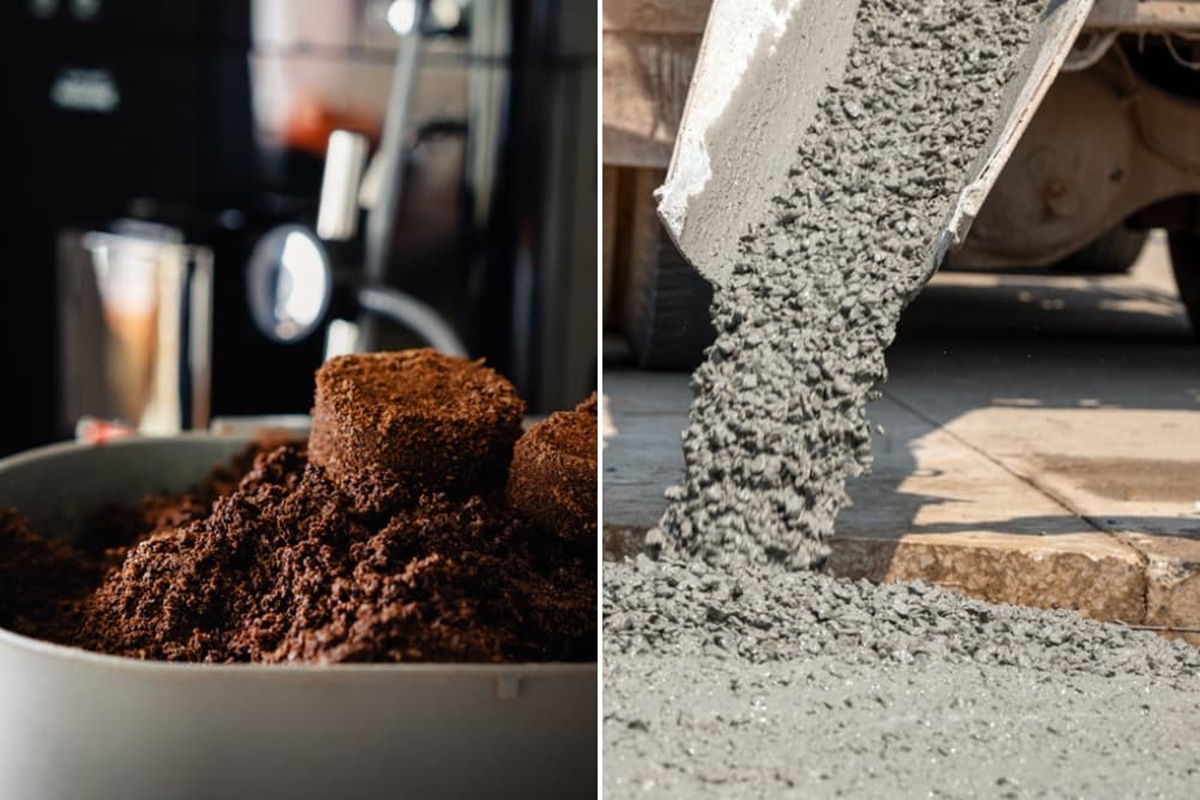
Coffee grounds, once seen just as disposable waste, can become a powerful ally for the construction industry. Researchers at RMIT University in Australia have developed an innovative concrete that incorporates this material and reaches 30% greater strength. The discovery combines sustainability and efficiency, reducing pressure on landfills and avoiding the predatory extraction of sand, one of the most exploited resources in the construction sector.
Engineers at RMIT University in Australia have developed an innovation that blends sustainability and civil engineering: concrete made with coffee grounds.
The material achieves up to 30% greater strength in laboratory tests and has already begun to be tested on streets and sidewalks in the country.
The research, initially published in the Journal of Cleaner Production, showed that transforming this common waste into biochar — through a process called pyrolysis — can change the landscape of the construction industry. Now, with real-world applications and recognition awards, the idea has moved beyond being merely theoretical.
-
Motorola launched the Signature with a gold seal from DxOMark, tying with the iPhone 17 Pro in camera performance, Snapdragon 8 Gen 5 that surpassed 3 million in benchmarks, and a zoom that impresses even at night.

-
Satellites reveal beneath the Sahara a giant river buried for thousands of kilometers: study shows that the largest hot desert on the planet was once traversed by a river system comparable to the largest on Earth.

-
Scientists have captured something never seen in space: newly born stars are creating gigantic rings of light a thousand times larger than the distance between the Earth and the Sun, and this changes everything we knew about stellar birth.

-
Geologists find traces of a continent that disappeared 155 million years ago after separating from Australia and reveal that it did not sink, but broke into fragments scattered across Southeast Asia.

The Environmental Problem of Coffee Grounds
Coffee grounds, known by the acronym SCG (spent coffee grounds), are the byproduct that generates the most waste throughout the coffee industry. Estimates suggest that every year, 27 million kilograms of this material end up in landfills.
The decomposition of the waste exacerbates the climate scenario because it releases carbon dioxide and methane, two high-impact greenhouse gases.
Moreover, there is another serious problem linked to concrete: the extraction of natural sand, which is used on a large scale as fine aggregate in the mix.
According to scientists, the construction industry alone consumes about 55 billion tons of sand per year, much of it taken from rivers and banks.
The result is environmental degradation, ecosystem imbalance, and increasing pressure on natural resources. Finding a sustainable substitute has become an urgent goal.
The Solution Created in Melbourne
Seeking to address these two issues simultaneously, the group led by Professor Rajeev Roychand decided to transform the grounds into biochar.
The process involves heating the waste without oxygen, causing the organic molecules to decompose into smaller and stable elements.
To conduct the first tests, engineers collected grounds from cafés in Melbourne, dried the powder, and heated it to two different temperatures: 300 °C and 500 °C. The result was a lightweight material similar to charcoal. This biochar was then incorporated into Portland cement as a partial substitute for natural sand.
After shaping, removing air bubbles, and letting it dry, researchers tested twelve combinations. The standout came from the version where 15% of the sand was replaced by biochar heated to 300 °C: this mixture showed almost 30% greater compressive strength.
Why Pyrolysis Is Crucial
The results were attention-grabbing, but they also brought an important observation. When coffee grounds are used untreated, organic compounds leach out and interfere with the hydration of the cement, compromising the structure.
Pyrolysis proved essential for stabilizing the material, creating a biochar that integrates into the concrete without disrupting its chemical reactions. This detail explains the performance leap.
According to co-author Mohammad Saberian, the team’s previous experience in developing wood, food waste, and agricultural biochar helped identify the ideal point for the coffee-based version.
Double Benefits for the Construction Industry
The technology offers advantages on two fronts. The first is technical: a more durable and stronger concrete. The second is environmental: less waste in landfills and less pressure on the predatory extraction of sand.
In practice, this means reducing emissions of harmful gases, preserving rivers and fragile ecosystems, and creating space for a circular economy in which common waste gains added value.
This combination has made the project attractive not only to engineers and scientists but also to public bodies interested in applying the solution in real projects.
From the Laboratory to the Streets
The first field test took place in May 2024, in Gisborne, Victoria. The team constructed sections of sidewalk using different mixtures: one with coffee biochar, another with wood biochar, and a third with traditional concrete.
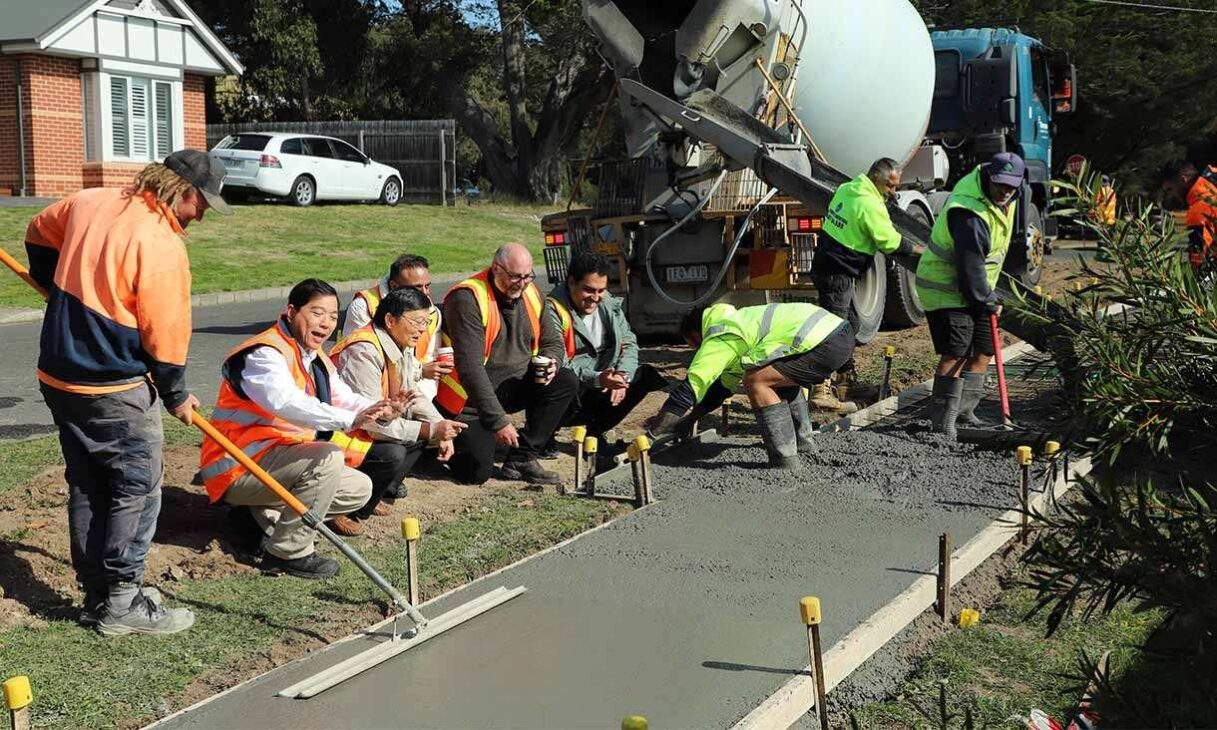
For residents, there was no visible or perceptible difference in use. But for researchers, the experience was valuable: for the first time, coffee concrete faced weather conditions, pedestrian traffic, and real wear and tear.
This step confirmed that the concept was not limited to the laboratory. It could be incorporated into the daily infrastructure.
Challenges Faced
In the scaled production process, the pyrolysis plant failed to maintain the ideal temperatures (such as the 350 °C needed for optimal performance).
Without this fine control, the biochar produced did not achieve the same properties obtained in the laboratory.
The result was a concrete with performance similar to traditional concrete, without the 30% gain observed in controlled tests.
The experience highlighted a reality: scalability and logistics bottlenecks need to be resolved for the technology to fulfill its full potential.
Publication and Comparisons
In July 2025, researchers published in the journal Case Studies in Construction Materials a study detailing the results of the field tests.
They compared coffee concrete with control concrete in terms of compressive strength, shrinkage, and flexural strength. They concluded that the performance was acceptable, but below the maximum observed in the laboratory.
The reason: difficulties in producing biochar at industrial scale, especially in temperature control.
Still, the fact that there is already real application and comparative analyses represents a rare and fundamental advancement for the field.
Recognition and Awards
The innovation also received acclaim. In February 2025, the team won the Problem Solver award at the Shaping Australia Awards, in the audience choice category.
The initiative highlighted the social and environmental impact of the research and valued the proposal to transform a disposable waste into a solution for construction challenges.
Perspectives and Challenges
The results show both the promises and the obstacles. In the laboratory, the 30% gain is proven. In the field, the material still needs to overcome technical limitations to replicate that performance.
Producing biochar at scale is the main bottleneck. Without robust equipment that ensures ideal pyrolysis temperatures, the structural reinforcement does not reach its full potential.
Another gap lies in durability: there is still insufficient data on how this concrete reacts over the long term under adverse conditions, such as freeze-thaw cycles, humidity variations, or heavy traffic.
Ecological Impact and Dimension
Despite the challenges, the potential environmental impact is enormous. Using coffee grounds in concrete addresses three fronts at once:
- Less waste in landfills, reducing methane and CO₂ emissions.
- Less sand extraction, alleviating pressure on rivers and banks.
- More circular economy, turning waste into valuable input.
In Australia alone, it is estimated that 75 million kilograms of coffee grounds are generated each year. If replicated on a global scale, the solution could significantly reduce sand exploitation and give new destinations to tons of organic waste.
Coffee concrete shows how science and sustainability can go hand in hand. From the laboratory bench to the sidewalks of Victoria, the idea has moved beyond theoretical phases and achieved real application.
There are still hurdles — mainly technical and logistical — but the path opened points to a future where coffee can strengthen not only those who drink it but also the buildings around the world.
What was once waste now emerges as a raw material for greener, stronger, and more innovative engineering.








-

-

4 pessoas reagiram a isso.